UK teams usually hire model makers when drawings and renders are not enough to explain a scheme clearly. A strong physical model helps people grasp massing, context, routes, phasing and design intent faster than a flat board can.
### TL;DR: Summary
* UK teams should hire model makers when a proposal needs clearer spatial understanding for planning consultation, client approval, investor presentation or exhibition display.
* GOV.UK guidance explicitly recognises 3D models, interactive visualisations and digital storytelling as tools that help the public understand proposals, which makes model makers especially useful in pre-application engagement and formal consultation support.
* The best model maker is not just a fabricator. Look for a supplier that can define purpose, advise scale, build context, manage lighting, control packing and installation, and explain its production workflow from brief to delivery.
* Physical models and digital tools are not substitutes in most planning work. If you need room-based discussion and instant visual comprehension, choose a physical model; if you need wider reach and response collection, add digital consultation tools as well.
* Check concrete delivery proof before appointing anyone: relevant project type, workshop capacity, in-house technologies, quality control steps, cross-border logistics and clear quotation detail on scale, materials, lead time and installation.
Not all model makers solve the same problem. The right choice depends on what the model must do, who needs to use it, and whether the model is supporting consultation, sales, design review or public communication.
When do model makers add real value to a UK project?
Yes. In UK planning, model makers add the most value when a scheme is hard to read from plans alone and when consultation, client approval or exhibition viewing depends on quick spatial understanding. GOV.UK guidance treats 3D models as a valid way to help the public understand proposals.
This is most obvious in masterplanning, mixed-use development, transport-adjacent sites and complex urban infill. If a proposal changes sightlines, density, access routes or the relationship between existing and proposed buildings, a physical model can reduce ambiguity very quickly. That matters in pre-application engagement, public exhibitions and investor presentations.
"ARI Model says it has produced over 499 models across 17 countries since 2000."
A common mistake is treating a model as a decorative extra. In practice, the model is most useful when it helps people compare options, test responses and understand a specific scheme in context, not when it simply sits in a reception area.
Should you choose physical model makers or digital visualisation for planning consultations?
Choose both when budget allows. Physical models support shared discussion in the room, while digital visualisation and consultation platforms extend reach beyond the event itself. GOV.UK guidance supports this mixed approach.
A physical model is strong when several people need to look at the same object and ask location-based questions at the same time. People can point to routes, corners, setbacks and neighbouring buildings instantly. That makes physical work especially useful for community meetings, committee preparation and sales suite discussions.
Digital tools do something different. GOV.UK notes that digital tools can significantly increase the number of people engaged, and that community engagement platforms can support early engagement, formal consultation and response analysis. The key trade-off is simple: if you need reach, filtering and response capture, digital wins; if you need immediate spatial comprehension in a room, a physical model usually wins.
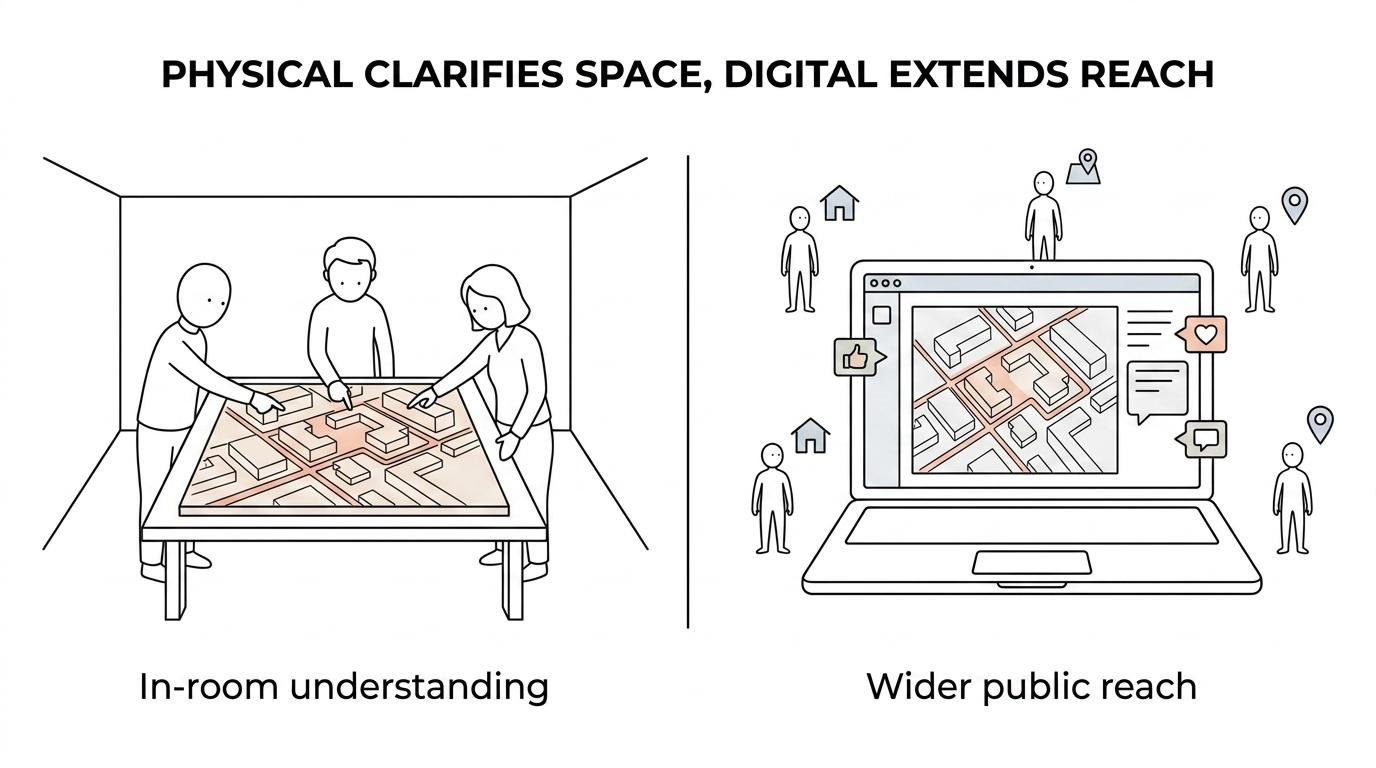
The misconception is that one replaces the other. GOV.UK also states that digital tools do not replace statutory requirements or offline engagement methods, so a blended consultation setup is often the safest choice.
What are the main types of model makers UK teams hire?
There are several distinct categories of model makers, and the best fit depends on the scheme, audience and deadline. Architectural planning teams, industrial firms and exhibition organisers often need very different capabilities.
- Full-service architectural and industrial studios: ARI Model is an example of a supplier that covers design review, material selection, fabrication, lighting, delivery and installation across architectural and industrial work.
- Competition and planning model specialists: These makers focus on concept communication, planning boards, massing studies and public consultation pieces.
- Exhibition and sales model builders: These teams prioritise presentation finish, lighting, transport resilience and repeated use at events or in showrooms.
- Product and industrial prototype model makers: These workshops are better when the brief involves machinery, components, process layouts or functional prototype communication.
- Artisan craft workshops: These makers can be excellent for one-off display pieces, heritage subjects or highly manual finishes, though capacity and repeatability may be narrower.
The useful question is not who is “best” in the abstract. It is who has the closest match to your use case, scale range, finish standard and logistics risk.
How should you brief model makers for a planning or exhibition model?
Start with the decision the model must support. Architects and developers get better results when the brief defines audience, use case and message before discussing materials or aesthetics.
First, define the purpose in one sentence. Is the model for consultation, committee preparation, investor approval, a trade show, or a sales suite? If the answer is consultation, include surrounding context and public-facing landmarks. If the answer is sales, the emphasis may shift towards finish, lighting and branded presentation.
Next, lock the content boundary. Decide what is existing, what is proposed, what must be removable, and what can be simplified. This is where many projects go off course. A common error is sending full BIM or CAD data without saying what the audience actually needs to see.
Then, give the maker a clean decision package: site plan, massing files, required scale, venue constraints, delivery date, and any transport limitations. Pro tip: mention the final viewing distance early. A model seen from 2 metres away needs a different detail strategy from one handled at close range in a client room.
ARI Model describes a workflow that starts with evaluating customer needs and then moves through design, material selection, fabrication, lighting, quality control, delivery, installation and after-sales support.
"ARI Model describes a process from needs evaluation to delivery, installation and after-sales support."
Is a handcrafted model or a CNC and 3D printing workflow better?
A hybrid workflow is usually better. CNC cutting, laser processing and 3D printing improve repeatability, while hand assembly and finishing still matter for presentation quality. ARI Model lists CNC, laser, FDM, PolyJet, SLA and SLS among its production tools.
Handcrafted work can look warm, controlled and highly legible, especially in timber or monochrome architectural presentation models. It is often the right choice when the design language depends on clean abstraction rather than ultra-fine texture.
Digital fabrication becomes stronger when geometry is repetitive, highly detailed or time-sensitive. CNC and laser workflows handle terrain, façades and acrylic components efficiently. SLA or PolyJet can help with fine parts, while SLS can suit robust geometries. The misconception is that 3D printing alone guarantees a better model. It does not. Print quality, orientation, support cleanup and paint finish all affect the final result.
If your scheme needs many repeated buildings, tight tolerances or replacement parts, digital fabrication is usually the practical route. If the aim is a refined boardroom piece with selective abstraction, more hand finishing may be the better balance.
What should you ask about scale, materials and lighting before production starts?
Ask for scale logic, material rationale and lighting intent before approving fabrication. A good model maker should explain why 1:500, acrylic or internal LED lighting fits your brief, not just list them.
The most useful questions usually cover these points:
- Scale: Is this a 1:1000 context model, a 1:500 masterplan, a 1:200 building study or a 1:50 interior or façade presentation?
- Materials: Will the model use acrylic, timber, resin, printed polymers or mixed media, and how will those materials affect durability and finish?
- Lighting: Is lighting decorative, instructional or both, and will it highlight circulation, unit mix, phasing or landmark elements?
- Context treatment: How will existing buildings, landscape and roads be differentiated from proposed works?
- Access and maintenance: Will roofs, blocks or landscape sections be removable for transport, cleaning or content updates?
The right answers depend on audience and venue. If the model will travel, lighter materials and robust joins matter more. If it will stay in a permanent sales space, lighting control and presentation finish may matter more. Pro tip: ask to see how cables, switches and power supplies are hidden before sign-off.
How do lead times, packing and installation usually work?
Lead times are driven by design freeze, not just workshop speed. Fabrication, lighting tests, quality control, crating and venue installation all need planned time, especially for large architectural models.
A sensible sequence starts with file review and scope lock. Once geometry, scale and finishes are approved, fabrication begins. After that comes assembly, lighting integration if required, final checks and photography or approval review. The final phase is not just shipping. It includes protective crating, handling instructions, site access checks and installation planning.
This is where commercial risk often hides. If the model is made outside the UK, ask who manages customs paperwork, transit insurance and venue delivery terms. If the venue has restricted loading hours or narrow lifts, the maker should plan modular assembly from the start. A small buffer before the event date is wise because lighting tests and transport contingencies are rarely optional.
How do you check whether a model maker can actually deliver at scale?
Check tangible delivery proof, not broad claims. Workshop space, in-house machinery, repeatable process and cross-border logistics tell you far more than a polished gallery page.
Start with capacity. Ask what is produced in-house, what is outsourced, and how quality control is handled between stages. Then check relevance. A maker that excels at one-off display miniatures may not be the right choice for site-specific masterplanning or industrial demonstration models.
Next, look for operational proof. ARI Model states that it operates 1,000 m² of workshops in France and Germany and added a German workshop in 2023. Facts like that do not guarantee fit, but they do help you assess whether the supplier is set up for volume, specialist processes and international delivery.
"ARI Model operates 1,000 m² of workshops in France and Germany, with a German workshop added in 2023."
Finally, test the process with practical questions. Who checks files before cutting? How are fragile parts packed? Can lighting be serviced after delivery? If a maker answers these clearly, the operational foundation is usually sound.
Which warning signs show a model maker is the wrong fit?
Clear warning signs appear early. Weak briefing questions, vague quotations and no logistics detail usually indicate risk before any fabrication starts.
Watch for these signals:
- No questions about audience, consultation use or viewing distance
- A quotation that omits scale, materials, lighting scope or delivery terms
- No explanation of how existing and proposed elements will be distinguished
- An all-purpose recommendation for one method regardless of project type
- No clear answer on packing, installation or after-sales support
The deeper issue is not style. It is process discipline. If a model maker cannot explain why a certain scale, workflow or transport method fits your scheme, you may end up paying for a visually attractive object that does not answer the project’s real communication need.