A realistic production schedule is one of the first questions behind any model brief. Before materials are chosen or detailing begins, clients usually want to know when the model will be ready, what might slow it down, and which decisions make the biggest difference.
The honest answer is that model production is never one-size-fits-all. A compact presentation model for a single building can move quickly. A large urban planning display, a highly detailed industrial prototype, or an illuminated exhibition piece will need more time. At ARI Model, the published project examples show just how wide that range can be, and why careful planning matters from day one.
Typical model production times for professional model making
Publicly available project information from ARI Model shows verified production times ranging from 15 days to 60 days for architectural model work. That is the clearest published benchmark available from the company’s own project pages.
A useful way to read those figures is not as a fixed promise, but as a grounded range based on real jobs. One published example, a 1:200 office building model for MERCK, was produced in 15 days. Another published example, the Pendik model for KILER GYO, took 60 days and involved eight employees during the production period. Those two references give a practical picture of how fast a controlled-scope model can be, and how long a larger, more demanding commission may require.
For many clients, that means a rough expectation of two to eight and a half weeks is sensible at the enquiry stage, before the brief is fully defined. Once the scope is clear, the schedule becomes far easier to predict.
| Model example or type | Published time | What the timeline suggests |
|---|---:|---|
| 1:200 office building presentation model | 15 days | A focused brief, moderate scale, presentation-led scope |
| Large, detail-heavy architectural showcase model | 60 days | Greater complexity, more manual work, broader team input |
| Urban planning model | Not publicly standardised | Timeline depends on site size, landscaping, buildings, lighting |
| Industrial or prototype model | Not publicly standardised | Timeline depends on geometry, testing needs, finish, fabrication method |
That range matters because it sets the right expectation early. A model can be produced quickly, but speed depends on scope discipline, decision-making, and the right production methods.
Main factors that affect model production time
Production time is shaped by far more than model size alone. The schedule is really the result of design choices, visual ambition, and practical constraints.
The first major factor is scale. A larger scale reveals more. More becomes visible, more has to be fabricated, and more surfaces need finishing. A building at 1:200 can be presented clearly with selective detail, while a model at 1:100 or larger often demands a much richer treatment of façades, interiors, landscape elements, and circulation zones.
The second factor is detail level. A conceptual massing model is a very different task from a sales-suite centrepiece. If the brief includes planting, people, cars, furniture, illuminated interiors, street textures, water features, or removable sections, the production window naturally expands.
After those two, the process is often shaped by a combination of material choices and presentation requirements:
- scale and footprint
- façade complexity
- lighting systems
- landscaping content
- transport constraints
The intended use also changes the timing. A model for internal planning may prioritise clarity and speed. A model for a property launch, investor presentation, museum setting, or trade fair usually needs more finish, more durability, and stricter quality control before handover.
Materials and fabrication methods in model production schedules
Materials influence both visual character and production rhythm. ARI Model works with traditional workshop methods and advanced digital fabrication, and that mix is often what makes an efficient schedule possible.
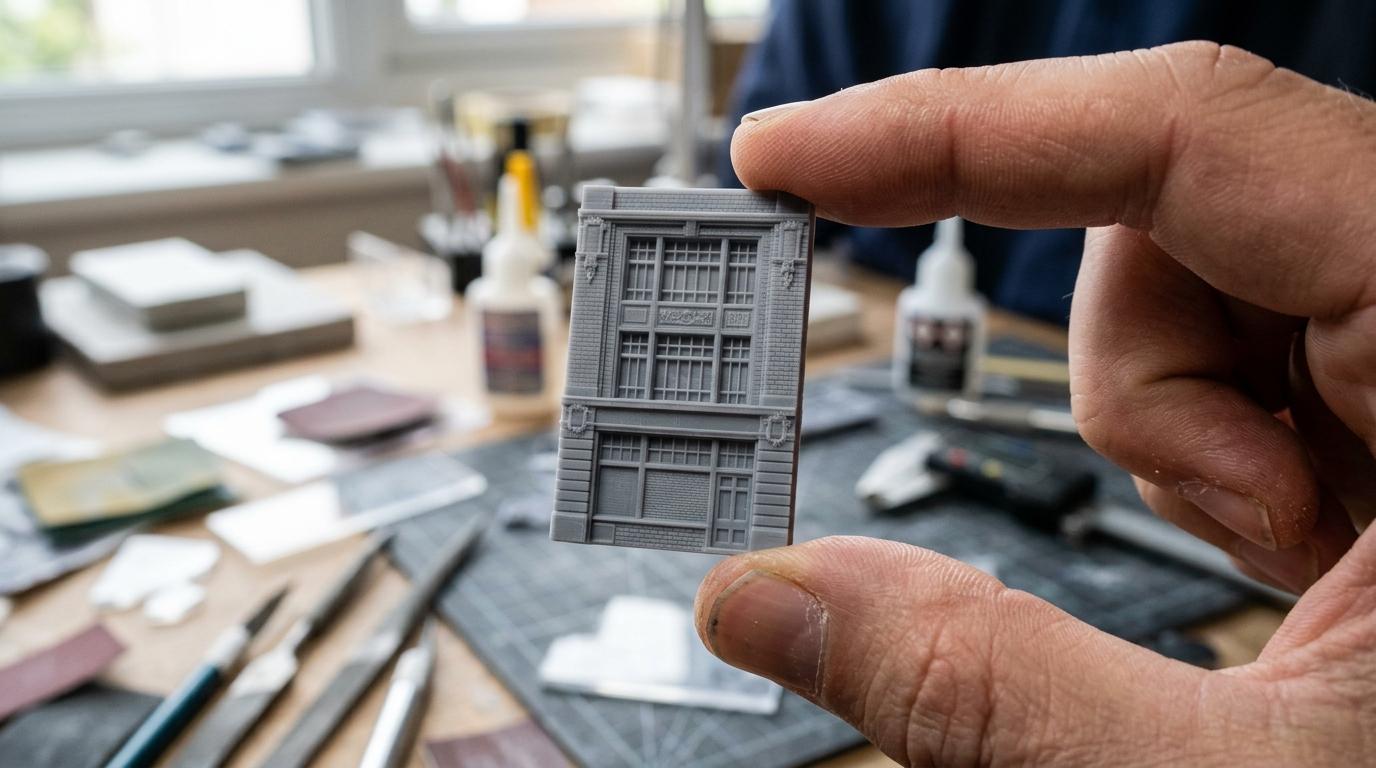
Wooden architectural models can require careful cutting, sanding, assembly, and finishing. They are often chosen when clients want permanence, elegance, and strong physical presence. Plastic components and laser-cut parts can support fine detailing with strong repeatability. CNC machining can accelerate precise structural elements. 3D printing is especially valuable for complex geometries, custom façade modules, and prototype parts that would be slow to build by hand.
Even so, digital production does not make time irrelevant. A printed part still has to be prepared, checked, cleaned, finished, assembled, and integrated into the larger model. The benefit is control, precision, and efficiency in the right areas, not instant completion.
A practical schedule usually depends on combining methods intelligently rather than relying on a single technique.
A realistic model production workflow and schedule
Once a project starts, production tends to move through several linked stages. Some are fast. Some absorb more time than expected, especially if decisions change midstream.
A typical workflow can include briefing, scale definition, file review, technical preparation, fabrication, assembly, finishing, lighting integration, quality control, packing, and delivery. On simpler projects, some of these stages overlap. On more ambitious ones, each stage needs its own buffer.
This is where many clients gain clarity: the clock is not only ticking during fabrication. Time is also spent preparing the work so fabrication can happen efficiently and accurately.
A realistic workflow often looks like this:
1. Brief and file review
2. Scale, scope, and finish confirmation
3. Technical preparation and production planning
4. Fabrication of parts
5. Assembly and surface finishing
6. Lighting, interaction, or special features
7. Quality control, packing, transport, and installation
That sequence explains why a project with a short fabrication phase can still need a sensible lead time. If the model has to travel internationally, the final days before dispatch are especially important.
Client approvals and deadline pressure in model production
One of the least visible timeline factors is the approval process. Even when workshop production is moving well, the overall delivery date can shift if files arrive late, design revisions continue during fabrication planning, or finish decisions remain open.
This is common in architecture, development, and exhibition work because the model often sits inside a larger programme. Marketing teams may still be refining branding. Architects may still be updating façade details. Event teams may still be confirming stand dimensions or transport windows.
A strong schedule usually depends on early agreement about a few key points:
- Approved files: final drawings, 3D data, and site references
- Fixed scope: what is included, omitted, or simplified
- Display purpose: planning tool, sales model, exhibition piece, or prototype
- Delivery target: production deadline, shipping date, and installation date
When those decisions are made early, the production team can allocate time with confidence and avoid the stop-start effect that slows good work.
How different model types change the model production timeline
Not every model asks for the same kind of labour. This is where comparisons become helpful.
A competition model may need to communicate design intent clearly and quickly, often under a hard submission date. A sales model for real estate marketing may require warmer materials, lighting, branded presentation, and refined landscaping. An urban planning model can be physically large even when individual structures are simplified. An industrial model or prototype may need mechanical precision, removable elements, cutaways, or repeated testing before sign-off.
That difference can be summarised quite simply:
- Presentation models: speed and clarity often matter most
- Sales and exhibition models: finish, lighting, and visual impact take more time
- Urban planning models: area coverage can increase fabrication and assembly time
- Prototype models: precision, iteration, and testing can extend the schedule
The useful point for clients is this: the fastest route is not always the simplest-looking model, and the most detailed route is not always the best solution. The right brief is the one that matches the model’s purpose.
How ARI Model production planning supports delivery confidence
When a schedule is tight, production planning becomes just as important as craftsmanship. ARI Model’s setup, including workshops in France and Germany and a mix of CNC, laser, FDM, PolyJet, SLA, and SLS capabilities, supports a more controlled approach to timing. That matters for projects that combine handcrafted finish with digitally produced accuracy.
What tends to improve delivery confidence is not only equipment. It is the ability to organise the work from concept through fabrication, packing, transport, installation, and after-sales support. A model is only useful when it arrives safely and performs as intended in its final setting.
For clients working toward a launch or exhibition date, that wider view is essential. Production time is only one part of the full schedule.
How to shorten model production time without lowering quality
A faster project does not have to mean a weaker result. In many cases, the strongest time savings come from clear decisions, not shortcuts.
The most effective step is to define the communication goal. If the model is meant to secure approvals, support investor discussions, or present urban context, not every detail needs the same treatment. A selective approach to emphasis can protect both schedule and budget while keeping the model persuasive.
A few practical choices usually help:
- lock the scale early
- provide clean, coordinated files
- agree what can be simplified
- confirm materials and finishes quickly
- leave time for packing and transport
There is also value in asking one direct question at the start: what must the audience notice first? Once that is clear, the production team can focus effort where it has the most impact.
Planning model production around shipping and installation
Fabrication is only part of the delivery story. The larger and more fragile the model, the more attention must be given to packing, transport, and installation conditions.
This is especially true for international shipments, trade fair use, and permanent displays. A beautifully finished model still needs structural stability, protective packaging, and a route to site that matches its dimensions and sensitivity. If lighting or interactive systems are involved, installation planning becomes even more relevant.
That is why experienced clients often work backwards from the public date rather than the workshop finish date. If a model must be presented on a Monday in another country, the real schedule has to include freight timing, customs considerations where relevant, unpacking, positioning, testing, and contingency.
For that reason, the smartest time question is often not “How long does fabrication take?” but “When does the model need to be installed and ready for use?” Once that date is fixed, the rest of the plan becomes much easier to structure.
When to start a model production project
A strong rule is to start earlier than the minimum possible lead time. Published examples from ARI Model show that some models can be completed in 15 days, while others need 60 days. Both are real, both are achievable, and both depend on the brief.
If the project is relatively compact, files are ready, and the presentation scope is controlled, a shorter programme may be realistic. If the model is large, highly detailed, illuminated, or intended for a major launch, extra time creates room for better refinement and calmer delivery.
For architects, developers, planners, and exhibition teams, early scheduling is not just a way to reduce risk. It is also a way to give the model enough time to become what it should be: a precise, persuasive object that supports decisions, communicates vision, and arrives ready to perform.