Trade show floors are crowded, noisy and highly competitive. In that setting, a physical model gives people a reason to stop, look closer and start a conversation. It turns an idea, product or place into something immediate and memorable.
ARI Model creates custom trade show models for brands, developers, architects, industrial companies and exhibition teams that need strong visual impact with technical accuracy. Since 2000, the company has designed and fabricated presentation models, illuminated displays and prototype pieces for clients across Europe and worldwide, supported by production workshops in France and Germany.
Trade show models that make complex ideas clear
A well-made exhibition model does two jobs at once. It attracts attention from a distance, then it explains detail at close range. That combination matters when visitors decide in only a few seconds whether a stand is worth their time.
Physical models are especially effective when a project is difficult to explain through graphics alone. A masterplan, a charging system, an industrial process, a new showroom concept or a product mechanism often becomes much clearer when people can see scale, relationships, movement and material finishes in three dimensions.
For sales teams and event teams, this creates a stronger platform for discussion. Instead of relying on abstract slides, they can point to key elements, guide visitors through the story and keep attention focused on the message that matters most.
Custom exhibition model types for trade shows
ARI Model develops trade show models in a wide range of formats, from architectural presentations to industrial cutaways and interactive displays. Each project is shaped around the event brief, available space, transport requirements and target audience.
| Trade show model type | Typical use at exhibitions | Common features |
|---|---|---|
| Architectural models | Property launches, investor presentations, urban projects | Scaled buildings, landscaping, illuminated zones, sectional construction |
| Urban planning models | City development, infrastructure, public consultation events | District layouts, transport networks, phased development display |
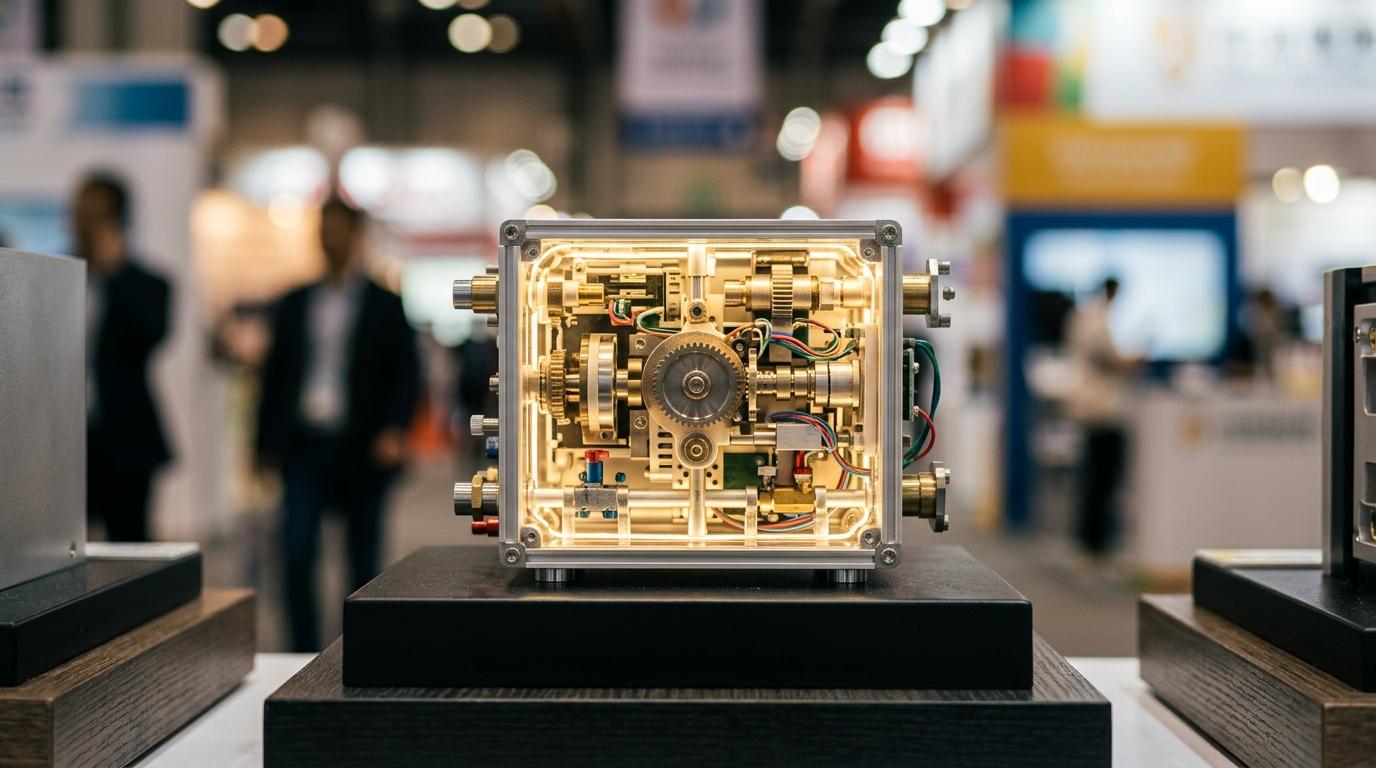
| Industrial models | Technical systems, manufacturing processes, energy projects | Cutaway sections, clear materials, moving parts, operational lighting |
| Automotive and showroom models | Dealership concepts, vehicle display environments, mobility brands | Vehicles, interior layouts, branded lighting, rotating or animated elements |
| Interactive display models | Technology launches, immersive brand stands, product demonstrations | Sensors, touch triggers, projection mapping, AR or VR integration |
| Prototype models | Product validation, launch events, engineering exhibitions | High-precision parts, material studies, functional presentation elements |
Some projects are designed to dominate a large island stand. Others need to work within a compact booth and still create presence. Scale, proportion and visibility are planned with the event environment in mind, not only the object itself.
That practical view is essential. A beautiful model that is difficult to transport, assemble or power on site can create unnecessary pressure before the event even opens.
Trade show model design features that increase engagement
Visitors respond quickly to movement, light, contrast and clarity. A model that includes these elements can hold attention far longer than a static display panel.
ARI Model can integrate physical craftsmanship with digital and electronic systems to create a stronger exhibition experience. Depending on the brief, this may include:
- LED lighting: highlight circulation routes, active zones, interiors or brand colours
- Animation and motion: rotating platforms, moving components, kinetic product parts
- Projection mapping
- AR and VR integration
- Cutaway construction: reveal internal mechanisms without losing overall form
- Modular sections
These features are not added for novelty alone. They are most effective when they support a clear message, whether that is product performance, development scale, engineering logic or visitor experience.
In many sectors, interactivity also improves recall. If attendees can trigger an effect, inspect a mechanism or see a district come alive through lighting and projection, they are more likely to remember both the model and the brand behind it.
Architectural and industrial trade show models built for real event conditions
Trade show models must do more than look impressive in a studio. They need to survive packing, transport, handling, installation and repeated use. That is why fabrication choices matter from the beginning.
ARI Model uses a mix of advanced production methods, including CNC machining, laser cutting and multiple 3D printing technologies such as FDM, PolyJet, SLA and SLS. This allows each component to be produced in the most suitable way, balancing detail, strength, finish and lead time.
Materials are selected according to the intended visual effect and the practical needs of the event. Acrylic can provide crisp geometry and light transmission. Wood can add warmth and depth. Printed parts can capture complex forms with high accuracy. Metal details may be introduced where structure or finish requires it.
The result is a model that is designed as an exhibition object, not just as a display piece.
Modular trade show models for transport, installation and reuse
Large trade show models often need to travel internationally, pass through venue access routes and fit strict installation windows. Modular construction helps solve those issues without reducing impact.
Sections can be split for crating, transport and safe handling, then assembled efficiently on site. Removable covers, protected lighting components and dedicated packing solutions reduce risk during transit. This is especially important for city models, dealership concepts and industrial layouts with delicate detailing.
A reusable model can also offer better long-term value. One model may support multiple trade shows, investor meetings, showroom presentations or planning sessions, with updated graphics or interchangeable zones added over time.
Trade show model production process from brief to installation
A strong exhibition model begins with a focused brief. The objectives should be clear before scale, lighting or interactive features are decided. Is the aim to attract footfall, explain a process, support lead generation or present a future development with credibility? Each goal changes the right design approach.
ARI Model supports the full production path, from early concept work to fabrication, delivery, installation and after-sales support. That joined-up service is particularly valuable for time-sensitive events where stand builders, marketing teams and technical teams all need coordination.
A typical trade show model project may include:
- Brief review: goals, audience, venue limits, timeline and budget
- Scale studies
- Design development: layout, materials, lighting strategy and interaction points
- Fabrication
- Testing and quality control
- Delivery and installation: packing, transport planning, on-site assembly
- Storage or refurbishment options
This structured process helps reduce surprises late in the programme, especially when a model includes electronics, moving elements or integrated digital content.
Choosing the right trade show model for your exhibition goals
The most suitable model is not always the largest or the most technically complex. It is the one that communicates the right message clearly, fits the stand properly and supports meaningful conversations.
If the audience is highly technical, a cutaway model or transparent system display may be the best choice. If the event is focused on investment or public launch, a refined architectural or urban model with lighting may be more effective. If the aim is to create theatre and draw a crowd, motion, sound or digital overlays can be introduced in a controlled way.
Budget should also be considered in relation to use over time. A modular model with durable construction may support several events and presentations, making it a stronger investment than a one-off display built only for short-term effect.
Why ARI Model is chosen for trade show model projects
Experience matters when exhibition deadlines are fixed and expectations are high. ARI Model has produced more than 499 models in 17 countries, with international production capacity supported by 1,000 m² workshops in France and Germany.
Clients often need one partner who can handle precision fabrication, lighting, digital integration and logistics without breaking the project into separate suppliers. That is where an end-to-end approach becomes valuable.
Key strengths include:
- 24+ years of model making experience
- International delivery capability
- High-precision detailing
- Integrated technology: lighting, interactive systems, AR and VR options
- End-to-end service: design, fabrication, delivery, installation and support
Trade show model planning for architects, developers and industrial brands
Different sectors need different storytelling tools, yet the principle remains the same: the model should make the message visible at a glance and rewarding at close range.
Architects and developers often need to show context, scale and design intent. Urban planners may need to explain phasing, infrastructure and circulation. Industrial companies may need to reveal internal functions that are normally hidden. Product and marketing teams may need a centrepiece that becomes the focal point of the stand.
The best starting point is usually a practical project pack that includes drawings, dimensions, event dates, target audience, stand layout and the main message the model must communicate. With that foundation, the model can be shaped into a display that is visually striking, technically credible and ready for the pace of a live event.