
Material choice is one of the clearest signs of quality in model fabrication. Two models can represent the same building, product, or industrial concept, yet feel completely different because the materials respond differently to light, detail, handling, and paint. A bespoke model is rarely judged only by accuracy. It is judged by presence.
That is why the best material is not simply the most expensive or the most advanced. It is the one that fits the purpose of the model. A high-detail sales presentation calls for one set of qualities. A transportable exhibition model calls for another. In many cases, the strongest result comes from combining several materials with precision.
Why material choice matters in bespoke model fabrication
A fabricated model has to do several jobs at once. It must represent form accurately, hold together during transport, look convincing under exhibition lighting, and support whatever story the client wants to tell. If the material is poorly matched to the brief, even a well-built model can feel heavy, rough, fragile, or visually flat.
The key question is simple: what should the viewer notice first? If the answer is intricate façade detail, fine texture matters. If the answer is glazing, internal lighting, or protected display, transparency and rigidity matter more.
If the model is a fast-moving planning tool, weight and speed of assembly may take priority.
A useful material choice usually balances these factors:
- scale and level of detail
- viewing distance
- paint finish
- transport demands
- lighting requirements
- production speed
SLA resin for high-detail presentation models
When bespoke model fabrication demands precision, SLA resin is often the strongest option. SLA, or stereolithography, uses a laser to cure liquid resin layer by layer through photopolymerisation. Among plastic 3D-printing methods, it is widely associated with the highest resolution, sharp accuracy, and the smoothest paintable surfaces.
That combination is especially valuable for presentation models. Fine mullions, façade relief, staircase geometry, industrial components, and miniature structural details all benefit from crisp edges and minimal surface stepping. Resin parts also accept primer and paint well, which helps the final finish look refined rather than obviously printed.
This is where resin separates itself from many other plastics. A bespoke model may need to persuade investors, support a design competition, or stand under close inspection at an exhibition. In those settings, surface quality is not a minor issue. It is central to how the model is read.
Resin is especially strong when the brief includes:
- Best use: highly detailed architectural presentation models
- Visual benefit: smooth surfaces ready for premium paint finishing
- Scale advantage: fine small-scale elements that would be difficult to machine by hand
- Production value: repeatable accuracy for multiple identical parts
Resin is not the whole answer, though. Large resin parts can add cost, and some geometries are better handled by other materials. For large masses, terrain, or broad internal volumes, it often makes more sense to pair resin with lighter sheet materials or carved substrates.
Acrylic sheet for transparency, durability, and crisp edges
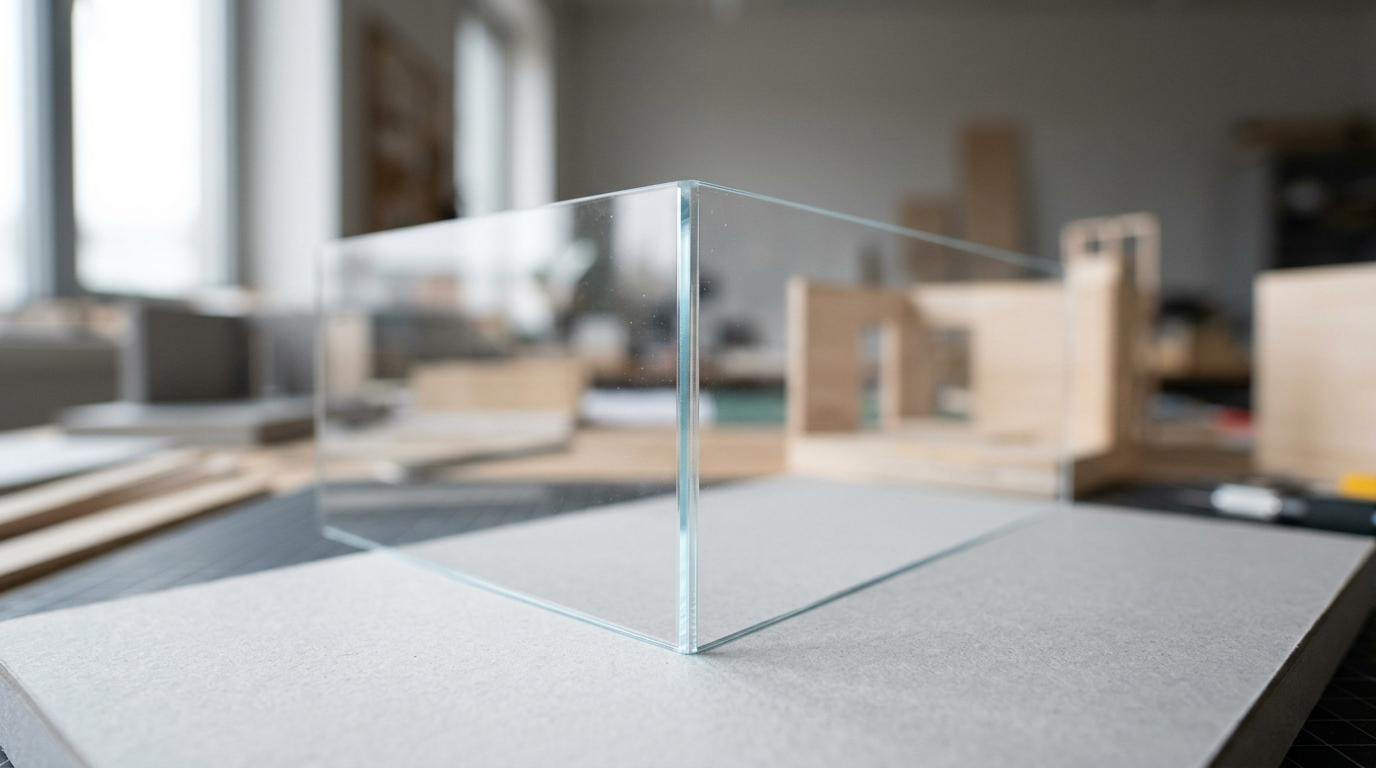
Acrylic is one of the most useful materials in model fabrication because it solves two problems at once: it creates clean transparent elements and it provides a durable structural sheet. Clear acrylic products can transmit around 92% of visible light, which is why they work so well for glazing, display covers, illuminated zones, and cutaway effects.
Compared with glass, acrylic is also lighter and more practical for model handling. Many grades are roughly half the weight of traditional glass and several times stronger in impact terms. That makes a real difference when a model is travelling between workshops, client offices, and exhibition venues.
In visual terms, acrylic brings a precise, contemporary language. Laser-cut edges can look sharp and deliberate, while polished or frosted finishes help separate interior and exterior zones. It is often used for windows, protective cases, water features, plinth details, and illuminated base elements. It can also support branding, labelling, and integrated lighting systems without making the model feel crowded.
Acrylic performs well in several roles:
- transparent façades
- model covers
- illuminated inserts
- durable base plates
One reason acrylic stays popular is its flexibility in design language. It can look nearly invisible when clarity is needed, or become an expressive material in its own right when colour, layering, or edge lighting are part of the concept.
Foam board for lightweight structure and rapid massing
Foam board is often underestimated because it appears simple. In practice, it is one of the most efficient materials for early-stage build-ups, large site masses, temporary exhibition pieces, and light internal support structures. High-quality boards are rigid, lightweight, and easy to cut, glue, machine, and fold.
That combination makes foam board ideal for broad surfaces that do not need deep surface detail. Urban planning models, topographical layers, conceptual volume studies, and internal fillers can all benefit from its low weight and quick handling. Some miniature-oriented foam boards are produced in thin formats, including 2 mm versions, which help when working at smaller scales.
Speed matters here. When a project needs fast iteration, foam board allows teams to move quickly without sacrificing clarity. It also reduces handling strain on large models, which helps during assembly and transport. In many cases, the smartest use of foam board is not as a visible hero material but as a disciplined structural layer inside a more complex finished piece.
That said, foam board has limits. Exposed edges can require finishing, and it does not deliver the same tactile richness as timber or resin. It is best treated as a precision support material or a clean conceptual surface rather than a substitute for every visible component.
Basswood for hand-crafted detail and tactile character
Basswood remains one of the finest traditional materials in bespoke model fabrication. It is soft enough to cut and carve with control, yet tight-grained enough to hold detail cleanly. That balance is the reason it has long been favoured for hand-crafted miniature work.
Where resin offers technical sharpness, basswood offers warmth. It gives a model a material honesty that many clients still value, especially in architectural presentations where natural finishes, crafted surfaces, or understated elegance are part of the message. It can be machined, sanded, engraved, and hand-finished with a precision that feels subtle rather than mechanical.
Basswood is particularly effective for façades, landscape features, roof forms, and hand-worked inserts where the grain needs to stay fine. It also suits projects where a monochrome timber palette is part of the visual strategy. A well-finished basswood model can feel calm, serious, and enduring without relying on heavy colour or glossy surfaces.
Its strongest qualities include:
- Material feel: warm, natural, and refined
- Working behaviour: easy to carve, cut, and sand
- Detail retention: fine grain supports precise edges
- Presentation style: excellent for premium monochrome or wood-finish models
Comparing the best materials for bespoke model fabrication
No single material wins every brief. The right selection depends on what the model must communicate, how close viewers will get, and how often it will travel.
| Material | Main strength | Best application | Watch-out |
|---|---|---|---|
| SLA resin | Highest detail and smooth finish among plastic 3D-printing methods | Client-facing presentation models, intricate parts, façade detail | Less efficient for large low-detail masses |
| Acrylic sheet | Transparency, rigidity, and durability | Glazing, covers, illuminated elements, water effects | Scratches need control during handling |
| Foam board | Lightweight and fast to process | Massing studies, terrain layers, internal structure, large lightweight forms | Exposed edges may need finishing |
| Basswood | Fine hand-work and tactile quality | Premium architectural models, carved details, warm natural finishes | Slower than sheet-based build methods for large repetitive parts |
Hybrid material strategies for stronger model fabrication results
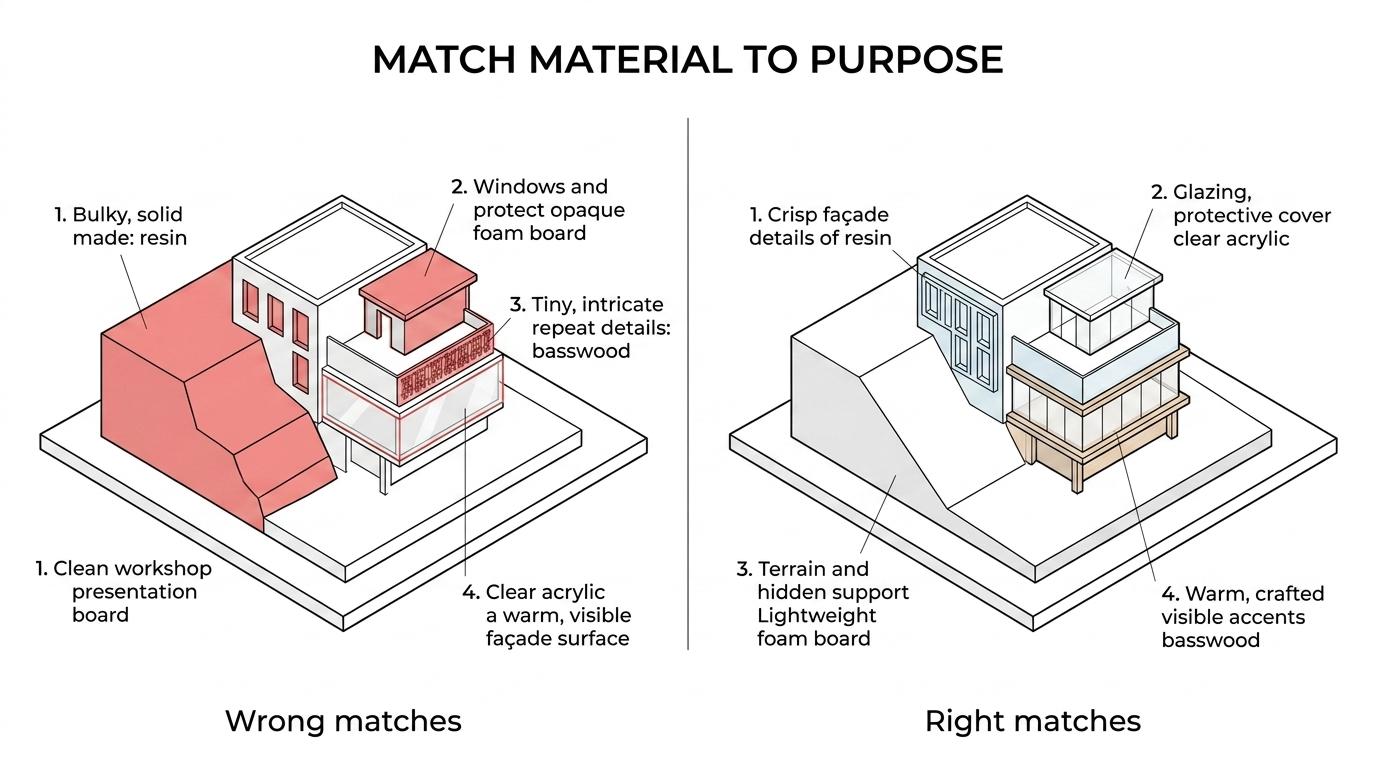
The most successful bespoke models are often hybrid builds. Resin handles the intricate geometry. Acrylic brings clarity and protection. Foam board reduces weight and speeds up core construction. Basswood adds material richness and crafted surfaces. Used together, these materials do not compete. They support each other.
A large mixed-use development model is a good example. The podium and tower façades may be 3D printed in resin for precision. The glazing and display cover may be acrylic. The terrain and substructure may use foam board to keep the assembly manageable. Basswood can then introduce selected landscape, decking, or architectural accents.
The same approach works in industrial model fabrication. Technical machinery can be printed in resin, transparent process paths can be shown in acrylic, support masses can be built in lightweight board, and selected visible casings or display elements can use timber for a polished finish.
A balanced hybrid strategy often follows this logic:
- Resin: focal details and repeatable precision parts
- Acrylic: clear elements and durable sheet construction
- Foam board: hidden volume, topography, and low-weight structure
- Basswood: tactile surfaces and hand-finished visible details
How ARI Model approaches material selection in model fabrication
At ARI Model, material selection is shaped by the purpose of the model rather than by a fixed formula. A competition model, a trade show centrepiece, and a technical prototype each ask for a different balance of finish, robustness, scale, and speed. That is why early material planning matters just as much as CAD preparation or workshop production.
With international production capacity, precision machinery, and experience across architectural and industrial work, ARI Model can combine digital fabrication with hand-finishing where each brings the most value. CNC cutting, laser processing, and 3D printing make complex assemblies possible. Skilled finishing and assembly then give the model its clarity, discipline, and visual confidence.
A strong brief usually includes a few practical questions before production starts. How close will viewers stand? Will internal lighting be visible in daylight? Does the model need to survive repeated packing and installation? Is the goal to show technical truth, marketing impact, or both? Once those answers are clear, the material palette becomes much easier to define.

For many bespoke projects, the most effective answer is refreshingly direct. Use resin where fine detail matters most. Use acrylic where transparency and durability matter. Use foam board where weight and speed matter. Use basswood where crafted character matters. That approach keeps model fabrication focused on performance, not fashion, and it gives the finished piece a stronger presence from the first glance.