
A presentation model does far more than shrink a building or product into a smaller object. At its best, it turns a complex idea into something people can read quickly, remember clearly and discuss with confidence. That is why presentation models still matter in architecture, urban planning, industry and exhibitions, even when screens, renders and immersive media are everywhere.
A strong model gives shape to intent. It helps a client grasp proportion, a planner judge context, a sales team tell a story and a project team test whether the key idea is coming through. When people gather around a physical object, conversations often become sharper and more productive.
For that reason, the quality of a presentation model is never just about craftsmanship alone. Precision matters, of course, but so do editing, hierarchy, durability and the ability to guide attention to the right information.
Why a presentation model still matters in professional communication
A drawing can describe. A render can impress. A presentation model can do both while adding something neither medium offers in quite the same way: immediate spatial clarity.
That matters because many project decisions are made by people who are not trained to read plans, sections or technical visualisations. A physical model closes that gap. It allows viewers to move around the proposal, compare one side with another and judge the relationship between building, site and surroundings in a direct way.
This is one reason presentation models remain highly effective in planning reviews, investor meetings, sales environments and exhibitions. They create a shared point of reference, which often leads to faster questions and better feedback.
!A quote highlight featuring the line about presentation models adding immediate spatial clarity.
Core qualities of a successful presentation model
The best presentation models are edited with discipline. They are accurate enough to build trust, but selective enough to stay readable. Trying to show everything usually weakens the message.
A good model should answer the main question at a glance. Is the key story about massing? Context? Façade rhythm? Movement through the site? Public space? Product form? If that story is unclear within a few seconds, the model is working too hard and saying too little.
Most effective models share a few visible traits.
- clean edges
- restrained colour
- clear contrast between new and existing
- legible landscaping
- stable base and display presence
- careful lighting where needed
There is also an emotional dimension. People respond to objects that feel considered. Crisp assembly, balanced proportions and coherent material choices signal seriousness. That makes the model more persuasive before a single word is spoken.
Scale and level of detail in a presentation model
Scale is one of the first strategic choices. There is no universal best option, because scale depends on what the model needs to communicate and where it will be shown.
A masterplan model needs room for context. A sales model may need façade detail and landscape texture. A product prototype may need close inspection of form, seams or assembly logic. Choosing the wrong scale can make a model either vague or overcrowded.
| Model purpose | Typical scale | Main focus |
|---|---|---|
| Urban or masterplan presentation | 1:500 to 1:1000 | context, routes, density, topography |
| Building presentation | 1:200 to 1:500 | massing, site fit, overall form |
| Detailed architectural presentation | 1:100 | façade rhythm, entrances, circulation |
| Interior or sectional presentation | 1:50 or larger | space, structure, material junctions |
| Product or industrial prototype model | variable | form, mechanism, assembly, finish |
Detail should rise in layers, not all at once. The first layer is form and proportion. The second is envelope, circulation and key site conditions. The third is supporting information like trees, furniture, vehicles, figures, labels or lighting effects.
That hierarchy is what separates a professional presentation model from a busy miniature.
Clarity and visual hierarchy in presentation model design
Clarity begins with omission. If every surface carries the same intensity of detail, nothing stands out. The eye needs a path.
Many successful presentation models use a restrained palette for exactly this reason. White, off white, pale grey, timber tones and transparent acrylic are widely used because they keep attention on form, light and composition. When colour is added, it usually works best as a controlled signal rather than decoration.
A viewer should be able to tell what matters in seconds. Good visual hierarchy often comes from a few simple moves.
- Primary focus: the proposed building, product or intervention
- Secondary layer: access points, circulation, terrain, neighbouring context
- Support elements: trees, figures, vehicles, graphics and labels
- Contrast strategy: different tones or materials for new work versus existing fabric
Lighting can help too, though it must be handled with care. Internal illumination, street lighting or highlighted routes can add depth and theatre, but only when they support the story. If lighting becomes the main attraction, the design itself can disappear behind the effect.
Materials and fabrication techniques for presentation models
Material choice shapes both appearance and performance. The right combination depends on scale, budget, timeline, transport needs and the level of finish required.
Card and board remain excellent for concept driven work because they produce clean abstraction. Wood brings warmth and refinement. Acrylic introduces crisp transparency and suits glazing, covers and polished display elements. Resin and high resolution 3D printing are ideal for complex geometry and small detailed parts. CNC machining is especially useful for topography, plinths and larger terrain pieces.
In professional production, hybrid making is often the strongest route. Digital fabrication offers precision and repeatability, while hand finishing brings judgement and control. That balance is central to many high quality models produced today.
At ARI Model, this hybrid approach is part of what makes presentation work effective. With specialist workshops in France and Germany and a mix of CNC, laser and multiple 3D printing technologies, the aim is not to use technology for its own sake. The goal is to choose the process that gives the clearest, strongest result for the brief.
The most common fabrication mix usually includes:
- laser cut façade and wall elements
- CNC milled bases or terrain
- 3D printed intricate components
- hand assembled finishing and paintwork
That blend gives a model the precision of digital production and the character of skilled workshop craftsmanship.
Realism versus abstraction in a presentation model
A presentation model does not always need to look fully realistic to be convincing. In many cases, abstraction is more powerful because it helps viewers focus on structure, space and composition.
Early design presentations often benefit from simplification. A monochrome model can make the main architectural or industrial idea easier to read. It also avoids suggesting that every design decision is already fixed.
By contrast, marketing and public display models often need more atmosphere. Landscaping, lighting, glazing, surface variation and contextual elements can make the proposal feel tangible and emotionally immediate.
The right question is not “Should the model be abstract or realistic?” It is “What level of realism helps this audience make a better decision?”
Practical performance: transport, durability and display
A presentation model has to survive real use. That sounds obvious, yet practicality is often treated too late.
Models are moved between offices, planning meetings, exhibitions, sales suites and events. They may need to travel internationally, fit through doors, sit under protective covers and withstand repeated setup. A beautiful model that chips, flexes or sheds pieces under normal handling quickly loses value.
This is why modular design matters. Large models may need split bases, removable sections or detachable covers. Fragile elements should be protected or engineered with smarter fixing points. Good display design is part of model design, not an afterthought.
A reliable presentation model usually needs:
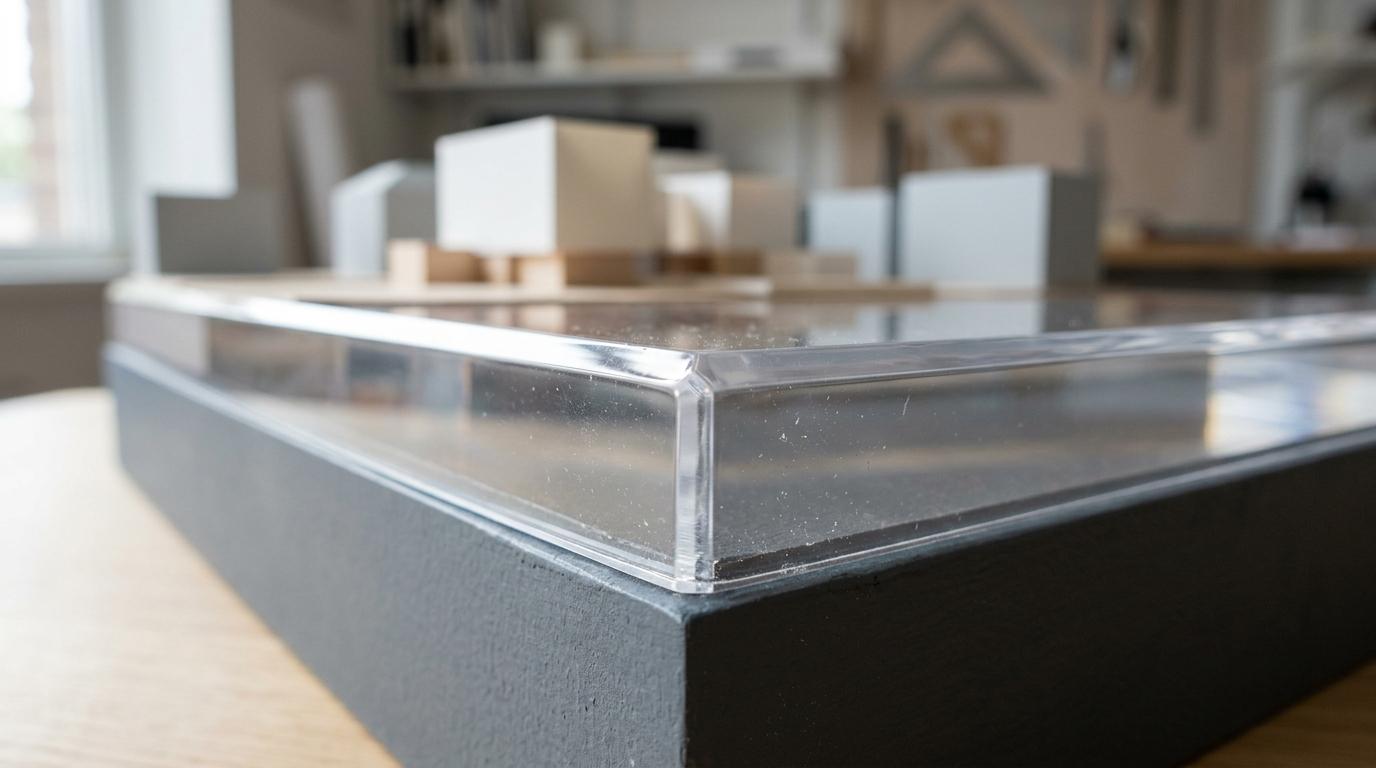
- Protective casing: acrylic cover, crate or transport box
- Modular planning: separable sections for movement and installation
- Repair strategy: replaceable components for vulnerable parts
- Display stability: rigid plinth, level base and safe cable management
These details are rarely the most glamorous part of the brief, yet they strongly affect how often the model can be used and how well it performs over time.
How a presentation model supports clients, planners and investors
Different audiences read models in different ways, and that should shape the design brief from the start.
Clients often want reassurance. They need to see what the project is, how it will feel and how it relates to its site or use case. Planners and public bodies may focus on scale, setbacks, urban context, access and impact. Investors usually want clarity, confidence and a strong visual story. Exhibition visitors respond to legibility first and detail second.
That means the same project can justify more than one presentation model, or at least one model with a very clear communication priority. A competition model may be sparse and concept led. A sales suite model may be richly finished and illuminated. A public consultation model may emphasise surrounding context and movement routes.
When the brief is right, the model helps people ask better questions. That is often where its real value lies.
How to brief a presentation model effectively
The strongest presentation models usually begin with a brief that is shorter and sharper than expected. Too much undecided information creates confusion in the workshop and noise in the final object.
Before any fabrication starts, the project team should be clear about audience, message, scale, finish and display conditions.
Som NB Architects fremhæver i sin practical briefing template, reducerer tidlig afklaring af målgruppe, formål og beslutningspunkter risikoen for omarbejde senere i processen.
It also helps to define what can be simplified. Not every tree, balustrade, fixture or material change deserves equal attention at model scale.
A useful briefing structure looks like this:
- Audience: who will read the model first
- Purpose: planning, sales, investor review, exhibition or internal presentation
- Focus: context, massing, façade, section, landscape, product form or phasing
- Scale: based on viewing distance and required detail
- Finish level: abstract, semi realistic or high realism
- Logistics: deadlines, transport, installation and storage
Good modelmaking is a combination of design judgement and production discipline. When both are in place, a presentation model becomes more than a display piece. It becomes a decision tool, a sales tool and a persuasive physical argument that people can see from every angle.