Prototype models are not just for product designers. They are a decision tool used by industries that face high costs, strict tolerances, safety requirements, or complex stakeholder approval.
### TL;DR: Summary
* Prototype models are most needed in aerospace, automotive, medical devices, electronics, defence, architecture and civil infrastructure, consumer products, jewellery, and education or research.
* The strongest cross-source evidence points to aerospace, automotive, medical, and electronics as the most prototype-intensive sectors, based on official and technical references from NIST, CRS, IEEE, GAO, and Autodesk.
* Teams use prototype models to test fit, form, function, ergonomics, manufacturability, and stakeholder communication before expensive tooling or production starts.
* If a project has high regulatory risk, low-volume functional parts, complex geometry, or frequent design changes, prototype models usually save time and cost.
* Rapid prototyping and additive manufacturing are not the same as a finished product strategy: some sectors need visual presentation models, while others need functional validation parts made with methods like SLA, SLS, FDM, CNC, or metal powder bed fusion.
The practical question is not whether prototyping matters, but where it matters most and what type of model each industry actually needs. A medical device team, an automotive studio, and an urban planning group may all ask for a prototype model, yet their criteria are very different.
Why do prototype models matter across industries?
Prototype models matter because CAD and simulation are not enough. In aerospace and architecture, physical models reveal geometry, assembly, visibility, and communication issues that are easy to miss on screen.
A prototype model turns an abstract design into something teams can inspect, compare, hold, test, or present. That is valuable in any sector where one design change can affect tooling cost, regulatory timing, or client approval. IEEE treats virtual prototyping as useful before physical builds, but physical prototypes still carry a different kind of proof: people can check scale, touchpoints, clearance, handling, and finish in real space.
That is why prototype models sit at the meeting point between design intent and production reality. They help engineers, marketers, planners, surgeons, buyers, and non-technical stakeholders discuss the same object without guessing.
"ARI Model has produced 499+ models in 17 countries, which reflects the cross-sector demand for physical models in planning, exhibitions, and technical presentations."
A common misconception is that prototype models are only for late-stage validation. In practice, many teams use rough prototypes early, then refined models later, because catching a mistake before tooling or procurement usually costs less than correcting it after launch.
How do prototype models reduce risk before production?
Prototype models reduce risk by making failure visible earlier. In automotive and medical device development, that means testing fit, usability, and assembly before committing to production processes.
Risk in this context is not only technical failure. It can be regulatory delay, supplier confusion, poor stakeholder buy-in, packaging issues, or a weak exhibition presentation. A prototype helps because it forces decisions into the open. If a housing does not close, if a connector clashes, or if a surgical handle feels wrong in the hand, the team knows before capital is spent on moulds or production tooling.
The trade-off is simple. Faster prototypes may be less accurate in surface finish, material behaviour, or tolerance. Higher-fidelity prototypes take longer and cost more, but they answer more serious questions. If the decision is about visual approval, a presentation-grade model may be enough. If the decision is about heat, load, sterility, or repeated use, a functional pre-production model is usually required.
A practical rule helps here: match the prototype to the decision at hand, not to the whole project. Many delays happen because teams overbuild an early prototype or under-specify a late one.
What are the 9 industries that need prototype models most?
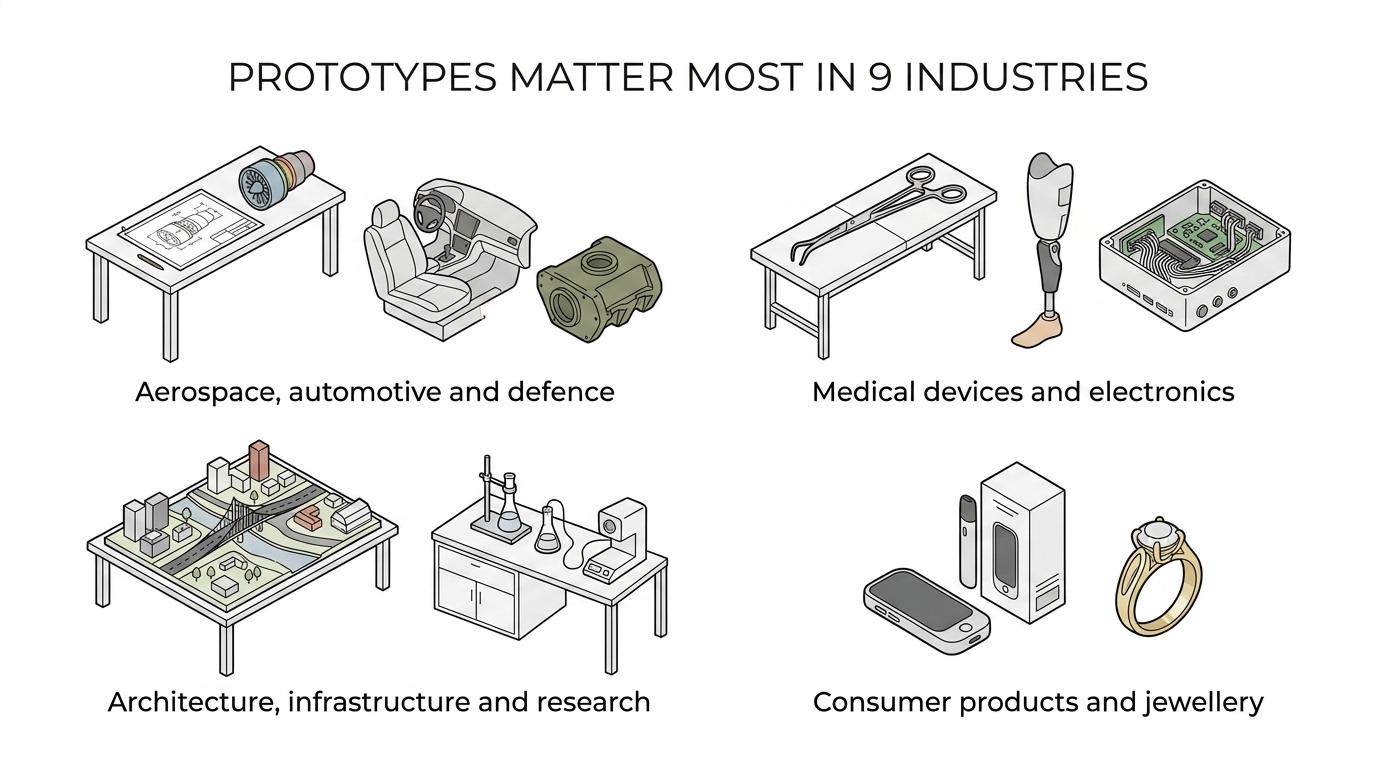
The nine industries below are the most consistently supported by official and technical sources. NIST, CRS, IEEE, GAO, and Autodesk repeatedly point to sectors where prototyping supports design, testing, and low-volume functional parts.
- Aerospace: Used for complex components, concept validation, and low-volume functional parts. GAO highlighted a jet-engine fuel nozzle as a well-known additive manufacturing example.
- Automotive: Used for vehicle concepts, interior parts, ergonomic checks, aero studies, and supplier coordination before tooling.
- Medical devices and healthcare: Used for surgical instruments, prosthetics, implants, training aids, and clinician feedback.
- Electronics: Used for enclosures, PCB fit, cable routing, thermal packaging, and consumer electronics form testing.
- Defence: Used where ruggedness, low-volume builds, rapid iteration, and field-specific modifications matter.
- Architecture and civil infrastructure: Used to communicate planning, phasing, transport links, public consultation, and development impact.
- Consumer products: Used for ergonomics, retail presentation, packaging integration, and design refinement across short product cycles.
- Jewellery: Used for highly detailed small parts and metal process validation, including complex geometries named by NIST.
- Education and research: Used in teaching, proof-of-concept work, engineering labs, and design iteration across disciplines.
The pattern is clear. The more expensive the error, the more useful the prototype.
How should aerospace and defence teams validate a prototype model step by step?
Aerospace and defence teams should validate prototypes in stages. NIST and GAO point to complex, low-volume parts where geometry, material behaviour, and traceability all matter.
Step 1 is to define the question the prototype must answer. Is the team checking aerodynamic form, service access, assembly sequence, operator interaction, or manufacturability? If that question is vague, the prototype will likely be vague too.
Step 2 is to choose the fidelity level. A visual form model may suit a concept review. A functional part may need tighter control over material, wall thickness, and build orientation, especially if additive manufacturing is involved. Powder bed fusion is relevant when metal geometry and low-volume functional performance are part of the brief.
Step 3 is to run the prototype through the real decision path. That means engineering review, supplier feedback, handling checks, and where needed, documentation tied to revision control. A common mistake is treating the prototype as a one-off object rather than as part of a validation process.
"With 1,000 m² workshops in France and Germany, ARI Model can support prototype model programmes that combine design, fabrication, finishing, lighting, and delivery."
In defence-related work, speed matters, but traceability matters too. If a geometry change affects weight, mounting, or access, then the prototype should be updated and re-reviewed instead of informally approved from memory.
How is automotive prototyping different from consumer electronics prototyping?
Automotive prototyping is broader in system complexity. Consumer electronics prototyping is usually faster, smaller, and more tightly linked to enclosure, interface, and assembly constraints.
An automotive prototype often has to answer questions about body form, cabin ergonomics, airflow, mechanical packaging, supplier interfaces, and service access. Autodesk specifically links rapid prototyping to automotive parts and vehicle concepts, which reflects this wide scope. One model may support styling, while another supports engineering fit.
Consumer electronics prototypes focus more on user touchpoints and production packaging. Teams care about button travel, connector access, PCB clearance, thermal layout, hand feel, and perceived quality. Tolerances may be smaller in absolute size, but the overall system is often less mechanically large than a vehicle programme.
A useful distinction is time pressure. Consumer electronics tends to move in shorter cycles, so teams may accept several quick iterations in SLA or CNC-cut mock-ups. Automotive programmes may need more staged sign-off because more systems depend on the same geometry. The misconception to avoid is thinking that "small product" means "simple prototype". In electronics, a tiny alignment issue can still break assembly.
That is especially true in electromechanical products, where Rikta’s guidance on johdinsarjan suunnittelu shows how cable routing, bend radius, connector placement, and service access can all turn a seemingly minor packaging change into a functional problem.
How do medical device teams use prototype models step by step?
Medical device teams use prototype models to reduce clinical and regulatory uncertainty. Autodesk identifies surgical instruments, prosthetics, and implants as key rapid prototyping applications.
Step 1 is clinical fit. The team checks whether the shape, grip, reach, or placement works for the intended use. Surgeons and clinicians often spot usability problems that are not obvious in CAD. If the device interacts with anatomy, then human factors become central very early.
Step 2 is functional refinement. Here the team tests moving parts, assembly logic, sterilisation assumptions, packaging constraints, or workflow around the device. Not every prototype must use the final material, but the behaviour has to be close enough to answer the real question.
Step 3 is documentation and iteration. Medical projects live under tighter scrutiny, so version control, test records, and change rationale matter. A polished prototype without a controlled review trail is less useful than a modest model tied to clear design decisions.
The trade-off is often between realism and speed. A fast prototype can support early clinician feedback. A later-stage prototype may need better tolerances, biocompatibility consideration, or process similarity to the final device.
How do architecture and civil infrastructure models differ from industrial prototype models?
Architecture and civil infrastructure models are primarily communication tools. Industrial prototype models are usually validation tools for fit, function, or manufacturability.
That does not mean architectural models are less technical. In planning and development, they often carry site geometry, massing, circulation, lighting, transport context, or phasing detail. IEEE explicitly includes architecture and civil infrastructure in virtual prototyping use cases, which shows that built-environment teams also depend on early design testing.
Industrial models tend to answer narrower but harder performance questions. Will this assembly clear adjacent parts? Can this bracket be produced efficiently? Does the housing support the mechanism? The success metric is usually operational. In architecture, the success metric is often shared understanding among planners, clients, investors, and the public.
This is where scale matters in two different ways. In an urban model, scale compresses a large environment so stakeholders can see relationships. In an industrial prototype, full-scale detail may be necessary because hand access, mounting, and tolerance behaviour cannot be judged reliably at miniature scale.
How should a company choose materials and prototyping methods step by step?
Companies should choose prototyping methods by decision criteria, not by habit. SLA, SLS, FDM, CNC, and metal powder bed fusion each answer different questions.
Step 1 is to identify the primary test. If the test is visual presentation, a fine-finish resin or machined model may be enough. If it is snap fit, heat exposure, or structural behaviour, then method and material must reflect that use more closely.
Step 2 is to compare constraints across cost, speed, finish, and performance. This is where many teams lose time by defaulting to the method they used last time instead of the one that fits the new brief.
- SLA: Strong for surface quality, concept parts, and presentation models with fine detail.
- SLS: Useful for robust polymer parts, internal features, and functional iterations without support structures.
- FDM: Fast and economical for early geometry checks and larger draft parts.
- CNC machining: Better when material realism, tight features, or production-like behaviour are priorities.
- Metal powder bed fusion: Relevant for complex metal geometry and low-volume functional parts in sectors like aerospace, defence, medical, automotive, and jewellery.
"Since 2000, ARI Model has delivered architectural and industrial models with end-to-end support from design to delivery, installation, and after-sales service."
Step 3 is to decide whether one prototype is enough. Often the right answer is no. A low-cost draft model can answer geometry questions first, while a second, higher-fidelity model answers functional or presentation needs later. That staged approach is usually more efficient than forcing one model to do everything.
When is a prototype model enough, and when do you need a functional pre-production model?
A prototype model is enough when the decision is mainly about shape, layout, or presentation. A functional pre-production model is needed when performance, regulation, or manufacturing risk is still unresolved.
If the team only needs internal approval, a marketing visual, or an exhibition piece, then a prototype or display-grade model can do the job well. ARI Model’s work in architectural and industrial models fits that use case where finish, clarity, and communication are important.
If the prototype must survive load, heat, repeated handling, sterilisation, or precise assembly, then the project has moved closer to pre-production validation. At that point, material selection, tolerance planning, and documented testing become more important than appearance alone. GAO and NIST both reflect the shift from prototyping toward direct production in some additive manufacturing contexts, especially for complex or low-volume parts.
One final misconception is worth avoiding: a beautiful model is not automatically a useful prototype. The right model is the one that answers the next critical question with enough accuracy to support a decision. If that question changes, the model specification should change with it.
---