When a development needs to win approval, support investment, or drive sales, a custom scale model gives people something clear and immediate to assess. Plans on a screen can explain dimensions and layout, yet a physical model brings massing, context, proportion, and design intent into one view.
For architects, developers, planners, and marketing teams, that clarity matters. A well-made model can turn a technical discussion into a confident decision, whether the project is a single residential building, a mixed-use scheme, or a large urban masterplan.
Custom scale models for property developments
Custom scale models are built around the needs of a specific project, not around a standard template. That means the scale, level of detail, materials, lighting, surroundings, and presentation style are chosen to suit the audience and the stage of the scheme.
At early design stages, a simpler model may be the right tool. It can test form, density, site relationships, and circulation without slowing the process with unnecessary detail. Later, a presentation model can show façade character, landscape treatment, public realm, transport links, and the wider setting in far greater depth.
This flexibility is what makes custom models so valuable for developments. The same project may need one model for design review, another for planning meetings, and a more refined version for a sales suite or exhibition. ARI Model supports this full range, producing physical and digital presentation tools that match the purpose of the brief.
Scale model formats for each development stage
Different project milestones call for different types of model. The right format depends on who will use it, how often it will be handled, and what questions it needs to answer.
A planning model, for example, often needs strong site context and legible massing. A marketing model may need lighting, premium finishes, and interactive features. A concept study may focus on speed and design feedback.
| Project stage | Model format | Main purpose |
|---|---|---|
| Early concept | Massing or study model | Test volume, orientation, and site fit |
| Design development | Detailed working model | Review layout, façade rhythm, and technical relationships |
| Planning and consultation | Context model | Show neighbours, streetscape, height, and public impact |
| Sales and exhibitions | Presentation model | Support marketing, investor meetings, and launch events |
| Interactive display | Physical model with digital layers | Add lighting, phasing, AR content, or VR walkthroughs |
This staged approach helps teams invest where it matters most. Instead of building one model that tries to do everything, the model becomes a focused communication tool for a specific decision.
Materials and technology for high-precision scale models
A successful model depends on more than appearance. It also depends on choosing the right making methods for accuracy, durability, finish, and timescale.
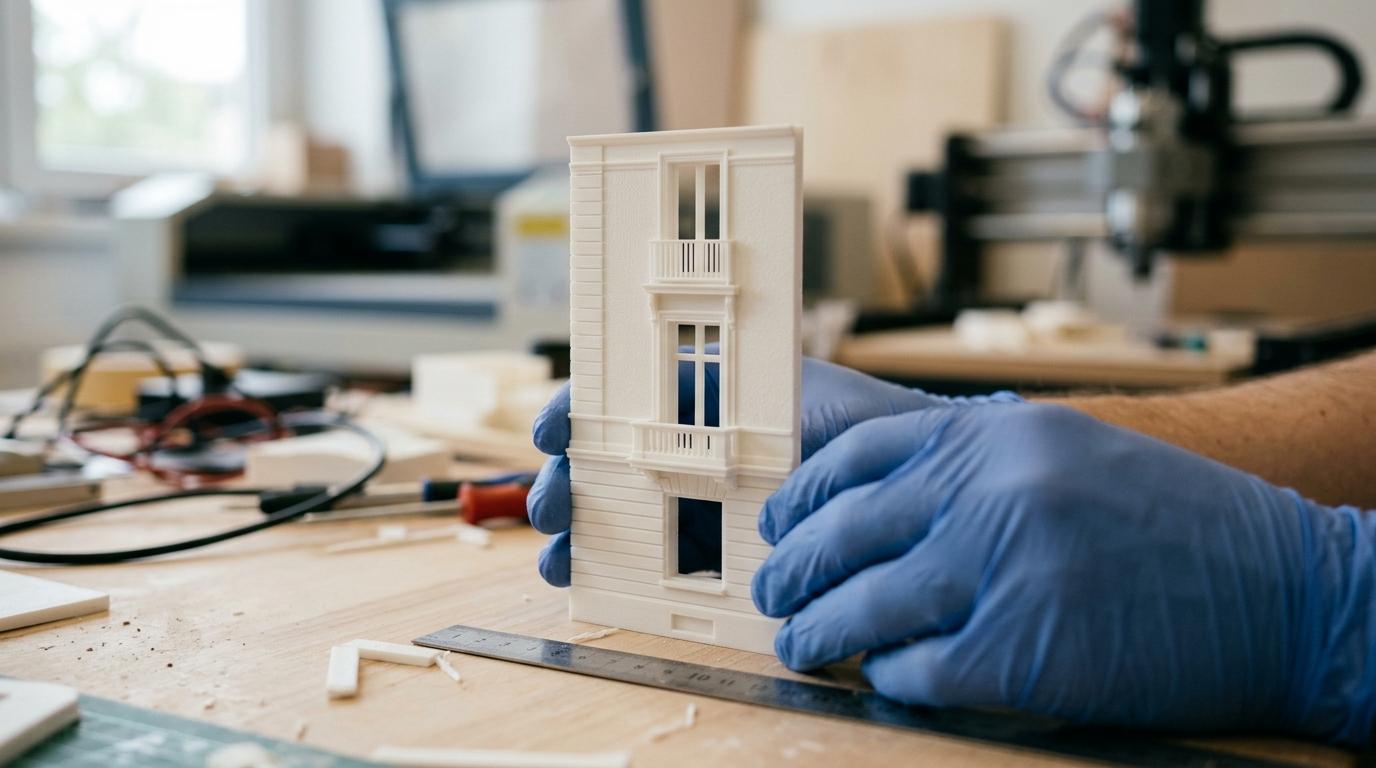
ARI Model uses a mix of handcraft and advanced production techniques. Laser cutting creates crisp wall lines and roof elements. CNC machining is ideal for terrain, plinths, and larger structural forms. High-resolution 3D printing makes it possible to produce intricate façades, balconies, planting elements, and other fine details with consistency across the model.
Material selection shapes the visual character of the final piece. Clean white finishes can keep attention on form and composition. Timber presentation models can give warmth and architectural elegance. Acrylic and resin components are useful when transparency, sharp edges, or lighting effects are needed. For more expressive schemes, colour coding can be introduced to separate phases, uses, or circulation routes.
Physical models can also be paired with digital systems. Illuminated zones, programmable LEDs, touch controls, AR overlays, and VR walkthroughs add another layer of communication without losing the impact of the physical object.
Common options include:
- White massing models
- Timber presentation models
- Illuminated sales suite displays
- Masterplan and urban context models
- AR-supported physical models
- VR walkthrough companions
Planning approval models and stakeholder communication
Planning discussions often slow down when people are interpreting the same proposal in different ways. A scale model reduces that gap quickly. It shows height, depth, spacing, and context in a form that can be read by technical and non-technical audiences alike.
That is especially helpful in pre-application meetings, consultation events, and investor presentations. A drawing can be precise, yet a model can make that precision easier to absorb. Streets, neighbouring buildings, open space, sunlight exposure, and approach routes all become easier to discuss when they are visible at once.
For larger sites, this clarity becomes even more valuable. Masterplan models can show phasing, density shifts, public realm, transport connections, and landmark buildings across a broad area. They are useful not only for planning authorities, but also for landowners, delivery partners, and community groups.
A custom model can support several audiences at the same time:
- Planning teams: clear massing, context, and visual impact
- Investors: a concise view of project quality and commercial ambition
- Design teams: quicker review of form, proportions, and site relationships
- Public consultations: easier communication with non-specialist audiences
- Sales teams: stronger engagement in marketing suites and launch events
Sales suite models and interactive presentation models
In a marketing environment, the model often becomes the focal point of the room. It helps buyers and investors form an immediate impression of the development and its setting. That effect is hard to replicate with boards or screens alone.
Lighting is a major part of this. Illuminated buildings, highlighted amenities, active plot selection, and phased sequences can direct attention to key selling points. A residential scheme may show available units or shared facilities. A mixed-use development may light retail zones, landscape areas, or transport access points.
Interactive systems can take this further. Tablets can trigger lighting scenes or display data linked to the model. AR layers can show interior layouts, usage plans, or development phases. VR can add a human-scale walkthrough that complements the physical overview offered by the model itself.
When a model is intended for long-term display, build quality and service matter just as much as presentation. Transport, installation, protective cases, maintenance access, and later updates should all be considered from the start.
ARI Model services for custom development models
ARI Model creates architectural and industrial models for clients across Europe and worldwide. With more than 24 years of experience, 499+ models delivered in 17 countries, and 1,000 m² workshops in France and Germany, the service is set up for both complex one-off commissions and larger production demands.
Each project begins with the brief: audience, scale, programme, display setting, and deadline. From there, model strategy can be defined around the purpose of the piece. Some developments need a fast concept model. Others need a highly refined centrepiece with lighting, landscaping, and removable sections. Some need both.
Production draws on a broad technical base, including CNC machining, laser cutting, and multiple 3D printing processes such as FDM, PolyJet, SLA, and SLS. That range allows ARI Model to match fabrication method to detail level, material behaviour, and delivery schedule. It also supports consistent quality when a model includes both large site elements and very fine architectural parts.
The service can extend beyond fabrication alone. Project teams may also need advice on scale selection, context coverage, presentation layout, transport planning, installation, and after-sales support. When a model is travelling to an exhibition or being placed in a permanent sales environment, those details matter.
Development sectors and project scales for custom models
Custom scale models are used across a wide range of sectors. Residential schemes, office developments, hotels, campuses, healthcare projects, infrastructure, industrial sites, and urban extensions can all benefit from a model built around their communication needs.
Some projects need a single-building display with façade detail and interior lighting. Others need a district-wide masterplan model that explains movement, density, green space, and future phases in one piece.
ARI Model works with project teams that need precision, reliability, and presentation impact in equal measure. Whether the brief calls for a clean concept model or a fully illuminated development display, the aim is the same: to make the project easier to evaluate, easier to present, and easier to remember.