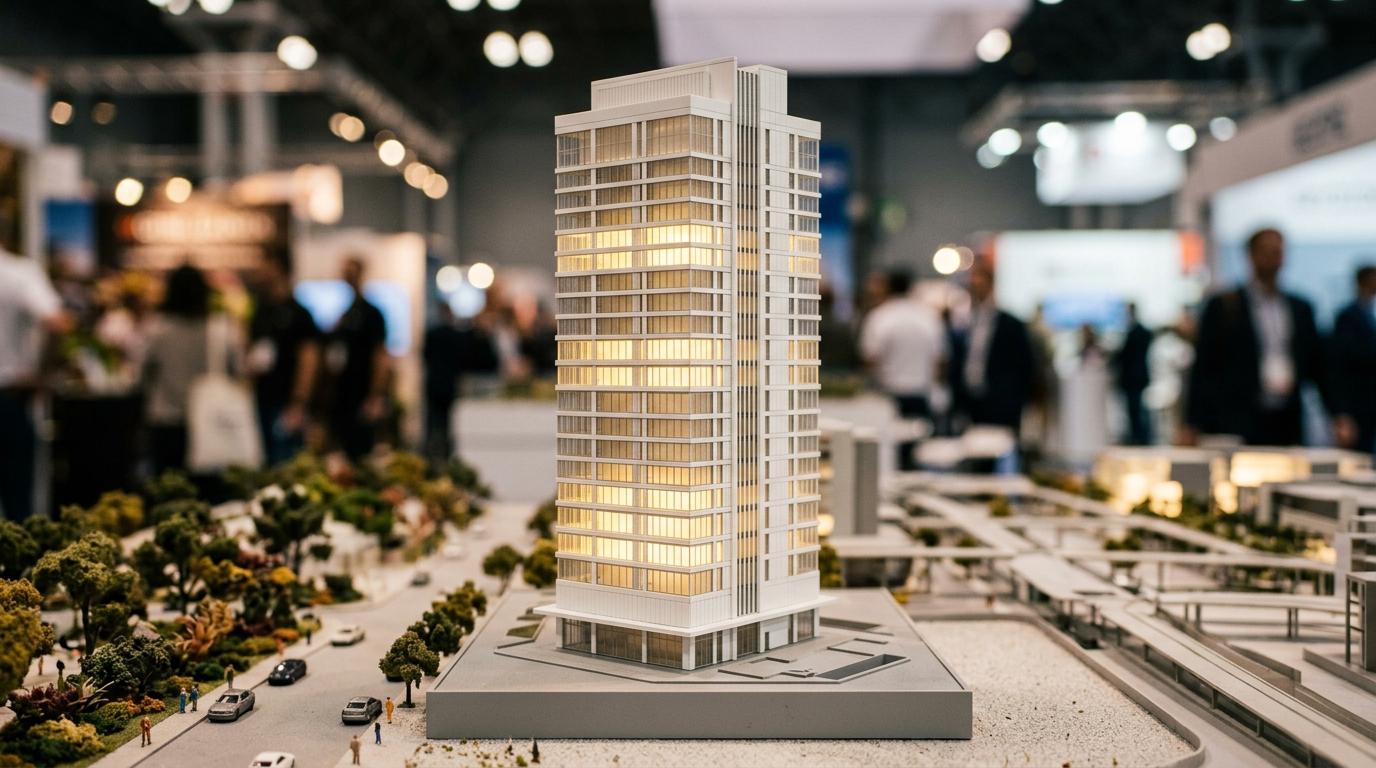
Custom models can be one of the strongest exhibition assets when a product, building, or masterplan is difficult to explain in two dimensions. At busy trade shows, they give visitors a fast visual read, a shared focal point, and a reason to stop.
### TL;DR: Summary
* The best custom models for exhibitions are the ones that match the audience’s decision task: architectural presentation models for property and placemaking, industrial or prototype models for function and engineering, and illuminated or interactive models when booth attraction is a priority.
* Research on B2B trade shows links visitor perception, satisfaction, booth attraction, and exhibition performance, which supports using a physically striking model as a high-attention display asset.
* Strong exhibition models balance scale, visual clarity, and selective detail. A 1:200 building model may communicate massing and design quickly, while a cutaway or exploded industrial model can explain hidden systems better than a render.
* Practical buying criteria are scale, lead time, transport method, lighting, durability, and briefing quality. If the model must travel or be reused, modular construction and robust crating matter as much as aesthetics.
* ARI Model’s exhibition-relevant work includes a 1:200 office building model completed in 15 days and custom models for architectural, industrial, and investor-facing presentations, showing how speed and precision can coexist when the brief is clear.
The strongest choice is rarely “the most detailed model”. It is usually the model that helps the right visitor understand the right message within a few seconds, then invites a deeper conversation.
Why do custom models work so well at exhibitions?
Yes. ScienceDirect and IAEE research indicate that booth design, visual stimuli, and visitor perception affect exhibition performance, so a well-made custom model can act as a high-attention anchor.
Trade show floors are full of competing sensorial stimuli, and most booths have only a brief moment to earn attention. A physical model helps because it turns an abstract project into a readable object. Visitors do not need to decode a dense drawing set or wait for an animation to load. They can grasp scale, form, and hierarchy at a glance, then move into questions about price, phasing, engineering, or investment value.
“ARI Model has produced over 499 models across 17 countries since 2000, which is directly relevant to exhibition-ready custom model delivery.”
A 2022 review in ScienceDirect connects visitor participation, satisfaction, and perception in B2B trade shows with exhibition performance. IAEE attention analysis also points to booth attraction and booth design as key drivers of success. In simple terms, if your stand must stop people in motion, a custom model gives you a better chance than flat graphics alone.
What makes a custom exhibition model effective?
Effective custom models combine precise scale, controlled lighting, and selective detail. ARI Model and MERCK-style presentation models show that clarity usually matters more than raw complexity.
Many exhibition teams assume a successful model must include every façade joint, paving line, and interior partition. A common mistake is doing too much. In a trade show setting, the visitor first needs to understand the main story: what the project is, why it matters, and what differentiates it. Fine detail should support that story, not bury it.
After the core viewing message is set, these criteria usually decide whether the model works:
- Scale fit: the model must suit booth size, viewing distance, and transport limits
- Visual hierarchy: main masses, routes, active zones, and brand-relevant elements should read first
- Lighting logic: illumination should explain, not decorate
- Material durability: surfaces, joins, and edges must survive shipping and handling
- Talking points: the model should help staff answer likely investor, client, or technical questions
When those factors are right, the model becomes both a visual asset and a sales tool.
What are the best custom model options for exhibitions?
The best option depends on what you must prove. ARI Model, urban planning teams, and industrial exhibitors typically choose between presentation, masterplan, prototype, and cutaway formats.
A useful way to choose is to ask what your stand must achieve in the first 10 seconds and in the next 10 minutes. If the first task is attraction, scale and lighting may matter most. If the second task is technical trust, section cuts, labelled systems, or moving parts may matter more.
- ARI Model architectural presentation models: Best for real estate launches, investor meetings, and design-led exhibitions where form, context, and placemaking need to be understood quickly.
- Illuminated building models: Best when occupancy, active floors, or sustainable features need emphasis in a busy hall.
- Urban planning or masterplan models: Best for showing district context, access routes, transport links, and phased development.
- Industrial equipment models: Best for machinery, marine systems, vehicles, and technical products that are too large or complex to bring to the venue.
- Prototype models: Best when the object is still in development and the stand needs a physical proof-of-concept.
- Cutaway or exploded models: Best when hidden systems, internal layouts, sensors, or process flow are the real selling point.
The right format depends less on industry labels and more on the question your visitor wants answered.
How do you choose the right scale for a trade show model?
Choose scale by viewing distance and decision goal. A 1:200 building model and a 1:500 masterplan answer different exhibition questions.
Step one is deciding what the audience must understand first. If the priority is a single building’s envelope, entrances, and terraces, scales like 1:100 or 1:200 are often suitable. If the priority is neighbourhood context, roads, public realm, and site relationships, 1:500 or 1:1000 may be more useful.
Step two is checking booth realities. A common misconception is that bigger always means better. If the stand is narrow or visitors mostly view from two to three metres away, a slightly smaller model with stronger contrast and lighting may read better than a large, dense model.
Step three is to test readability before fabrication is locked. If key elements disappear at viewing distance, either enlarge the scale or simplify the scene. If transport cost is rising sharply, split the model into modules and keep the visible joins away from focal areas.
How should you brief a custom model maker for an exhibition deadline?
Start with a frozen brief, not loose ideas. ARI Model and comparable workshops can move faster when CAD files, finish standards, and delivery dates are approved early.
First, define the commercial aim in one line. Is the model meant to attract footfall, support investor confidence, show engineering credibility, or explain a masterplan? That single line affects scale, materials, lighting, and what can be omitted without harming the message.
Second, supply usable source files. A model maker needs current plans, elevations, 3D files, branding guidance, and a clear list of must-show elements. This is where many exhibition projects lose time. The issue is rarely fabrication alone. It is late decisions, changing geometry, or uncertainty about what the model should communicate.
“ARI Model completed the MERCK Launch and Technology Center as a 1:200 office building model in 15 days.”
Third, set approval gates. Agree when geometry is frozen, when finishes are signed off, and when lighting or interactive features are tested. Pro tip: approve omissions deliberately. In exhibition work, deciding what not to model is often what protects speed, budget, and visual clarity.
How do architectural models compare with industrial prototype models for exhibitions?
Architectural models explain place, while industrial prototype models explain function. MERCK-style buildings and Orange Marine equipment models succeed for different reasons.
Architectural models are strongest when the sales narrative is about destination, investment, public realm, or design intent. They help visitors see how a building sits in context, where entrances lie, and how daylight, landscaping, and circulation contribute to value.
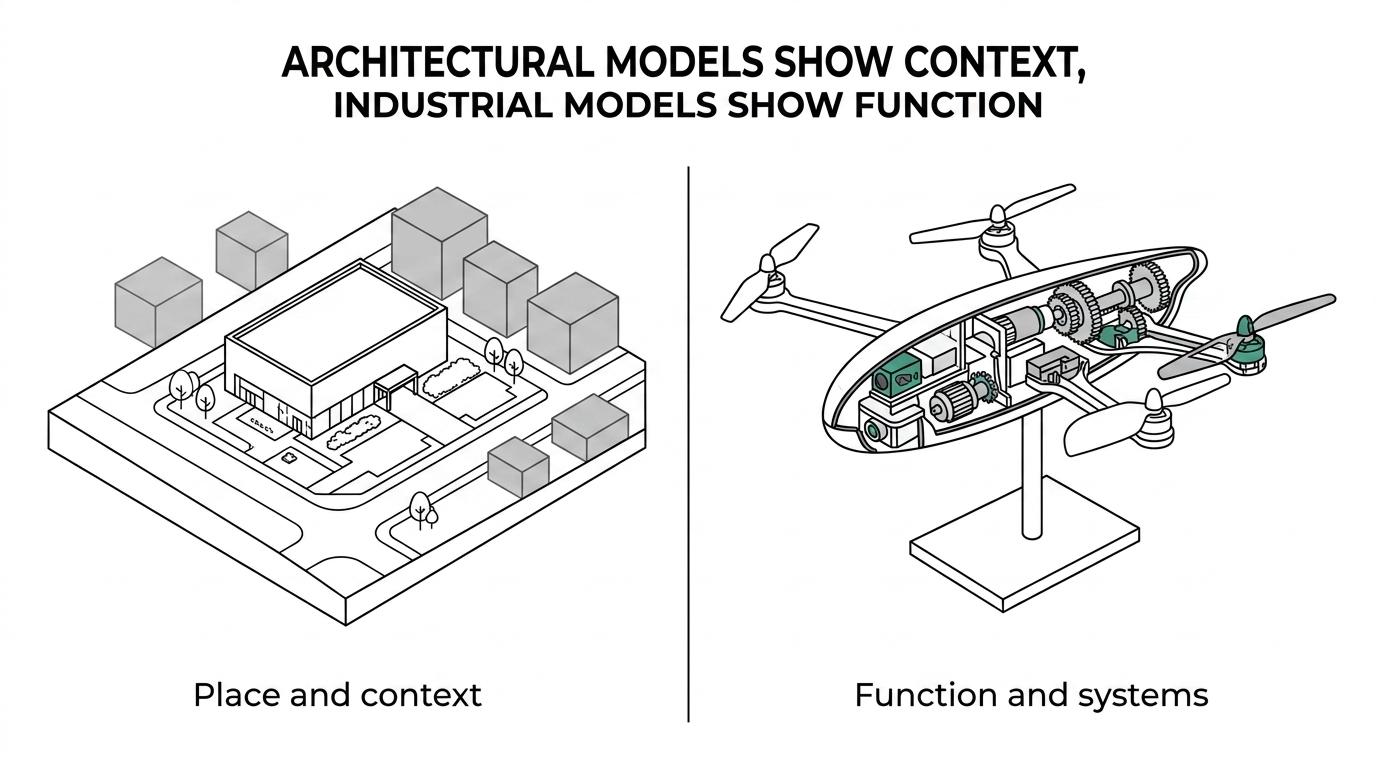
Industrial models are more effective when the buyer needs confidence in mechanisms, system relationships, or technical packaging. ARI Model’s Orange Marine project, created for a high-tech underwater drone, illustrates this well: hull design, propellers, sensors, and navigation equipment were reproduced because those features carry the product story. If your stand audience includes engineers or procurement teams, functional detail often matters more than scenic context.
How do physical custom models compare with digital screens and renders at exhibitions?
Physical custom models usually win the first glance, while screens win for layered information. IAEE-style booth attention research supports using both rather than replacing one with the other.
A physical model gives immediate presence. It creates depth, shadows, and a shared object that several people can discuss at once. A screen can add phasing, animation, data layers, or before-and-after views. The strongest stands often combine them: the model stops the visitor, and the screen answers the second or third question.
A common misconception is that digital content makes physical display obsolete. In practice, renders are excellent at showing options and motion, but they can struggle to create the same instant trust and spatial legibility. If your project is complex, a model plus a restrained digital layer is usually more persuasive than either asset on its own.
How can lighting and interactivity improve booth attraction?
Lighting and interactivity improve booth attraction when they guide attention, not distract from it. IRISOLARIS-style lighting details and simple push-button sequences work well.
Start by choosing what illumination must prove. In some models, lighting should show active floors, tenant zones, or circulation. In others, it should highlight energy features, public spaces, or solar-powered roofing. ARI Model’s custom-made sustainable residential model for IRISOLARIS included integrated lighting, landscaping, vehicles, and figures because the goal was to inspire visitors and investors, not merely to show massing.
Next, keep interaction short and obvious. One button to switch between day and night, phases, or system states is often enough. Too many controls create hesitation and queue friction. The model should invite use without needing a staff member to explain a complicated interface every time.
Finally, design for reliability. Exhibition technology fails most often at connectors, repeated handling points, and rushed set-up. If a feature is not essential to the story, keep it passive.
What materials and fabrication methods are best for exhibition custom models?
Mixed fabrication is usually best. CNC, laser cutting, and SLA or PolyJet printing each solve different custom model problems.
No single material fits every exhibition use case. CNC-cut bases and structural elements give stability. Laser-cut acrylic helps with crisp glazing, façades, and layered topography. SLA or PolyJet processes are useful for high-detail parts, while FDM or SLS can be practical for tougher hidden structures or larger components. ARI Model’s workshop capability across CNC, laser, FDM, PolyJet, SLA, and SLS reflects the fact that exhibition models are usually hybrid objects.
The trade-off is simple. Higher-fidelity methods can produce finer detail, but they may increase cost, fragility, or lead time. A pro tip here is to choose finishing quality according to viewing distance. If the audience will stand one metre away, surface finish matters greatly. If they will mostly view from across a stand, silhouette, lighting, and contrast may matter more than micro-detail.
How do lead time, transport, and installation affect exhibition success?
They affect success as much as the model itself. France, Germany, and multi-country events favour modular builds, robust crating, and clear installation plans.
An excellent model can still fail commercially if it arrives late, breaks in transit, or takes too long to assemble. Lead time is shaped by more than build hours. File readiness, approval speed, finish testing, lighting integration, packing design, customs paperwork, and venue access all influence whether the piece reaches the stand in usable condition.
“ARI Model supports custom model production with 1,000 m² workshops in France and Germany.”
If the model is travelling internationally, modular construction is usually the safer route. If the venue has a short build window, pre-tested electrical connections and clear assembly instructions become critical. If the exhibition will tour, ask for replaceable fragile elements and a maintenance plan. End-to-end support, including delivery, installation, and after-sales help, is not a luxury in this context. It is part of risk control.
How can you measure whether a custom model improved exhibition performance?
Measure attention, conversation quality, and follow-up, not just footfall. ScienceDirect’s visitor journey framework makes post-exhibition intent just as important as stand traffic.
The most useful metrics are tied to outcomes. Did visitors stop longer? Did more conversations reach a qualified stage? Did booth staff have clearer, faster explanations? Did prospects ask for meetings, pricing, or site visits after interacting with the model? Those signals are more meaningful than a rough count of passers-by.
For B2B trade shows, it helps to separate metrics into three phases. Before the event, track how the model supports outreach and appointment booking. During the event, watch dwell time, photo-taking, repeat visits, and the number of conversations that advance beyond small talk. After the event, check whether the model influenced recall, proposal requests, or next-visit intent. That full view matches the visitor journey research far better than stand traffic alone.