
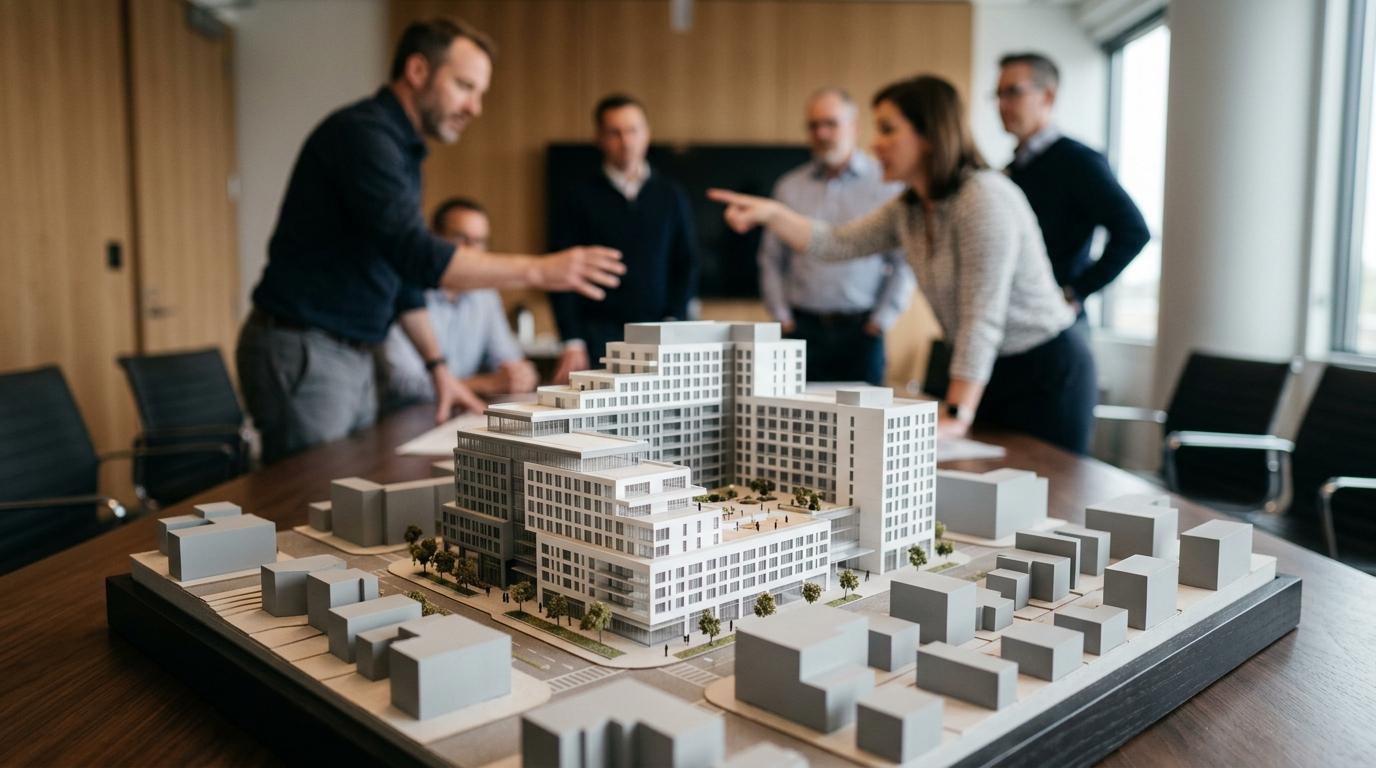
A polished render can be striking. It can show atmosphere, materials, lighting and a carefully framed moment with great efficiency. Yet when a project has to be judged, discussed, questioned and approved, physical models still hold a stronger position than many teams expect.
That is not nostalgia. It is a practical response to how people read space.
A building is not a flat image, and most stakeholders are not trained to translate a sequence of views into a confident mental picture of massing, depth, height and circulation. A physical model turns those abstract questions into something immediate. It places the project in front of everyone at once, in real scale relationships, from every angle, without depending on a chosen camera view.
Physical models create clearer spatial perception
The first advantage is simple: a model is a real object in real space. People can walk around it, crouch slightly to inspect a street edge, compare one volume against another and judge how the scheme sits on the site. Perspective changes naturally as the viewer moves. Parallax is genuine, not simulated.
Research has supported this for years. A study published in Frontiers of Architectural Research found that physical models helped viewers make faster and more accurate comparisons of building heights than virtual models. That point matters because height, massing and relative scale are often the very issues clients, planners and investors care about most in early and mid-stage presentations.
Another strand of research has described architectural models as a form of embodied participation. In plain terms, people think with their bodies as well as their eyes. Moving around an object helps the brain build a more stable sense of form. A screen can approximate that experience, but it still asks the viewer to trust a mediated version of space.
That difference changes meetings.
After looking at a model for only a few moments, viewers can usually do several things with more confidence than they can from still renders alone:
- judge height relationships
- compare setbacks
- read circulation routes
- grasp site context
- spot gaps between intention and appearance
Physical models improve scale judgement better than renders
Renders often look convincing because they are selective. A camera angle can flatter a façade, minimise a bulky service zone or make a courtyard feel larger than it will be. None of that is dishonest by default. It is simply part of image-making. Yet the same selectivity can weaken decision-making when stakeholders need clarity rather than mood.
A physical model is much less dependent on visual persuasion. Scale stays fixed. Relationships remain visible. The viewer is free to test the proposal rather than accept a curated sequence of views.
The contrast is easiest to see side by side:
| Presentation factor | Physical models | Renders |
|---|---|---|
| Scale perception | Stable and shared | Often affected by lens choice, cropping and screen size |
| Viewing angles | Open to all angles | Limited to prepared views unless navigation tools are used |
| Group discussion | Strong focal point for several people at once | Often controlled by one presenter on one screen |
| Trust | Feels concrete and inspectable | Can feel polished, edited or promotional |
| Site context | Easy to compare neighbouring volumes | Depends on how much context is included |
| Emotional effect | Calm, grounded realism | Strong atmosphere and visual drama |
This does not make renders weak. It shows that they serve a different purpose. When the question is, “What will this feel like at sunset?”, a render may lead. When the question is, “How big is this compared with everything around it?”, a physical model usually wins.
Physical models support better stakeholder communication
Physical models are powerful because they are social objects. They create a common focal point that does not belong to one person holding a mouse or changing slides. Teams gather around the same artefact, point to the same junctions and test the same assumptions in real time.
That shared focus can lower friction in complex discussions. Non-specialists do not have to reconstruct three-dimensional relationships from plans, sections and perspective images. They can inspect the scheme directly. The conversation becomes more precise because everyone is speaking about the same visible condition.
For investor briefings, planning reviews and client presentations, this can make a measurable difference in the room. Instead of debating whether an image is representative, people move faster into the substance of the proposal.
In practice, the strongest communication gains often appear in settings like these:
- Investor presentations: a clearer sense of value, scale and site presence
- Planning consultations: easier discussion of massing, access and urban impact
- Sales environments: a more memorable, trustworthy centrepiece for prospects
- Internal design reviews: quicker identification of awkward relationships or missing detail
ARI Model has built much of its work around this communication value. Across architectural and industrial projects, the emphasis is not just on craftsmanship, but on helping clients, stakeholders and exhibition visitors read a project with confidence. That includes accurate scale, careful detailing, lighting integration and, where useful, interactive features that support public presentations.
Why renders still matter but cannot replace physical models
Renders remain essential. They communicate material tone, occupancy, lighting ambience and emotional positioning very well. A marketing campaign without renders would be incomplete. A competition entry without rendered scenes may struggle to set a mood. A developer launching apartments often needs imagery that places the viewer inside the future.
Still, photorealism has limits. Recent research on rendered architectural scenes has shown that realism depends on a set of perceptual cues, and when those cues are slightly wrong, viewers notice. A render can be sharp, glossy and expensive, yet still feel artificial. It may impress without convincing.
That gap is one reason physical models continue to outperform renders in decisive moments. A model does not need to simulate objecthood because it already is an object. It does not need to suggest dimensional truth through shading and perspective because dimensional truth is built into it.
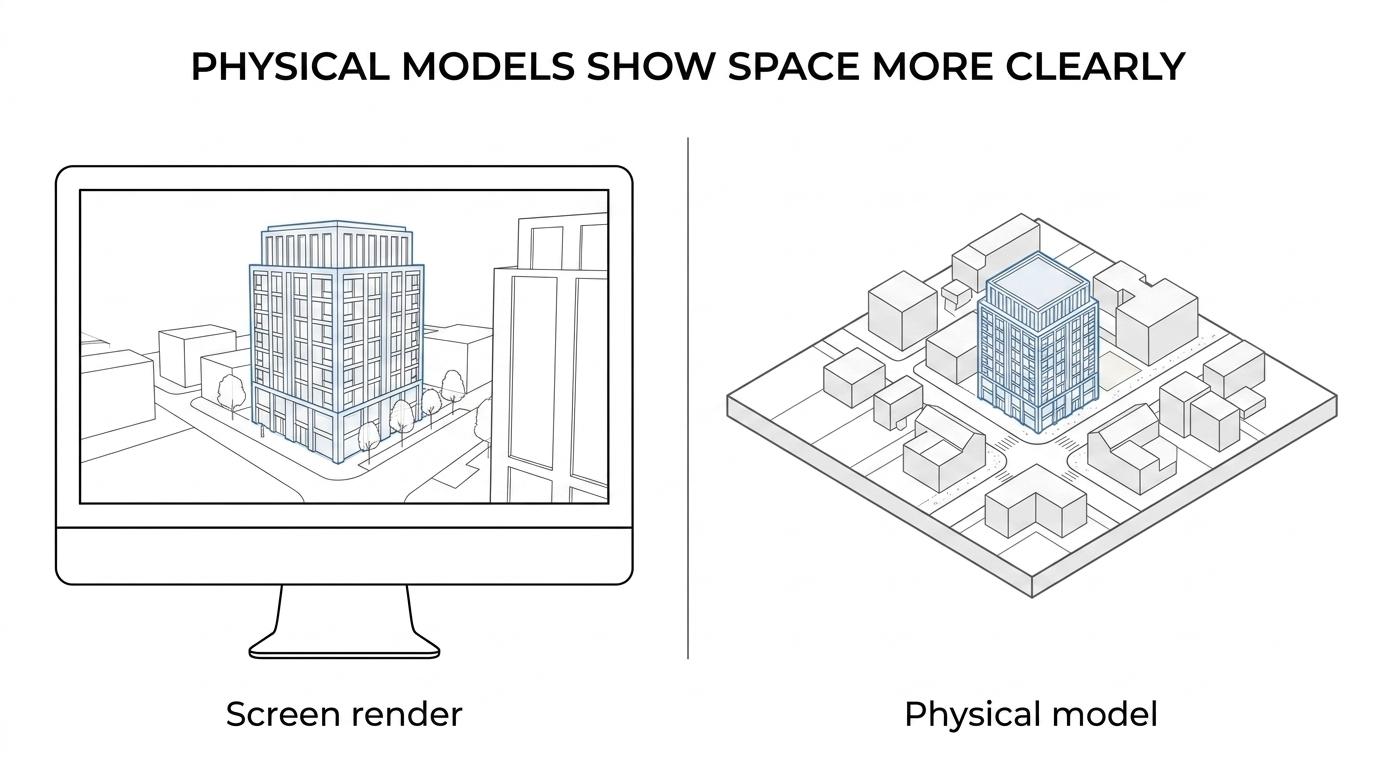
People trust what they can inspect.
There is also a practical issue. Screen-based presentations tend to be linear. Someone controls the narrative. They choose the order, the pace and the view. That can be useful, but it can also hide unresolved parts of the design. A model is less forgiving in the best possible way. It invites honest scrutiny.
Physical models add presence at exhibitions and sales launches
Trade fairs, showrooms and launch events demand more than technical accuracy. They need presence. A physical model draws attention differently from a screen because it occupies the room. Visitors can approach it from a distance, circle it and return to it later. It becomes a landmark within the event itself.
That quality is especially valuable when the project is large, technical or hard to explain through drawings alone. Industrial systems, transport infrastructure, mixed-use masterplans and phased developments all benefit from a format that makes complexity legible at a glance.
ARI Model has used this strength across exhibition and presentation work, where scale models act not only as display pieces but as working communication tools. Lighting, moving elements and robust fabrication can turn a model into a focal point that holds attention longer than a looping screen animation.
This is one reason physical models often support sales activity so effectively. They give prospective buyers and investors a stable reference point. They can see the scheme, its surroundings, access routes and public areas together, rather than piecing them together from multiple brochures and digital views.
Physical models help non-experts read architecture faster
Architects and designers are trained to think spatially. Many clients are not. That is not a weakness in the client. It is simply a difference in professional language. A model narrows that gap.
Rather than asking a stakeholder to translate a plan into volume, and volume into lived experience, the model externalises that mental work. Complex geometry becomes readable. Street relationships become obvious. Tower separation, podium depth, courtyard size and circulation logic become easier to discuss without long explanation.
This is why physical models are often so effective in mixed groups where technical specialists and non-specialists must make decisions together. They reduce ambiguity without reducing sophistication.
A good model does not simplify the project. It makes the project legible.
The strongest presentations combine physical models and renders
Choosing between models and renders is often the wrong question. The best presentations usually combine both, with each medium doing the job it does best.
A render can express atmosphere and aspiration. A model can confirm proportion and physical logic. One sells the experience; the other validates the proposal. Used together, they form a more credible presentation than either one on its own.
That combination is especially effective when teams sequence the media carefully. Start with the model to establish trust, scale and site relationships. Then use renders to show materiality, interior character and lived scenes. The audience receives the vision, but on top of a structure they already believe.
When presentation teams plan that sequence well, several benefits tend to follow:
- Physical models establish spatial credibility early.
- Renders add emotional texture without carrying the whole burden of proof.
- Stakeholders leave with a stronger memory of both the concept and the practical reality.
When physical models are the better choice for a project
There are moments when a physical model is not merely helpful but strategically smart. Large urban schemes, planning submissions, investor roadshows, museum displays, industrial demonstrations and premium sales suites all gain from a format that makes space legible and tangible.
The case becomes even stronger when the project includes one or more of these conditions:
- multiple buildings on one site
- sensitive height relationships
- complex circulation
- public scrutiny
- exhibition use
A model is also the right choice when trust matters as much as style. If the audience is likely to question scale, context or operational logic, a physical object answers those concerns more directly than a polished image can.
For teams looking for that level of clarity, ARI Model represents what modern model-making can be: precise, technically advanced and ready for real commercial use, from design development through delivery and installation. In that setting, the physical model is not a charming extra. It is a serious presentation instrument that helps good projects speak with authority.