
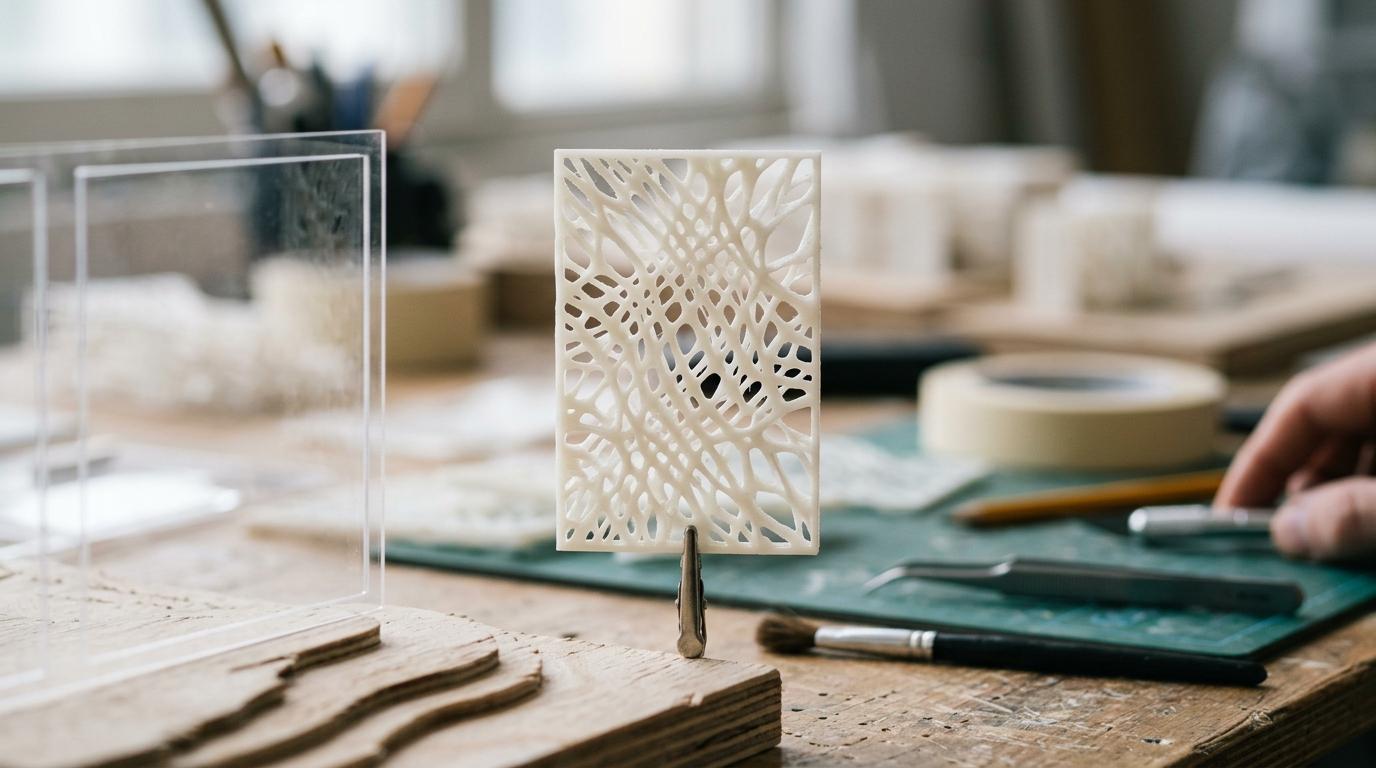
Physical models still change the quality of a design conversation. A building that exists only on screen can feel abstract, even to experienced decision-makers. Put that same scheme on a table, in scale, with its streets, context and massing made visible, and the discussion becomes sharper straight away.
That is why the question is no longer whether physical models matter. It is which kind of model best serves the brief: a traditionally fabricated architectural model, a 3D printed model, or a combination of both.
What an architectural model means today
A traditional architectural model is usually built through a mix of manual craft and precision workshop methods. That can include laser cutting, CNC milling, hand assembly, sanding, painting, lighting integration and careful finishing in materials like wood, acrylic, foam, cardboard or resin components. The result can be highly refined, tactile and visually rich.
A 3D printed model begins with digital geometry. A CAD or BIM file is prepared, split into printable parts, and produced layer by layer using technologies such as SLA, FDM or SLS. The printed elements are then cleaned, assembled and often painted or coated. In many professional studios, printing is not a replacement for craftsmanship. It is one fabrication method within a wider production process.
That distinction matters.
When people compare architectural models with 3D printed models, they often speak as if one is analogue and the other is digital. In practice, both belong to the same professional family of presentation and prototype tools. The real difference lies in how they are made, how fast they can change, how they look up close, and what they communicate best.
Materials, precision, lead times and cost
The clearest differences appear when the project is measured against practical criteria.
| Criterion | Traditional architectural model | 3D printed model |
|---|---|---|
| Production method | Cut, milled, assembled and finished by hand and machine | Built from digital files, layer by layer |
| Common materials | Wood, MDF, acrylic, foamboard, card, metal details | PLA, ABS, resin, nylon powder, specialist print materials |
| Detail level | Strong on clean planes and mixed materials | Strong on intricate geometry and repeatable fine detail |
| Surface quality | Excellent for large flat surfaces and premium finishes | Excellent with high-end resin printing, though some prints need post-finishing |
| Revisions | Slower once assembly has started | Faster when design files are updated |
| Lead time | Often longer for complex work | Often shorter, especially for iterative design stages |
| Cost profile | Labour-heavy, especially for detailed models | Often more efficient for complex or repeated parts |
| Best fit | Sales suites, prestige displays, material-rich presentations | Rapid prototyping, planning models, complex façades, repeated iterations |
This table gives a useful first filter, but not the whole answer. A low-rise residential scheme with a clean urban context may benefit from laser-cut acrylic, timber veneer and soft lighting. A parametric façade or a highly articulated industrial component may point strongly towards 3D printing.
Scale matters too. Large masterplans and city models can be made through either route, though print volume limits mean very large 3D printed models are often split into modular sections. Traditional fabrication has fewer constraints on broad format pieces, especially where terrain, roads and context blocks are built in layers.
Where 3D printed models excel
The strongest case for a 3D printed model is precision tied to speed. Because the geometry comes directly from the digital source, the physical result can follow the design with exceptional accuracy. That is especially valuable when façade depth, curved surfaces, perforation patterns or structural rhythm matter to the discussion.
3D printing also reduces the friction around revision cycles. If the architect updates the roof profile, adjusts a core, changes balcony spacing or reshapes a public plaza, the model can often be revised by reprinting selected components instead of rebuilding large sections from scratch. For design teams moving quickly, that is a major advantage.
Complexity is where the method becomes especially persuasive. Organic forms, lattice structures, double curves and dense façade articulation can be difficult and time-consuming to fabricate by hand. A well-prepared print file makes those elements far more practical.
After considering the brief, many teams choose 3D printing when these priorities are at the top of the list:
- Precision: direct translation from CAD or BIM into physical form
- Iteration speed: revised parts can be reprinted quickly
- Complex geometry: curved, perforated or highly detailed forms are easier to produce
- Repeatability: identical copies can be made for multiple stakeholders or venues
There is also a clear commercial logic. For many schemes, especially those with complex geometry, a 3D printed model can reduce labour time and shorten delivery programmes. That efficiency becomes even more valuable when the model is needed for planning meetings, investor presentations or exhibition deadlines.
Where traditional architectural models still lead
Traditional fabrication remains deeply relevant because not every project is won on geometric complexity. Many are won on atmosphere, finish and physical presence. A handcrafted model in timber, acrylic and carefully painted components can feel calmer, warmer and more prestigious than a purely printed piece.
Large flat surfaces are another strength. A crisp acrylic façade, a polished plinth, a clean landscaped base or a beautifully finished timber surround often looks more convincing than an equivalent surface that has been printed and heavily post-processed. The quality is immediate. People read it at a glance.
Material richness also matters in sales environments.
A model built with mixed media can suggest glazing, stone, timber, metal and landscape through material choice rather than paint alone. That gives it a tactile credibility which is difficult to match with one-material printing. This is one reason premium presentation models for real estate marketing still rely heavily on workshop craft, even when digital fabrication supports part of the process.
Traditional methods are especially valued for:
- Real wood and veneer
- Clear acrylic glazing
- Broad, smooth planes
- Premium tactile presence
There is another point that deserves attention. Hand finishing is not just cosmetic. It shapes how light behaves across the model, how edges feel, and how durable the display remains over time. In sales galleries, museums and long-term exhibitions, that refinement can carry more weight than raw production speed.
Why hybrid model making often delivers the best result
The most effective comparison is not traditional versus 3D printed as if they were rivals. In high-level model making, they are often partners.
A hybrid model can use 3D printing for the pieces that benefit from digital accuracy, then combine those elements with laser-cut acrylic, CNC-milled terrain, timber bases, lighting systems and hand-applied finishes. This approach keeps the strengths of each method in play without forcing a compromise.
A façade screen may be printed in high-resolution resin. The site base may be machined from layered material for crisp topography. Glazing may be made from clear acrylic. Public realm textures may be painted by hand. Trees, lighting, removable roof sections and branded display housings can then be added as needed.
Studios with advanced workshop capability increasingly work this way. The most reliable results often come from teams that can switch between CNC, laser cutting, FDM, SLA, SLS and fine hand assembly depending on the brief rather than relying on a single process for everything. That flexibility is especially useful for architects, developers and industrial clients who need the model to do more than look attractive. It may also need to travel, illuminate, separate into modules, or survive repeated use at trade fairs.
Hybrid thinking is also good risk management. If one part needs reprinting late in the programme, it can be replaced without remaking the whole model. If the client wants a warmer display finish, traditional materials can take the lead in the final presentation layer.
How model choice changes by project type
The right answer often becomes clearer when the model is tied to its job rather than its fabrication method.
Planning and public consultation models usually need clarity first. Massing, context, rights of way, neighbouring buildings and topography must be legible from a distance. Here, 3D printed building volumes paired with a clean site base can be highly effective. The finish does not need to be luxurious if the model communicates policy and urban impact well.
Sales and marketing models usually demand more theatre. Lighting, removable sections, polished surfaces, landscaped context and a refined plinth can all help. Traditional materials often perform strongly here, with 3D printing supporting detailed components behind the scenes.
Industrial and product presentation models create a different set of demands. Complex plant layouts, machinery, pipe networks or prototype forms may favour 3D printing because dimensional fidelity matters. Yet the final display may still call for hand finishing, branding and robust mounting.
That is why a project brief should ask a few direct questions before a fabrication route is chosen:
- Planning review: is the priority urban context, compliance discussion and legibility?
- Sales suite: is the priority finish quality, lighting and emotional impact?
- Trade fair display: is the priority durability, transport and fast installation?
- Design development: is the priority rapid revision and close geometric fidelity?
Once those answers are clear, the best production route usually becomes obvious.
Choosing the right 3D printed model or architectural model for your brief
A strong brief should define scale, audience, deadline, transport conditions and the level of finish expected. Without that, any comparison between traditional and 3D printed production stays too abstract to be useful.
If the audience is a planning committee, clarity and context may matter more than material realism. If the audience is a property investor or buyer, finish quality and lighting may carry more weight. If the model will be revised three times before sign-off, the value of a 3D printed workflow rises sharply. If it needs to sit in a showroom for months and act as a centrepiece, traditional fabrication and premium finishing deserve serious attention.
One practical rule holds up well: choose the process that supports the message, not the process that happens to be fashionable.
In many cases, that message is strongest when digital accuracy and workshop craftsmanship are used together.