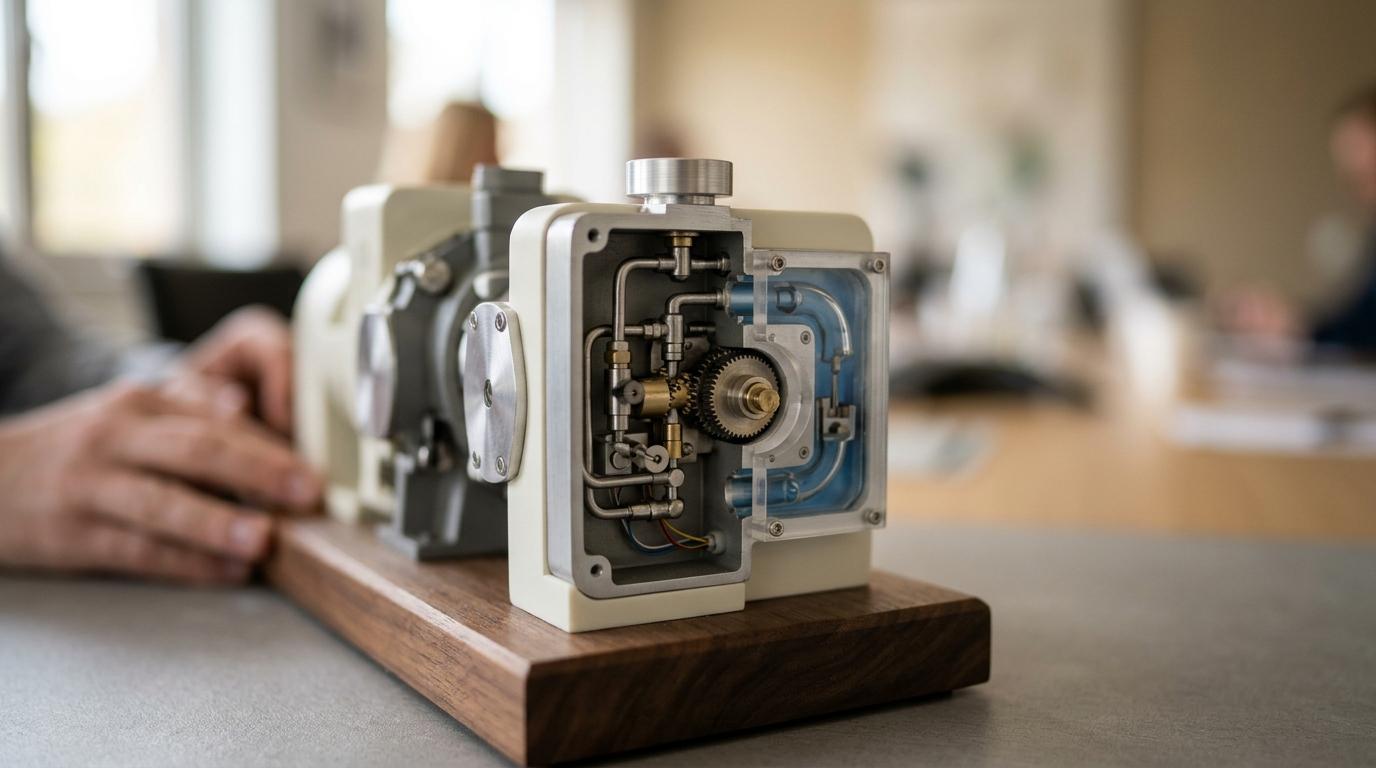
When a technical sales meeting depends on getting a complex product understood quickly, a physical model can change the quality of the conversation. ARI Model designs and manufactures product models that help buyers, engineers, project stakeholders and non-technical decision-makers see the product’s form, function and key details in front of them.
Since 2000, ARI Model has produced more than 499 models across 17 countries, supported by workshops in France and Germany. We create presentation and prototype models for industrial companies, engineering firms, product teams and exhibition organisers who need technical information to land clearly in client meetings, tenders, demonstrations and launch events.
Product models for technical sales meetings that make complex systems easier to explain
ARI Model builds physical product models for situations where a brochure, CAD view or slide deck leaves too much open to interpretation. If your product includes internal mechanisms, process flow, component relationships or installation logic, a model gives people something concrete to inspect, point at and discuss.
Our work covers presentation models, industrial demonstrations, cutaway sections, illuminated details and interactive displays. ARI Model uses these formats to help you explain technical systems, manufacturing processes, energy projects and product demonstrations in a way that is easier to follow during live sales conversations.
“Since 2000, ARI Model has produced 499+ models in 17 countries for presentation, prototype and technical communication needs.”
In practice, that means fewer moments where your team has to rely on verbal explanations alone. A physical model helps you guide the meeting around the points that matter most, whether that is access for maintenance, process sequence, footprint, assembly logic or the relationship between internal and external parts.
ARI Model helps industrial teams, engineers and product marketers communicate with mixed audiences
Technical sales meetings rarely involve one type of stakeholder. You may be speaking to engineers who want precision, procurement teams who want clarity, and commercial decision-makers who need to understand the product quickly enough to move the discussion forward.
ARI Model supports architects, real estate and urban development teams, industrial companies, construction and engineering firms, product and marketing teams, and event organisers across Europe and worldwide. For these clients, our models are used for sales, marketing, training, exhibitions and technical presentations, so the same core asset can support more than one stage of communication.
“ARI Model works from 1,000 m² of workshop space in France and Germany, giving clients dedicated production capacity for detailed physical models.”
That matters when your product has to be explained to both technical and non-technical audiences at the same time. Research on prototypes shows that physical models improve comprehension and reduce misunderstandings, and ARI Model applies that advantage directly to sales presentations where clear understanding affects buying confidence.
Product model options for demonstrations, tenders and presentation-led selling
ARI Model tailors each product model to the way you need to use it in the meeting room, at the exhibition stand or during a stakeholder review. The right format depends on what you need people to understand, how much detail the discussion requires and how the model will be transported and displayed.
Typical product model deliverables include:
- Presentation models: Exterior form, proportions and key design features for client meetings, launches and demonstrations.
- Cutaway sections: Open views that reveal internal systems, flow paths, assemblies or technical functions that are difficult to explain verbally.
- Illuminated models: Lighting used to highlight specific zones, circuits, movement paths or operating sequences during presentations.
- Interactive displays: Physical models combined with interactive features to guide audiences through processes, components or product logic.
ARI Model also produces highly detailed technical work when the sales context demands it. One published example is a 1/20 scale industrial model created to bring a client’s complex technology to life for global communication, which is exactly the kind of outcome many technical sales teams need when the product itself is too large, too complex or too inaccessible to present directly.
Sometimes the most useful sales model is not the most elaborate one. If you are still collecting stakeholder input or preparing for requirements discussions, we can help define a model scope that communicates the essential mechanism or product idea without adding unnecessary complexity to the brief.
ARI Model’s nine-step production process reduces risk before important client meetings
A technical sales model has to do more than look impressive. It needs to arrive on time for the meeting, represent the product accurately and hold up under repeated handling, transport and presentation use.
ARI Model follows a nine-step production process that starts with evaluating your needs and continues through design, manufacturing, assembly, quality control, delivery, installation and after-sales support. That structure helps you keep the project clear from the first brief, especially when the model is part of a wider launch, exhibition or investor presentation.
“ARI Model’s 9-step process covers the full path from customer need evaluation to delivery, installation and after-sales support.”
Our workshops in France and Germany are equipped for CNC machining, laser cutting and multiple 3D printing methods including FDM, PolyJet, SLA and SLS. ARI Model combines these tools with manual finishing, detailing, lighting and assembly work so that you can match the model to the level of technical explanation your audience needs.
For you, the benefit is straightforward: fewer handovers between suppliers, fewer avoidable errors in translation from concept to object, and a clearer route from brief to finished presentation model. If your project includes shipping, installation or post-event support, ARI Model can manage those parts as well.
Why ARI Model product models work well in technical sales conversations
In technical selling, the challenge is often not lack of product value. It is lack of shared understanding in the room. When people cannot easily picture a system, they ask fewer useful questions, give weaker feedback and delay decisions.
ARI Model addresses that problem by turning product information into something tangible. A physical model helps your audience understand spatial relationships, operating logic and component positioning far faster than a spoken explanation alone, especially when the real product is large, internal, not yet manufactured or difficult to transport.
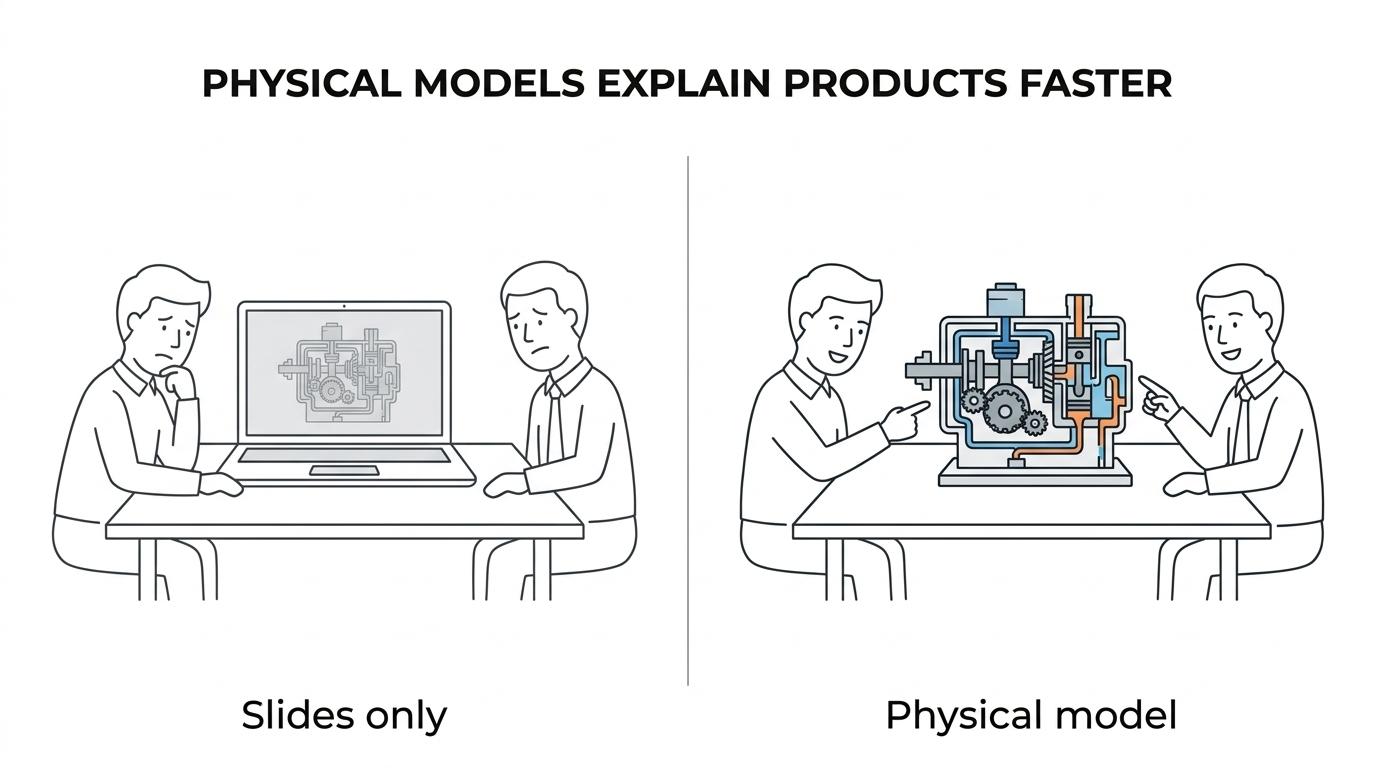
This also improves the quality of stakeholder feedback. When buyers, engineers or project teams can inspect the model together, they can react to specifics rather than assumptions. That makes technical objections easier to surface early and gives your sales team a stronger basis for the next step in the conversation.
When ARI Model is the right fit for your product model project
ARI Model is a strong fit when your sales success depends on helping people understand a product rather than just hear about it. That is often the case if you are preparing for one of the following situations:
- A technical sales meeting with multiple decision-makers
- A tender or pitch where complex systems need to be explained quickly
- A product launch, trade show or exhibition where you need a physical focal point
- A stakeholder review where form, function or internal detail needs discussion
ARI Model is also a practical choice when you need one partner to handle the full route from concept through fabrication, delivery, installation and support. That matters when your internal team does not have time to coordinate separate designers, model makers, transport arrangements and event setup.
If budget, timing or scope are part of your decision, we address those issues early. The brief can be shaped around the level of detail, scale, finish, lighting, interactivity and transport needs that actually support your meeting objective, so you invest in the model that fits the sales task rather than paying for features you do not need.
If you want your next technical sales meeting to be clearer, more persuasive and easier for stakeholders to follow, speak with ARI Model about your product model project. We can help you define the right model format, the right level of detail and the right production path for the way you sell.


