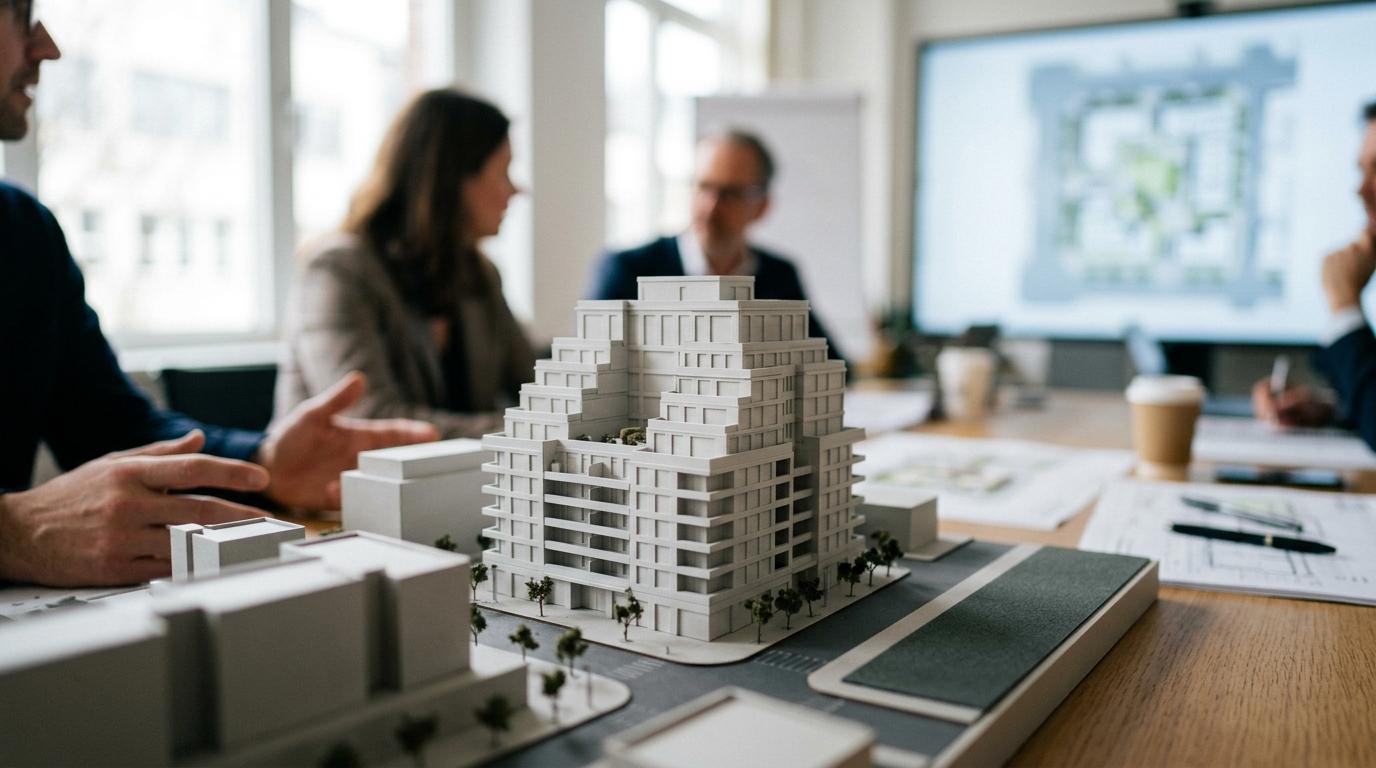
A client review can fail even when the design itself is strong.
The problem is rarely the quality of the scheme. More often, it is the gap between professional design language and what a client can actually grasp in a meeting. Plans, sections, renderings, fly-throughs, and technical packs all have their place, yet they do not always make a project feel tangible. A physical model does.
That is why the physical model still matters so much in client-facing reviews. It gives people a shared object to look at, point to, compare, and question. For non-specialist stakeholders, that shift is often the moment when a project becomes clear enough for useful feedback, rather than polite agreement.
Why a physical model improves communication in client reviews
A physical model reduces abstraction. Instead of asking a client to translate drawings into three-dimensional space in their head, it puts massing, scale, setbacks, circulation, and neighbouring context directly in front of them. The conversation becomes less theoretical and more grounded.
This matters in mixed meetings. Architects, planners, developers, investors, marketing teams, and end users do not read design material in the same way. A model creates a common visual language, which helps the room move faster towards the real issues: how the building sits on the site, where access feels awkward, whether public areas feel generous, or if one element dominates more than expected.
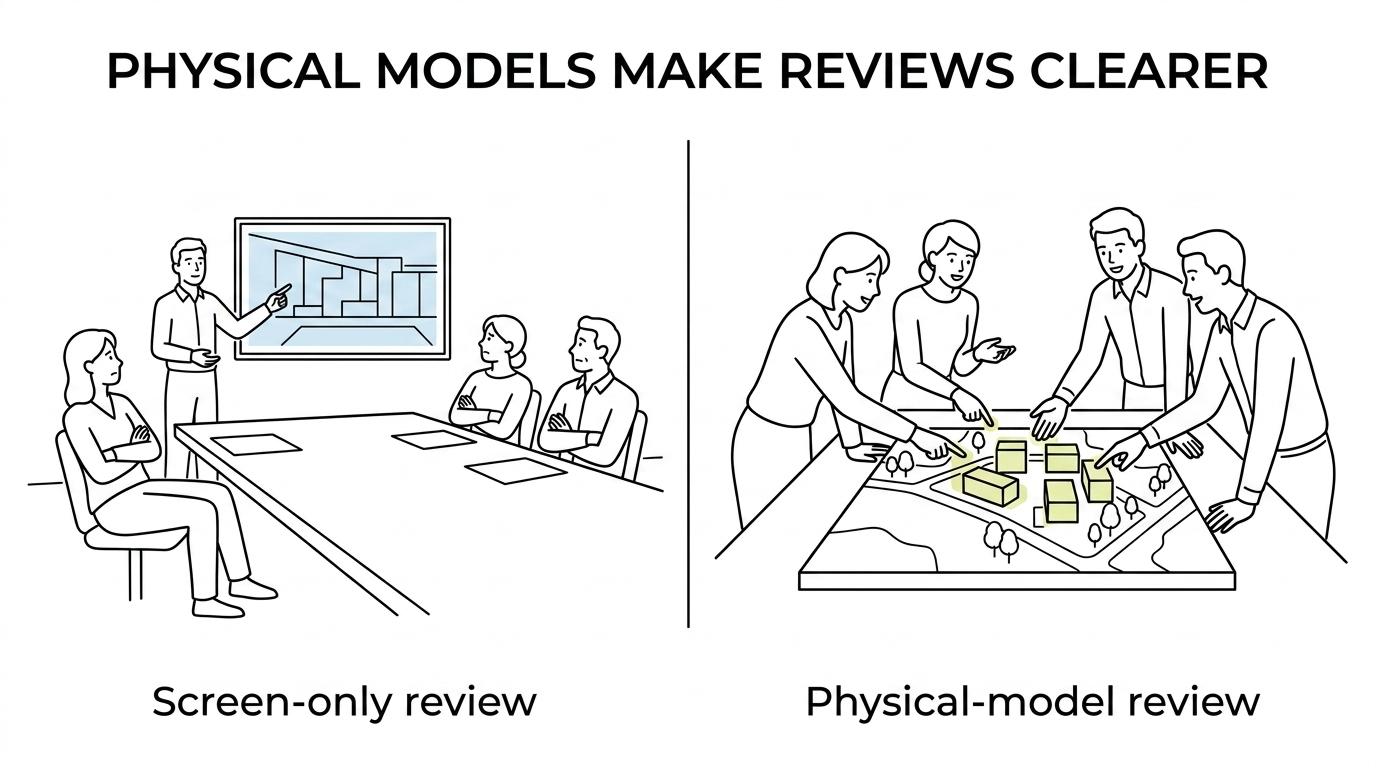
A model also changes behaviour. People gather around it. They lean in. They ask sharper questions. They compare one side to another. Instead of discussing a project through a screen, they discuss it through an object that can be seen from every angle.
After that first shift in communication, physical models are especially useful in reviews that involve:
- early concept sign-off
- investor presentations
- planning and consultation meetings
- sales suite discussions
- design coordination with non-technical stakeholders
Physical models and spatial comprehension for non-specialist stakeholders
There is solid academic support for this practical reality. A 2014 dissertation held by Texas A\&M University Libraries reported that, for people not professionally trained in architecture, a three-dimensional model is among the most effective communication media. Its quantitative findings also showed that laypeople who studied physical models performed significantly better than those using digital models on a spatial-layout task.
That finding is useful because it goes beyond preference. It suggests that physical models do not simply look reassuring in meetings. They can help people retain and interpret spatial information more accurately. In client reviews, that can mean fewer mistaken assumptions, fewer late-stage surprises, and a clearer basis for decision-making.
A screen can be persuasive. A model can be legible.
| Review need | What a physical model does well | Likely result in the meeting |
|---|---|---|
| Reading overall massing | Shows volume and proportion at a glance | Faster agreement on the main form |
| Grasping site context | Places the proposal against streets, neighbours, landscape | Better discussion of impact and fit |
| Assessing visibility and access | Makes routes, entries, and arrival points easier to read | More precise comments from clients |
| Comparing options | Lets viewers move physically around alternatives | Stronger preference based on real spatial cues |
| Building trust | Feels concrete and testable, not purely promotional | More confident informed decisions |
Where a physical model adds value at different client review stages
The value of a physical model is not fixed. It changes with the stage of the project and with the people in the room. In early design, the model often helps people comment on what matters most: scale, orientation, and site relationships. During design development, it becomes a tool for checking proportion, public realm, façade rhythm, and the balance between different blocks or programme areas.
Later, its purpose can shift again. A refined presentation model may support marketing, board review, public consultation, or exhibition display. ARI Model describes architectural presentation models as assets for client meetings and as a way to gather critical client feedback before construction begins. That is a strong summary of where the object earns its place: not only in showing the project, but in helping shape it before expensive decisions are locked in.
The most valuable review moments tend to look like this:
- Early concept review: clients can react to the core idea without being buried in technical material.
- Design development review: stakeholders can test whether the proposal still works once detail and constraints enter the picture.
- Mixed-audience presentation: non-specialists gain a clear read of the scheme while technical teams keep the discussion focused.
- Pre-construction sign-off: final comments surface earlier, when changes are still manageable.
- Sales and marketing review: teams can assess how the project story will be received by buyers, tenants, or visitors.
How a physical model supports better client feedback
Better feedback is usually more specific, not just more positive.
When clients look at a physical model, they tend to comment in direct spatial terms. They point to a corner that feels too tight. They notice that a courtyard appears smaller than expected. They ask whether an entrance could be more visible from the main road. They compare a tower height against surrounding volumes without needing to decode a plan key or camera angle. That kind of reaction is useful because it can be acted on.
The physicality of the model also supports group discussion. In a digital presentation, attention is often controlled by the presenter. With a model, people can set their own viewpoint. Different stakeholders can inspect different parts almost at once. That makes meetings more interactive and often more honest. A client who might stay quiet during a slide deck is more likely to speak when they can point to a place on the model and ask, “What happens here?”
There is another advantage that matters commercially. Early feedback is usually cheaper feedback. If a model helps a client spot a concern before construction information is fixed, the team gains time to respond while options are still open. That is one reason physical presentation models remain relevant even in highly digital workflows.
Physical models versus digital views in review meetings
This is not a debate where one tool must replace the other. Digital and physical formats work best when each is used for the tasks it handles most clearly.
That complementarity is also reflected in Brixval’s review of 3D visualisation, which argues that digital views are most useful when they clarify specific decisions rather than trying to replace a fuller reading of the project.
Digital views are excellent for quick revisions, animated sequences, internal coordination, and detailed zoom-ins. A physical model is stronger when the room needs shared spatial clarity, collective discussion, and confidence in the overall proposal. The strongest review process often uses both, moving from the model to supporting drawings or rendered views as questions become more specific.
That balance can look very practical in a meeting:
- Start with the physical model to establish form, context, and orientation.
- Move to digital material to answer detail-level questions.
- Return to the model to confirm that changes still make sense in the whole composition.
Used together, these tools reduce the risk that the meeting drifts into abstract debate or gets stuck on isolated details.
How ARI Model approaches client-facing physical model reviews
For firms and developers that rely on presentations to win approval, secure investment, or collect client input, the quality of the model matters as much as the idea behind it. Accuracy, material contrast, scale, setbacks, lighting, and site context all affect how well the model communicates. A poorly judged model can oversimplify the scheme or direct attention to the wrong features.
ARI Model positions its presentation work around that practical need. Its architectural and industrial model making is described as lifelike portrayals built to support informed decisions, with a pragmatic approach focused on the best result. The company also notes that these models are used in developer pitch meetings to gather critical client feedback before construction starts. That emphasis is useful because it treats the model as a decision tool, not just a display piece.
With dedicated workshops in France and Germany, dedicated workshops in France and Germany, and experience across architectural and industrial model making, ARI Model is set up for projects where presentation quality and delivery reliability both matter. For review settings, that matters more than it may seem. A model is often needed by a fixed date, for a fixed audience, with very little room for delay.
Choosing the right physical model for the review objective
Not every client review needs the same model. A planning discussion may need a broader urban context model. A developer pitch may need a polished presentation piece with lighting. A design workshop might call for a more study-focused object that makes revision options easy to compare.
The right choice depends on what the meeting is meant to achieve. If the goal is approval of the overall concept, massing and relationships matter most. If the goal is detailed feedback, the model should direct attention to entrances, circulation, landscape, programme zones, or façade articulation. If the goal is commercial persuasion, finish quality and visual impact rise in importance.
A useful brief for the model team should clarify:
- Audience: architects, investors, planning officers, buyers, community groups, or mixed stakeholders.
- Decision point: concept review, option comparison, design freeze, or marketing launch.
- Key message: site fit, visibility, public realm, operational flow, or product appeal.
- Level of detail: massing only, contextual detail, façade treatment, lighting, or interactive elements.
When that brief is clear, the physical model becomes far more than a miniature building. It becomes the meeting’s clearest piece of evidence, helping clients see the project as a whole, respond with confidence, and move the design forward on firmer ground.