Property development moves quickly, yet the decisions behind it carry long-term weight. A well-made model gives those decisions a clearer foundation. It turns massing, access, context, amenity, and commercial value into something people can read at a glance.
For developers, that clarity matters at every stage. Early in the scheme, a model helps test scale and site relationships. Later, it becomes a persuasive presentation tool for investors, planners, sales teams, and buyers. In the right format, it can make a proposal feel real long before construction begins.
Property development models that support design, planning and sales
A property development model is not only a display piece. It is a working communication tool that can reduce uncertainty and create stronger conversations around the project.
Physical models remain especially powerful because they are immediate and tangible. People gather around them naturally. They point, compare, ask questions, and understand the proposal faster than they often do with drawings alone. That makes them valuable in planning reviews, public consultations, boardroom meetings, and marketing suites.
Digital and interactive layers also add real value. A model can be combined with lighting, projection, screens, or AR content to show phasing, unit mix, transport links, landscaping, or night-time identity. For large mixed-use schemes, urban plans, and premium residential launches, this hybrid approach can be especially effective.
After the right introductory narrative, developers often want a model to achieve several things at once:
- planning communication
- investor confidence
- sales-suite impact
- clearer site context
- stronger brand presentation
Types of property development models for each project stage
The best format depends on what the development team needs the model to do. Some projects need a fast concept model to test volume and neighbourhood fit. Others need a refined marketing model with lighting, landscaping, and premium finishes. Many benefit from a combination of physical and digital tools rather than one format alone.
The table below shows how different model approaches serve different stages of development.
| Project stage | Best model format | Main purpose |
|---|---|---|
| Early concept | Massing model, simple site model, digital 3D model | Test form, density, access, and site relationships |
| Planning and consultation | Physical context model, urban model, AR-supported model | Explain impact, height, setbacks, routes, and public realm |
| Detailed presentation | High-detail architectural model, illuminated model | Show façade, programme, landscaping, and quality of design |
| Investor and board presentations | Premium display model, interactive model, animation support | Build confidence, show phasing, improve decision speed |
| Sales and marketing | Sales-suite model, illuminated residential model, VR or AR support | Create emotional connection and improve buyer understanding |
A rough concept model can be intentionally simple. It helps the team focus on proportion, movement, and land use without locking the discussion into finish selections too soon.
A sales model, by contrast, needs a higher level of precision. Materials, lighting, streetscape, planting, and podium activation may all need to be represented in a way that supports both storytelling and confidence.
Physical architectural models for property developers
Physical architectural models give property developers a rare advantage: they make complex schemes easy to read for both technical and non-technical audiences. That is why they remain so relevant even when digital visualisation is widely available.
In a planning meeting, a physical model can show how a building sits within its surroundings far more quickly than a stack of elevations. In an investor setting, it helps frame the scale of the opportunity. In a sales environment, it creates a premium focal point that holds attention and invites discussion.
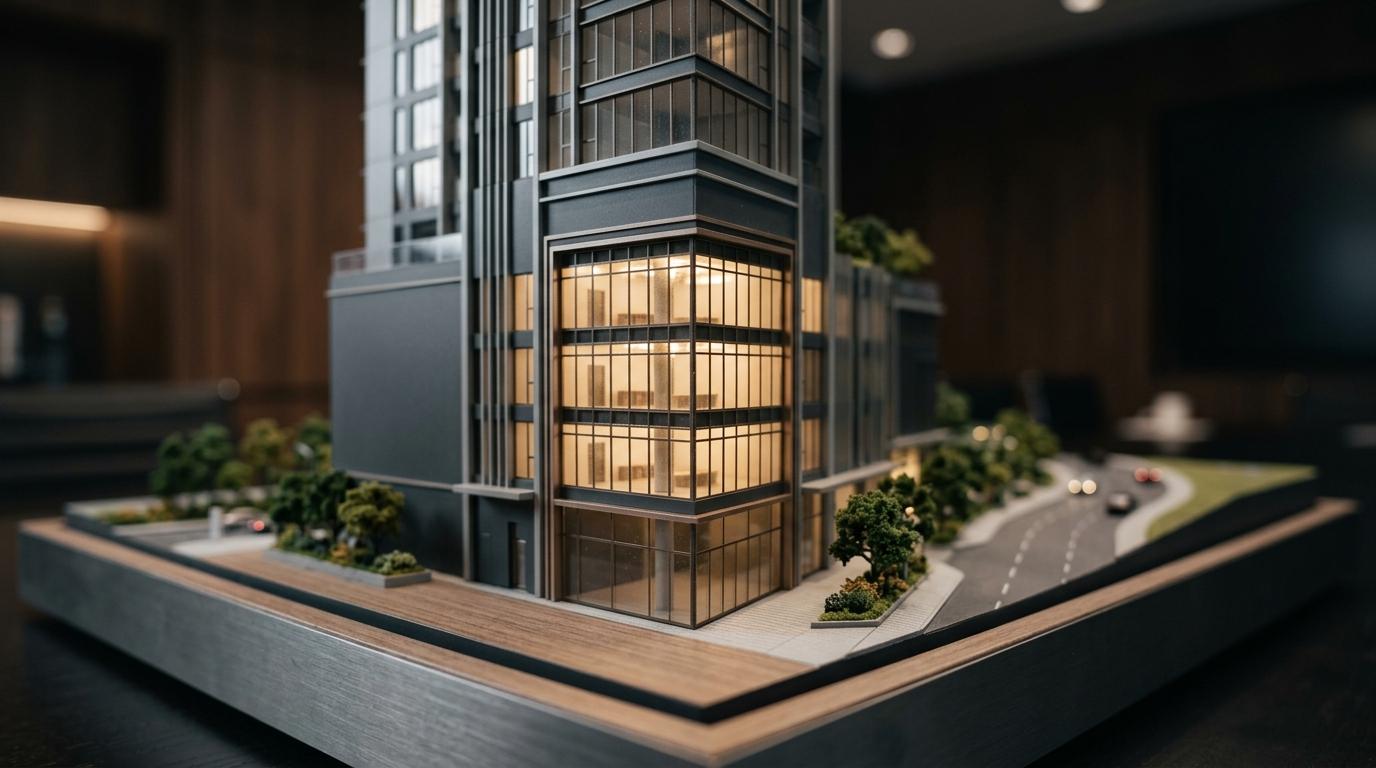
Lighting can make that experience even stronger. Carefully lit façades, highlighted amenity zones, illuminated roads, or phased activation points can guide the eye and support the presenter’s narrative. For residential and mixed-use projects, this can be the difference between a model that is merely attractive and one that actively sells the vision.
Interactive property development models with digital and AR features
Many developers now want more than a static display. They want a model that can explain options, activate interest, and adapt to different audiences across the life of the project.
That is where digital integration becomes especially useful. AR overlays, touch-triggered lighting, screen-based content, and animated presentation features can help audiences understand phasing, floor areas, transport connections, or public realm improvements without overwhelming the physical model itself.
These features can be tailored to suit the setting:
- AR overlays: show additional data, interior views, or phased development information
- Integrated lighting: direct attention to entrances, amenities, circulation routes, or tower identity
- Interactive controls: allow presenters to change scenes during investor, planning, or sales meetings
- Screen-linked content: connect the physical model with renderings, videos, flythroughs, or unit information
- VR support: give buyers or stakeholders a more immersive sense of internal space
For major schemes, hybrid presentation is often the strongest choice. A physical model establishes trust and scale. Digital tools then add flexibility, movement, and layered information.
Model making services for property development projects
ARI MODEL produces architectural and industrial scale models for clients across Europe and worldwide, with experience dating back to 2000. The work spans presentation models, urban planning models, competition models, prototype models, and exhibition pieces, supported by workshops in France and Germany.
For property developers, this means access to an end-to-end process that covers design review, fabrication, lighting, finishing, transport, installation, and after-sales support. That continuity is important when a model is being used in multiple settings, from internal approvals to public launch.
The production approach can include CNC machining, laser cutting, and several forms of 3D printing including FDM, PolyJet, SLA, and SLS. This range allows the model to be calibrated to the project, whether the goal is a refined timber presentation piece, a highly detailed acrylic and resin sales model, or a large urban display with integrated electronics.
A property development model service typically includes:
- Brief analysis: scale, audience, message, and display environment
- File preparation: CAD, BIM, plans, elevations, or sketches translated into a build-ready model package
- Fabrication: precision production of buildings, landscape, roads, site context, and presentation base
- Finishing: materials, colour treatment, glazing effects, vegetation, people, vehicles, and signage
- Installation and delivery: secure transport, on-site setup, testing, and support
Property developer model solutions for residential, mixed-use and urban schemes
Different development types call for different presentation priorities.
Residential developments often need warmth, liveability, and sales appeal. Buyers want to grasp orientation, green space, access, neighbouring buildings, and the character of the architecture. In these projects, landscaping, lighting, and local context can carry almost as much weight as the buildings themselves.
Mixed-use and commercial developments usually require clearer communication around programme, circulation, and phasing. A model may need to show office, retail, hotel, residential, or public uses within one coherent presentation. Colour coding, removable sections, or interactive lighting can help explain that complexity with confidence.
Urban planning and masterplan models need another level of discipline. They often serve many audiences at once, including local authorities, community stakeholders, investors, and internal project teams. Here, the quality of the site context matters enormously. Roads, topography, transport links, public spaces, and neighbouring structures all help explain why the proposal belongs where it does.
Choosing the right scale and detail for a property development model
The most successful model is rarely the one with the most detail. It is the one with the right detail.
Scale should be driven by viewing distance, venue, audience, and message. A boardroom model may need strong readability from close range. A sales-suite centrepiece may need dramatic impact from across the room. A planning model may need broader site context rather than fine façade texture.
Good decisions at this stage help control programme, cost, and presentation quality. Developers often review the following points before fabrication begins:
- audience type
- model scale
- required context
- transport constraints
- lighting and interactivity
- expected lifespan of the display
A clear scope also makes future updates easier. If a scheme is likely to change during planning or pre-sales, the model can be designed with that in mind.
Why precision matters in property development model making
A model does more than represent a project. It reflects the seriousness of the developer behind it.
Precise geometry, clean finishes, coherent lighting, and thoughtful presentation all shape perception. Investors read credibility in the craftsmanship. Planning stakeholders read care and transparency in the way context is shown. Buyers read quality in the atmosphere the model creates.
That is why experienced model making still matters. With more than 24 years of experience, 499+ models delivered in 17 countries, and dedicated workshops of 1,000 m² in France and Germany, ARI MODEL supports property developers with model solutions that are built for communication as much as display.
Whether the requirement is a refined residential sales model, a masterplan for consultation, or an interactive presentation piece for a launch event, the aim remains the same: make the development easier to understand, easier to present, and easier to believe in.