A well-made architectural model can shorten decision cycles, sharpen design conversations, and give a project a physical presence that drawings alone rarely match. Yet even the best architectural model maker can only work as well as the brief provided.
That is the part many teams underestimate.
When the brief is vague, the model often becomes expensive clarification. When the brief is precise, the model becomes a tool for planning, marketing, approvals, fundraising, and stakeholder confidence. For architects, developers, planners, and exhibition teams, the quality of the initial brief usually shapes the quality of the finished model.
Why the project brief matters for an architectural model maker
A physical model is not just a smaller version of a building. It is a filtered representation of selected information. That means every commission starts with choices: what to show, what to simplify, what to emphasise, and what outcome the model must support.
In early design, a model may be used to test massing, volume, and spatial proportion. Later, it may need to communicate façade treatment, landscape relationships, lighting intent, or sales value. These are very different tasks, so they require different briefing detail.
A strong brief gives the architectural model maker the same foundation that a design team needs at schematic stage: project goals, required reference drawings, intended audience, and the level of finish expected.
What an architectural model maker needs in the first conversation
Before materials, colours, or lighting are discussed, the model maker needs a clear picture of the project itself. That starts with purpose.
If the purpose is not defined, everything else becomes harder to decide, including scale, model type, and budget.
A competition model, a planning model, and a showroom presentation model may all represent the same building, but they are not built in the same way.
A useful starting brief should cover the essentials below.
- Model purpose: design review, planning approval, investor presentation, sales suite, exhibition, or public consultation
- Project stage: concept, schematic design, design development, or near-final presentation
- Clear audience
- Required delivery date
- Confirmed decision-makers
- Budget range
That short list often saves weeks later on.
Core brief components for an architectural model commission
The easiest way to brief an architectural model maker is to think in categories. Each category answers a practical production question.
| Brief component | What to provide | Why it matters |
|---|---|---|
| Project goal | The decision or message the model must support | Keeps the model focused on outcomes, not decoration |
| Site information | Site plan, access, roads, context buildings, landscaping, levels | Shows how the project sits in its environment |
| Building drawings | Floor plans, sections, elevations, roof plan | Gives the maker accurate geometry |
| Digital files | CAD, BIM, 3D model, PDF set | Speeds interpretation and reduces manual redrawing |
| Scale | 1:100, 1:200, 1:500, 1:1000, or detail scale | Determines size, detail, and cost |
| Model type | Working model, presentation model, urban planning model, detail model | Sets production method and finish |
| Level of detail | Simple massing, façade articulation, interiors, planting, signage | Prevents mismatched expectations |
| Materials and finish | White, timber, acrylic, painted, transparent elements | Shapes the visual language of the model |
| Lighting and interaction | Internal lighting, street lighting, removable parts, touch controls | Affects engineering and assembly |
| Logistics | Packing, shipping, installation, venue restrictions | Protects the model and supports delivery |
How to define the purpose of the architectural model
Purpose should be stated in a sentence, not left implied.
A brief that says “we need a model of the scheme” is incomplete. A brief that says “we need a 1:200 presentation model for investor meetings, showing façade rhythm, podium landscape, and evening lighting” is actionable.
This matters because current project briefing practice is increasingly outcome-based. The model should help a team achieve a result. That result may be approval, investment, pre-sales, public trust, or internal design review. Once that target is clear, the architectural model maker can advise on the best route.
After that first statement of purpose, it helps to define the audience in slightly more detail.
- Planning officers: site relationship, massing impact, access, setbacks
- Investors: presence, quality, commercial confidence
- Buyers or tenants: lifestyle cues, material impression, amenity
- Design team: geometry, proportion, coordination
- Exhibition visitors: quick visual clarity at a distance
The audience decides what must be legible at first glance.
Choosing the right scale and model type
Scale is not just a technical setting. It is a communication choice.
A larger scale can show more information, but it also increases footprint, production time, and cost. A smaller scale can be perfect for urban context, yet too limited for façade detail or interior reading. Good briefing means matching scale to the question being asked.
Working models are often used early to check shape, volume, and proportion. Presentation models tend to require more finish and more attention to lighting, materials, and display quality. Detail models may focus on a façade bay, entrance sequence, or structural junction at scales like 1:50, 1:20, or 1:10. Urban planning models often work well at 1:200, 1:500, or 1:1000, where spatial relationships across a district remain clear.
If a team is unsure which route fits best, the brief should still state the desired reading distance and primary message. That gives the model maker enough to recommend a scale.
Which drawings and files to send to an architectural model maker
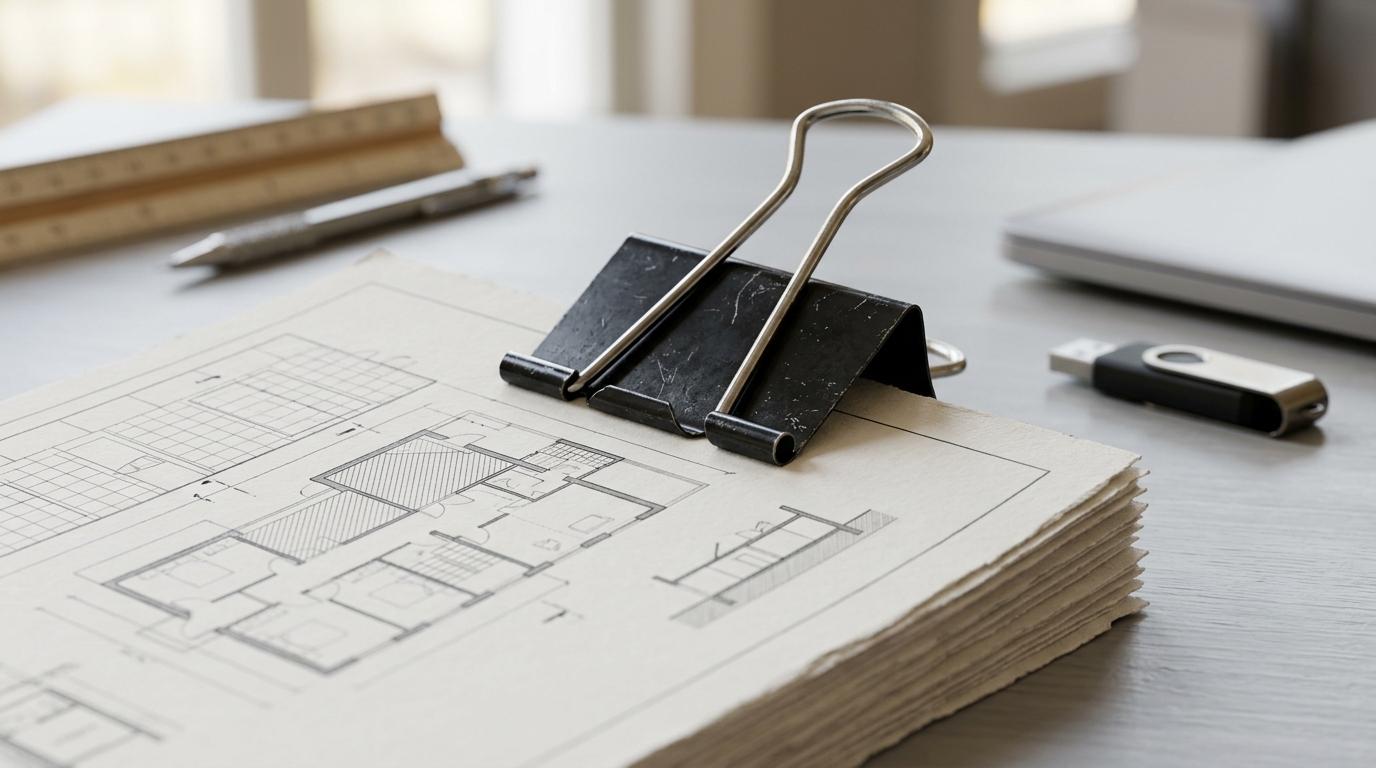
Every model brief should include a disciplined drawing package. Even when a 3D file exists, 2D references remain important because they confirm intent, dimensions, and hierarchy.
A site plan is one of the most valuable documents in the pack. It shows access conditions, road and path systems, neighbouring buildings, parking, landscape, and the wider project relationship to its setting. Floor plans, sections, and elevations are equally important because they define the form in a way no mood board can replace.
The ideal package usually includes the following items.
- Site plan
- Floor plans
- Elevations
- Sections
- Roof plan
- Landscape plan
- 3D model or BIM export
- Material references
- Updated revision index
If the design is still moving, that is not a problem. What matters is that the brief identifies which drawings are current and which areas remain provisional.
How to brief level of detail, materials, and finish
Many disappointing model commissions share one issue: the client and the model maker had different ideas of what “detailed” meant.
One team may expect a clean white massing model with simplified trees and no fenestration. Another may expect glazing treatments, railings, signage, paving patterns, people, vehicles, and illuminated interiors. Both think they asked for a “presentation model”.
That is why a brief should describe detail in zones. Not every part of the model needs equal emphasis. The focal building, public realm, and immediate context may need careful refinement, while background blocks can remain simplified. This selective detailing often gives a better result than trying to treat everything the same way.
Materials also need early discussion. White models are often excellent for reading volume and geometry. Timber can create warmth and craft value. Acrylic and transparent elements can help with glazing, removable sections, or illuminated features. Painted finishes may be useful when branding or sales communication matters more than abstraction.
Lighting, moving parts, and presentation features in the model brief
Presentation intent should be stated as clearly as architectural intent.
If the model will be shown in a darkened sales suite, integrated lighting may be central to its effect. If it will sit in a planning office, lighting may be unnecessary. If the audience needs to compare options, removable roofs or interchangeable façade panels can be built in from the start.
This part of the brief benefits from precision.
- Internal lighting: apartments, lobbies, amenity floors, atriums
- External lighting: streets, podium, landscape, feature façades
- Interactive features: push buttons, zones, removable roofs, phasing overlays
- Display base: protective cover, branded plinth, transport crate
- Viewing conditions: boardroom, exhibition hall, sales suite, public display
A model with lighting and electronics is not just a visual object. It becomes a coordinated product with technical, transport, and maintenance needs.
Budget, programme, and approvals
Even an excellent brief can fail if the approval structure is fuzzy.
The architectural model maker should know who signs off the drawings, who signs off the sample finish, and who gives the final production approval. Without that, revisions can multiply across too many voices, often late in the process.
It also helps to break the programme into review points. Typical checkpoints include quotation approval, drawing review, base geometry approval, finish sample approval, lighting test, and final sign-off before dispatch. This gives the client control without slowing production.
At ARI Model, the practical value of a structured process is clear. The work usually moves from evaluation of client needs into design, material and technique selection, model fabrication, detailing, lighting integration where required, quality control, delivery, and installation. A brief that anticipates those stages makes each step smoother.
Common briefing mistakes that slow down model production
Most briefing problems are easy to avoid once teams know what to look for.
The first is sending too much visual inspiration and too little technical information. Reference images can be useful, but they do not replace a coordinated drawing set. The second is choosing scale before choosing purpose. The third is asking for a highly detailed presentation finish while providing only early concept information.
A few recurring issues are worth checking before the brief goes out.
- Unclear revision status: multiple drawing versions in circulation
- Missing site context: no levels, access, or adjacent massing
- Late scope changes
- Undefined audience
- No finish benchmark: “premium” or “high detail” without examples
- Compressed approvals: long internal review, very short production window
A short pre-brief review meeting often clears these issues in less than an hour.
How to make the first brief easier for both sides
The most effective briefs are not necessarily long. They are specific, prioritised, and realistic.
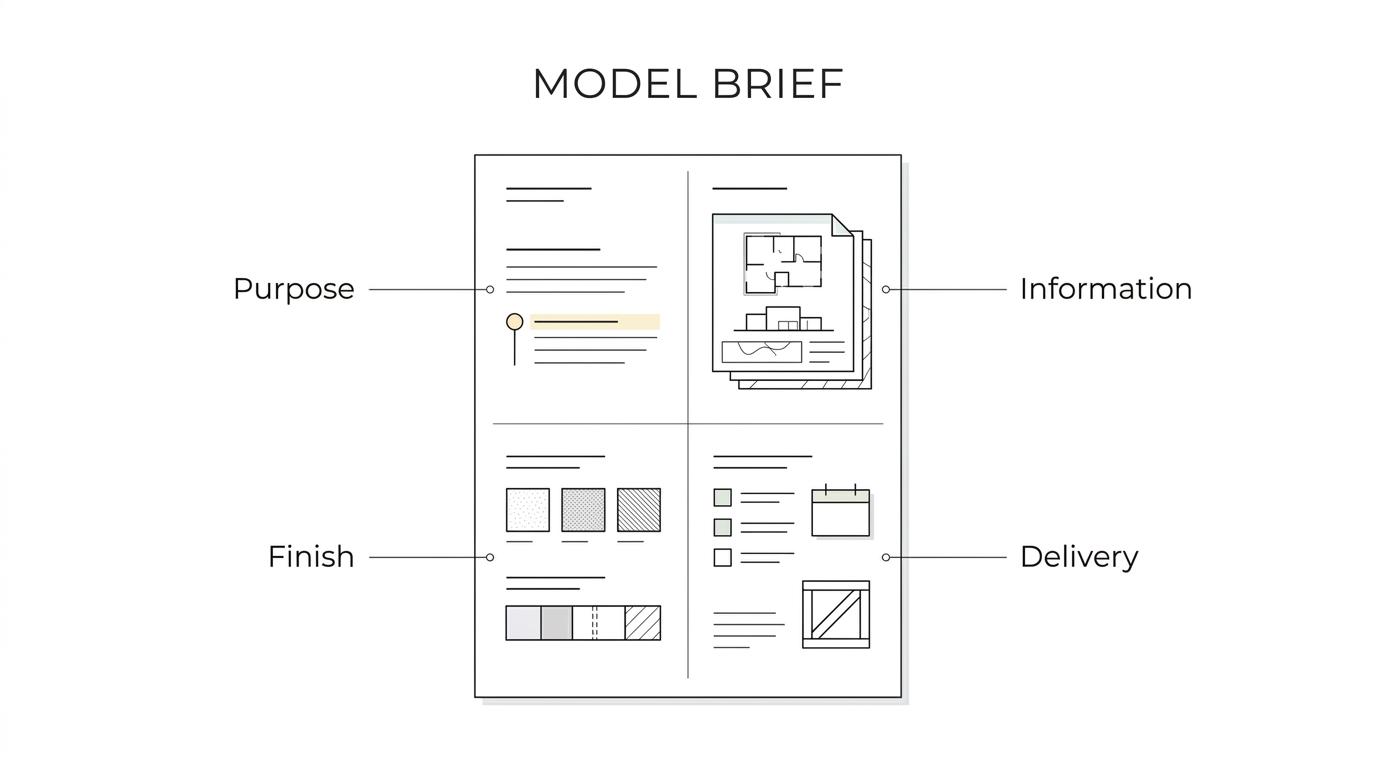
If time is short, focus on four points first: what the model is for, which information is approved, what scale is preferred, and how finished it needs to look. Those four answers will give an architectural model maker a reliable starting frame.
After that, add the practical layer: budget range, delivery address, installation requirements, lighting needs, and who will sign off revisions. Once those are in place, the model commission becomes far easier to price, schedule, and produce with confidence.
That clarity is what turns a model from a nice object into a high-value project tool. A good brief does not limit creativity. It gives it direction.