Sales teams in industrial markets often face the same problem: the offer is valuable, but it is difficult to explain quickly. A plant upgrade, a production line, a logistics platform, an energy installation, or a piece of specialised equipment may be technically strong and commercially sound, yet still feel abstract to the buyer.
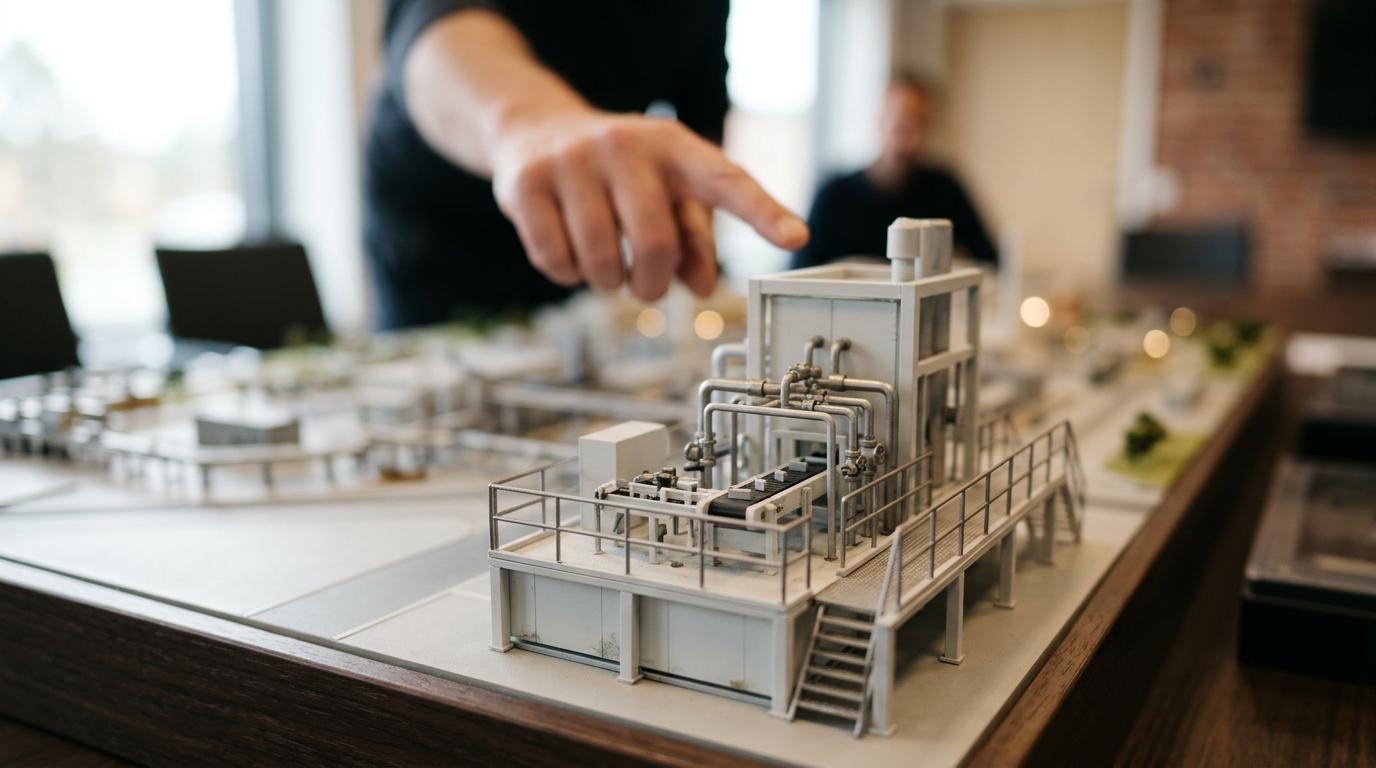
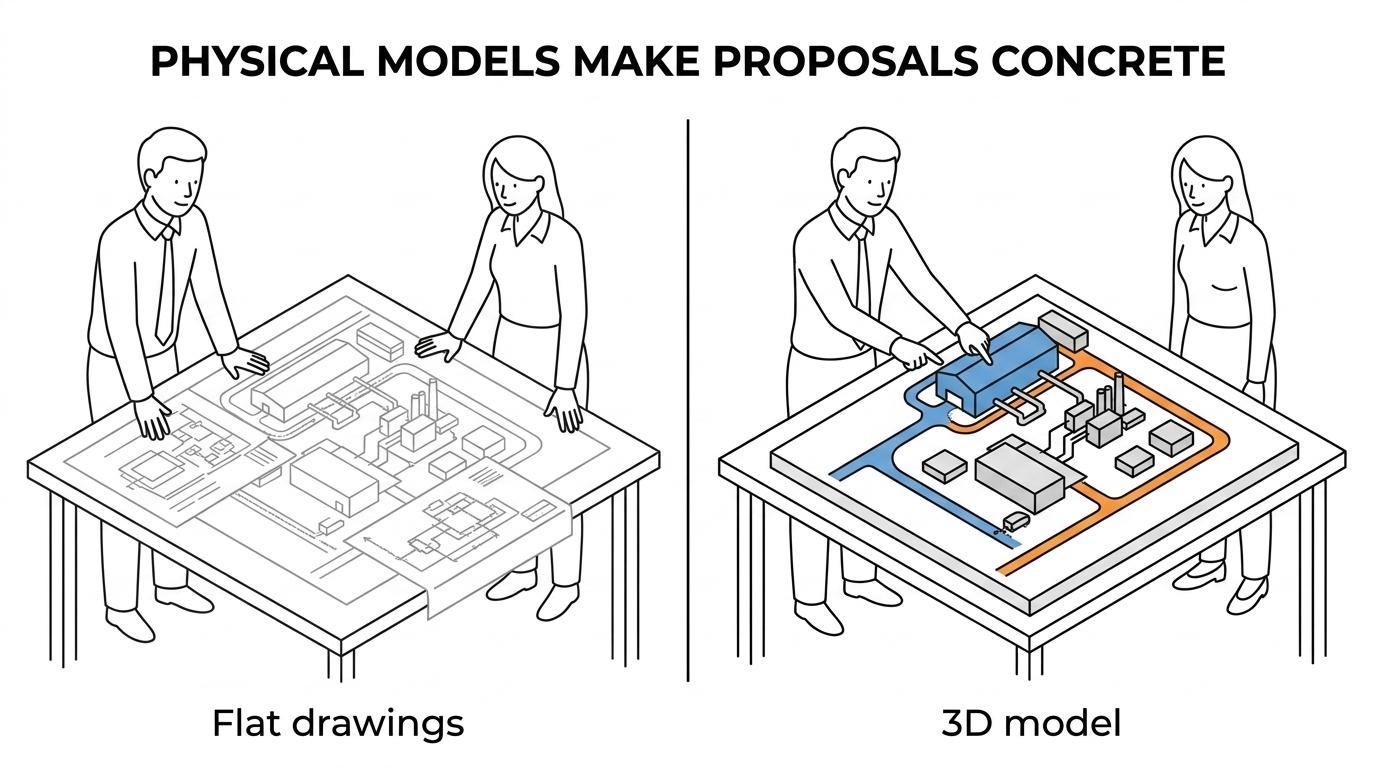
An industrial model changes that situation. It gives the sales conversation a physical centre. Instead of asking prospects to imagine scale, flow, access, interfaces, or site impact from drawings alone, the team can show those points in three dimensions. That simple shift often makes a complex proposal feel more concrete, more credible, and easier to discuss.
The strongest commercial value usually appears when the model is used actively in presentations, client meetings, trade shows, and sales offices rather than left as a passive display.
Industrial models make complex products easier to explain
Industrial buying is rarely based on one feature or one price point. Buyers want to know how a system fits into an existing site, how people will move around it, how maintenance teams will access it, and how separate elements connect. When those answers stay trapped in technical documents, a sales discussion can slow down.
A physical model supports faster grasp because it brings many variables into one visible object. It helps the buyer see relationships, not just isolated parts. That matters when multiple stakeholders are involved, including technical managers, procurement teams, executives, investors, and operational staff. Each group tends to focus on different concerns, and a model helps all of them refer to the same visual reference point.
In practical terms, a well-made industrial model can show:
- scale and footprint
- process flow
- equipment placement
- maintenance access
- transport routes and circulation
- interfaces between systems
This kind of clarity is valuable because many industrial sales cycles involve risk. If a buyer feels uncertain about what is being proposed, momentum drops. If the proposal becomes easy to read, the conversation can move from basic explanation to value, timing, implementation, and return.
Industrial models strengthen client meetings and buyer confidence
A sales presentation is at its best when it creates a shared view of the project. Industrial models do exactly that. They help the sales team guide attention to what matters most and reduce the gap between what is being said and what the buyer actually pictures in their mind.
Research on physical representations adds weight to this point. Studies discussed by the Design Society indicate that physical models can supplement incomplete or mistaken mental models. In plain terms, people often imagine a project inaccurately until they can inspect a physical representation. In a sales context, that is highly useful. It means fewer hidden assumptions and a better chance of reaching the real commercial discussion.
That makes buyer confidence easier to build.
A model also changes the rhythm of the meeting. Instead of a one-way presentation, the discussion becomes interactive. A prospect can point to an area, ask about a sequence, question a clearance, or compare layouts. The salesperson can answer directly on the model. That immediacy is hard to match with slides alone.
ARI Model has published project examples showing how a scale model can give investors, clients, and stakeholders a clear and precise view of dimensions, design, and features. While every project differs, the principle remains consistent: when people can see the proposal clearly, they are more prepared to discuss it seriously.
Industrial models improve trade show sales performance
Trade shows remain one of the most demanding sales environments in industrial sectors. Attention is limited, competition is intense, and sales teams have very little time to turn a passer-by into a qualified lead. In that setting, an industrial model is not just a visual asset. It can act as a sales tool across the full conversation.
Academic work in Marketing Science described trade show performance through three stages: attraction, contact, and conversion efficiency. That framework is highly useful for sales teams because it maps neatly onto what a strong industrial model can do on the stand.
After a short explanation of the offer, the model can support all three stages:
- Attraction: a three-dimensional object gives the stand a focal point and helps stop visitors who might otherwise keep walking.
- Contact: salespeople can use the model to begin specific conversations instead of broad introductory pitches.
- Conversion efficiency: once interest is captured, the model helps qualify needs, explain value, and move the discussion towards next steps.
This is not just theory. A field study from Penn State found that follow-up sales efforts produced higher sales productivity when customers had already seen the firm’s product at a trade show. The same study reported higher profits when trade shows were used with the right level of sales effort, along with higher return-on-sales among attendees than non-attendees and positive effects on purchase intentions.
That finding is especially relevant for industrial models. The model helps make the trade show encounter memorable, and it gives the later follow-up call or meeting a shared reference. The buyer is not starting from zero. They are returning to something they already saw, discussed, and mentally filed as important.
Sales stages where industrial models create value
The commercial effect of an industrial model is easiest to see when it is matched to specific sales moments rather than treated as a general marketing object.
| Sales stage | Typical buyer question | How the industrial model helps | Likely commercial effect |
| --- | --- | --- | --- |
| First prospect meeting | What exactly are you proposing? | Shows the overall configuration in one view | Faster qualification |
| Technical review | Will this fit our site and process? | Reveals interfaces, clearances, and workflow | Fewer misunderstandings |
| Executive presentation | Why should we invest? | Makes scope and strategic impact easier to grasp | Stronger internal support |
| Trade show conversation | Why should I stop and speak to you? | Creates visual interest and a natural opening line | More contacts |
| Follow-up sales call | How do we explain this to colleagues? | Gives a memorable reference point from the earlier meeting | Better purchase intention |
| Sales office display | How does the project compare with alternatives? | Lets teams compare layouts or options side by side | Clearer decision-making |
A model is especially effective when several people influence the purchase but do not share the same technical vocabulary. The object becomes the common language.
What makes an industrial sales model effective
Not every model helps sales in the same way. Some are visually impressive but commercially weak because they show too much, explain too little, or focus on craftsmanship without supporting the buyer’s decision process. The best sales models are built around the questions the buyer is most likely to ask.
That usually means selecting information carefully. A sales model does not need to display every internal detail. It needs to make the most important details legible. If the sales target is a factory expansion, site circulation and capacity zones may matter more than micro-detail. If the product is a machine line, the priority may be process sequence, loading points, safety areas, and service access.
A strong industrial sales model often includes the following qualities:
- Clear hierarchy: the most important commercial points should be visible within seconds
- Readable scale: critical components must be large enough to interpret without strain
- Selective lighting: illuminated zones can guide the conversation towards process, access, or movement
- Durability: trade show transport and repeated handling require robust construction
- Interactivity: moving parts, removable sections, or triggered lighting can make explanations quicker
There is one useful caution here. Research on physical representations also suggests they can sometimes narrow thinking and reduce the range of ideas in early creative work. In sales, that is less of a design risk and more of a presentation risk. If the model is too rigidly scripted, it can shut down useful buyer questions. The solution is simple: build the model to clarify the proposal, then use it as a prompt for discussion rather than a fixed answer to everything.
Industrial models support follow-up selling, not just the first pitch
Many sales tools work well in the room and then disappear from the buyer’s mind. Industrial models tend to do the opposite. Because they are tactile, spatial, and memorable, they often stay with the prospect long after the meeting or exhibition ends.
This is where the Penn State research is especially interesting. The study linked trade show exposure with stronger results in later follow-up selling. That tells sales leaders something important: the model should not be seen as a one-day exhibition asset. It should be treated as part of a wider sales sequence.
A useful sequence often looks like this:
- first contact at a show or presentation
- deeper technical discussion using the same model
- internal buyer review supported by photos or video of the model
- follow-up meeting focused on implementation and commercial terms
When handled this way, the model becomes a bridge between marketing visibility and personal selling. It can help the buyer remember the proposal, explain it internally, and return to the next meeting with better questions.
How ARI Model helps sales teams present industrial projects
For organisations that sell complex industrial projects, the challenge is not only to create a model but to create one that works under commercial pressure. It must be precise enough for technical discussions, attractive enough for public presentation, and durable enough for repeated use.
ARI Model operates in that space with a focus on architectural and industrial scale models for marketing, planning, exhibitions, and presentations. With more than two decades of work, international delivery experience, workshops in France and Germany, and production tools including CNC, laser systems, and multiple 3D printing methods, the company is positioned to support sales teams that need both detail and reliability.
That matters because industrial sales tools often fail on practical points rather than conceptual ones. They arrive too late. They travel badly. They look good from a distance but do not help the salesperson tell a clear story. A specialist model partner should solve those problems, not add to them.
ARI Model also offers lighting and interactive systems, which can be especially useful when the sales goal depends on showing sequences, highlighting zones, or demonstrating the logic of a facility in a short time window.
Questions sales teams should answer before commissioning an industrial model
Before commissioning a model, the sales team should define exactly how it will be used. A boardroom presentation model, a trade show centrepiece, and a mobile account-management tool may all represent the same project, but they should not be designed in the same way.
A clear brief will usually cover audience, venue, transport needs, lighting conditions, technical depth, and the single most important commercial message. If that message is vague, the model will probably be vague as well.
A few planning questions can sharpen the brief:
- Who is the main audience: engineers, executives, investors, operators, or mixed groups?
- What is the sales setting: trade show, private meeting, sales office, or roadshow?
- What must be remembered: footprint, process logic, expansion potential, safety, or visual impact?
- How long is the conversation: two minutes on a stand or forty minutes in a proposal review?
- What happens after the meeting: follow-up call, internal approval round, or formal tender step?
When those answers are in place, the industrial model becomes much more than a display object. It becomes a focused sales instrument built around how real buyers decide.