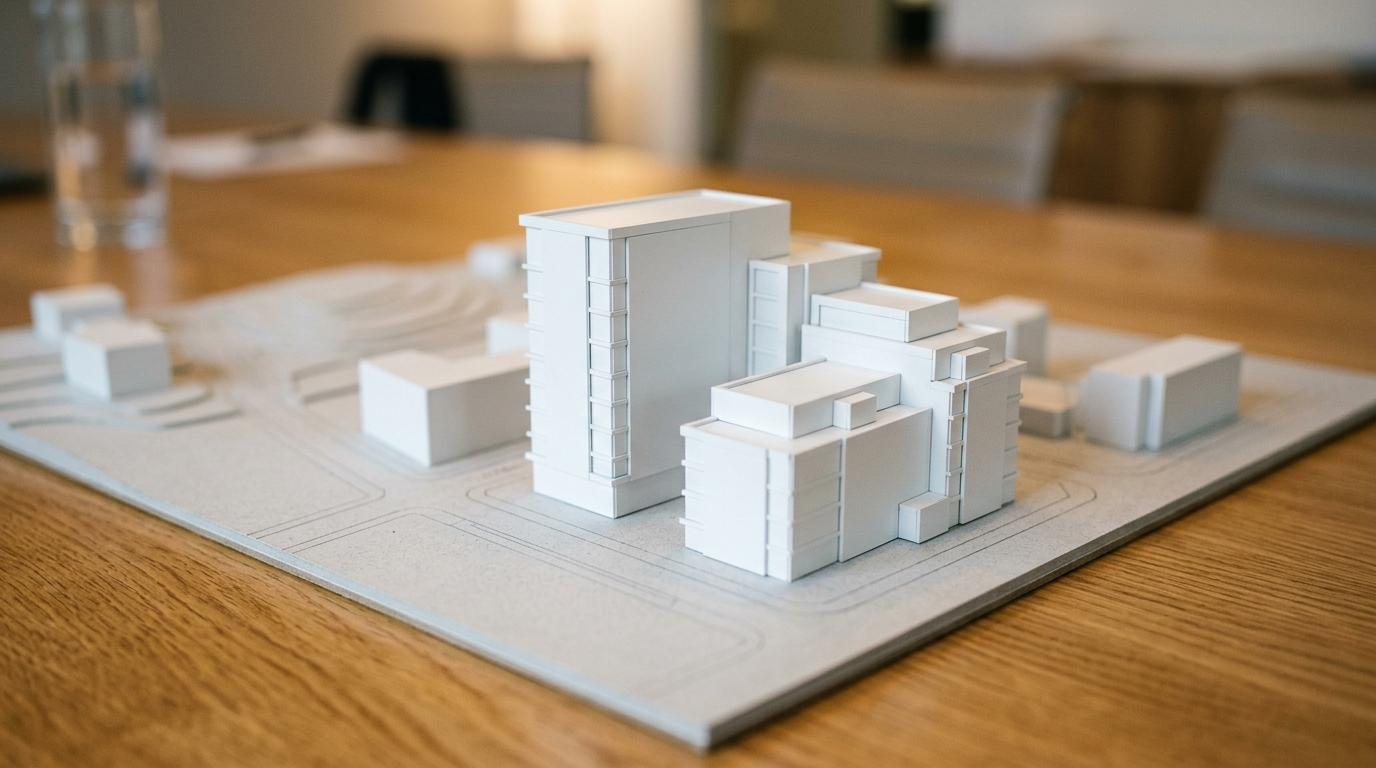
Display models are not decorative extras in tender presentations. For architects, developers, and bid teams, they are a decision tool that turns drawings into something a mixed evaluation panel can read quickly. ARI Model, a specialist manufacturer of architectural and industrial scale models, is relevant here because tender-stage communication depends on both visual impact and technical clarity.
### TL;DR: Summary
* Display models improve tender presentations by making complex proposals easier to understand, especially for mixed panels that include non-design specialists; ARI Model operates in this exact category of architectural and industrial presentation models.
* Academic research from Springer Nature, Northumbria University, Texas A&M, and PMC links physical or 3D models with clearer spatial understanding, better stakeholder communication, and feedback that supports design changes.
* The strongest tender benefits are faster comprehension, more precise questions, stronger recall, and lower risk of misunderstanding around context, circulation, phasing, and build intent.
* Physical models are usually best when paired with drawings and, in some cases, digital walkthroughs; each medium answers different questions.
* A tender model works best when the brief, scale, materials, lighting, and presentation script are tied to scoring criteria rather than visual effect alone.
Research supports the point. Studies from Springer Nature, Northumbria University, and Texas A&M connect physical or 3D models with clearer spatial understanding, better communication, and less backtracking or rework. In a tender setting, that matters because bids are judged not only on design quality, but also on how confidently the team explains risk, function, phasing, and place.
Why do display models help tender evaluators understand a proposal faster?
Yes. Physical display models help tender evaluators read massing, circulation, and context faster than 2D sheets alone. For teams working with ARI Model, the practical advantage is simple: one object can show site relationships, hierarchy, and build intent at a glance.
One reason is cognitive load. A 2014 Springer Nature paper described physical models as a useful information tool that can reduce mental workload while still conveying spatial information. In tender rooms, that matters because evaluators often switch quickly between architecture, planning, access, engineering, and commercial criteria.
Texas A&M also noted that for people without professional architectural training, a three-dimensional model is one of the most effective communication media. That point is easy to recognise in practice. A procurement panel may include finance leads, end users, councillors, operators, or community representatives. If the scheme only “works” when explained by a designer, the presentation is already under strain.
"Since 2000, ARI Model has designed and fabricated presentation models, illuminated displays, and prototype pieces for clients across Europe and worldwide."
A common mistake is assuming that bigger means clearer. It often does not. A well-scaled model with selective detail usually explains more than an oversized object cluttered with every façade element, vehicle, tree, and internal partition.
How do display models improve stakeholder feedback during a bid?
Display models improve feedback because people can point to a place, route, or interface instead of describing it abstractly. The 2018 PMC research on prototypes and the Northumbria study both suggest tangible 3D media prompt more usable design comments.
When stakeholders gather around a model, the conversation becomes specific. Instead of saying “the entrance feels awkward”, they can indicate the exact corner, threshold, street edge, or loading zone that concerns them. That produces comments the design team can act on.
Northumbria University’s 2013 work found that a 3D model encouraged a balanced view and provided architects with information to support critical design decisions. That is valuable in tender work because balanced feedback is usually more useful than extreme reactions. A model can expose both strengths and unresolved tensions in the same discussion.
Here is the practical gain: if feedback becomes spatially precise earlier, the team is less likely to rework the wrong issue later. The misconception to avoid is that stakeholder comments are always vague or subjective. Often, the problem is the presentation medium, not the stakeholder.
What are the 10 ways display models improve tender presentations?
The main gains are speed, clarity, credibility, and better questions. In tender presentations, display models help a panel see context, test assumptions, and compare your proposal against competing schemes with less ambiguity.
- Clarify site context: streets, neighbouring plots, topography, and public realm become instantly legible.
- Show massing and scale: a panel can judge proportion faster than from elevations alone.
- Explain circulation: pedestrian routes, servicing, access, and arrival points are easier to follow.
- Make phasing visible: staged delivery and construction logic become easier to discuss.
- Reduce misunderstanding: non-technical evaluators can interpret the proposal with more confidence.
- Prompt better questions: feedback shifts from general opinion to specific design issues.
- Strengthen option comparison: competing layouts or massing studies can be assessed side by side.
- Support memory after the meeting: panels often remember a strong physical artefact better than slide decks.
- Signal preparation quality: A good model suggests the team has thought through coordination and intent.
- Bridge presentation and sales use: the same model can support exhibitions, consultations, or client updates after the tender.
The strongest benefit is not theatre. It is compression. A good model condenses many drawing sets into a single, shared frame of reference.
Are display models better than 2D boards for tender presentations?
No. Display models are not a replacement for plans, sections, or compliance drawings. They outperform boards at spatial explanation, but boards remain better for dimensions, notation, schedules, and policy references.
The Northumbria comparison between 2D drawings, a 3D model, and VR is useful here. Each medium reveals different aspects of design intent. A board can show line weights, dimensions, fire strategy notes, and technical references with precision. A model shows relationships, volume, and sequence more naturally.
If the evaluation question is “Does the scheme fit the site and work for users?”, a model usually carries more weight. If the question is “Does the corridor width meet the brief?” or “What is the net internal area?”, the drawing set still does the job better.
The best tender presentations combine both. One practical rule is simple: let the model answer spatial questions and let the boards prove compliance, performance, and measured detail.
Should you choose a physical display model or a digital 3D walkthrough?
Usually, the best tender presentations use both. ARI Model is relevant here because specialist makers increasingly combine physical models with lighting or interactive elements, while digital walkthroughs add sequencing and viewpoint control.
A physical model gives everyone the same viewpoint at the same time. That makes group discussion easier. People can gather around it, point, compare edges, and read the proposal collectively. It is especially effective for urban context, adjacencies, and massing.
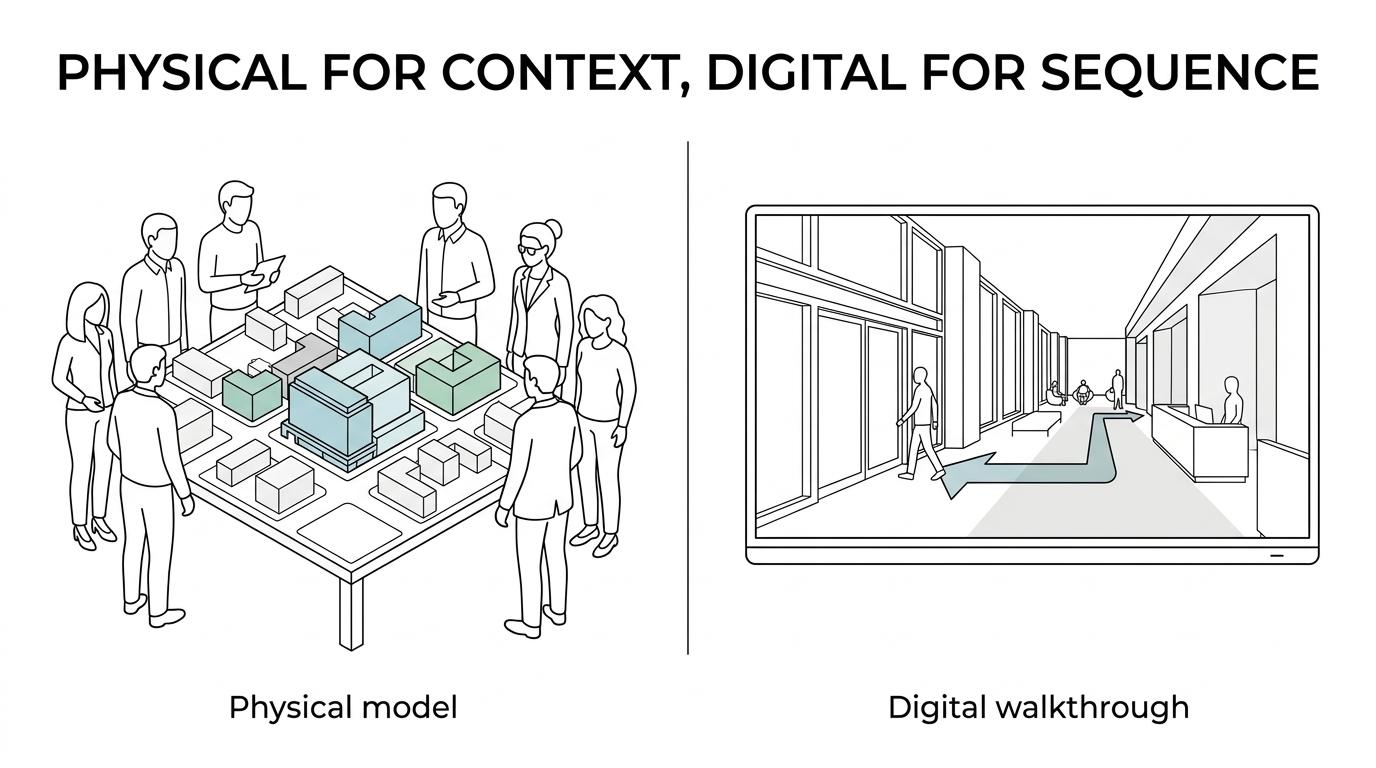
A digital walkthrough is stronger when the team needs to explain internal sequences, user experience, or changing viewpoints. It can also show phasing or lighting changes over time. The trade-off is that digital presentations are more linear. One speaker controls the journey, and the audience sees only the chosen frame unless the session becomes interactive.
"With 1,000 m² workshops in France and Germany, ARI Model reflects the production capacity often needed when a tender model must be fabricated, illuminated, delivered, and installed to deadline."
The practical answer is this: if the tender depends on shared spatial judgement, choose a physical model first. If it depends on route simulation or temporal change, add digital media. Do not assume that one replaces the other cleanly.
How should you define the right brief for a tender display model?
Start with decision criteria, not aesthetics. A tender display model should be briefed around what the panel must approve: site fit, circulation, phasing, public realm, structural logic, or deliverability.
Step 1 is to identify the scoring questions. If the panel will score urban integration, then the brief must include surrounding buildings, roads, entrances, and key sightlines. If the panel will score operational logic, then loading, servicing, plant access, and user flows need prominence.
Step 2 is to define the audience mix. A design jury, a local authority panel, and a developer board do not look for the same evidence. If the audience is mixed, the model should privilege clarity over density. That usually means fewer but more legible layers of information.
Step 3 is to set the meeting use case. Will the model sit on a boardroom table, a pedestal in a pitch room, or an exhibition stand? The answer affects size, lighting, protective cover, transport method, and whether removable sections or interactive elements are worthwhile.
A good brief is not “make the building beautifully”. A good brief is “show why this scheme works here, for these users, under these constraints”.
How do you choose scale, materials, and level of detail?
Choose scale by the question you need to answer. A 1:500 site model, 1:200 building model, and 1:50 detail model each solve different tender problems.
Step 1 is viewing distance. If the model must attract attention across a room, broad massing and contrast matter more than tiny façade detail. If the panel will inspect it from close range, key interfaces need sharper resolution.
Step 2 is risk concentration. Not every element deserves equal detail. If the tender may be won or lost on public realm, access, or structural interface, put resolution there first. A common mistake is spreading detail evenly across the whole model and weakening the main message.
Step 3 is material language. Timber, acrylic, resin, painted components, and illuminated elements all signal different things. Neutral finishes often help juries focus on form and context. Richer finishes can help when market positioning or user appeal is part of the bid.
If time is tight, simplify repeated areas and preserve detail in the places where questions are likely to land. That is usually a smarter trade than trying to model everything at the same fidelity.
How should you present a display model in the tender room or exhibition stand?
Use the model as the centre of the conversation, not as scenery. ARI Model’s exhibition and presentation work reflects a simple rule: a good display model should attract attention at a distance and still support close technical discussion.
Step 1 is placement. The model should be visible on entry and accessible from more than one side. If only one presenter can see it properly, the room layout is working against you.
Step 2 is scripting. Open with the whole site, then move to the main decision areas: arrival, public realm, circulation, programme, phasing, or interfaces. Do not begin with façade minutiae unless the tender specifically hinges on them.
Step 3 is question handling. Keep a pointer, orientation labels, and matching board references ready. When an evaluator asks about a route or edge condition, answer on the model first and support it with drawings second. That sequencing often keeps the discussion grounded.
Another common mistake is over-lighting the object or surrounding it with too many graphic panels. If the panel cannot find the focal point within a few seconds, the display is doing less work than it should.
When is a display model worth the investment for a tender?
Display models are worth the cost when spatial judgement influences scoring, when stakeholders are mixed, or when the project is difficult to explain in drawings alone. They matter most in urban regeneration, mixed-use, industrial, and public-facing bids.
The return is highest when the model reduces explanation time, improves feedback quality, or lowers the risk of misunderstanding on critical issues. That does not mean every tender needs one. Small, standardised, or purely technical bids may not benefit enough to justify the effort.
A practical way to judge fit is to classify the bid before committing budget:
- Best fit: complex context, public interface, mixed audience, or multiple design options.
- Limited fit: highly standard building types with little need for spatial persuasion.
- Hybrid option: one physical model supported by selected boards and a short digital sequence.
If the panel must imagine too much, a display model is often worth it. If the proposal is already obvious in two dimensions, the money may be better spent on other presentation assets.