Public consultation works best when people can see what is actually being proposed, not just what is being described. That sounds obvious, yet many planning and development teams still rely heavily on drawings, boards, and screen-based visuals that demand a level of spatial reading most members of the public do not use in everyday life.
Physical models change that dynamic. They turn an abstract proposal into something that can be read at a glance, discussed from multiple angles, and compared directly with its surroundings. In consultation settings, that shift often leads to sharper questions, more grounded comments, and feedback that is easier for project teams to act on.
Why public consultation feedback often lacks clarity
Public consultation is meant to surface issues early, test assumptions, and help shape proposals before positions harden. UK planning guidance on pre-application engagement makes that point clearly: meaningful feedback depends on proposals being sufficiently developed and communicated in ways people can respond to.
The problem is not a lack of interest from communities. It is often a lack of legibility. A planning board may show elevations, sections, and CGI views, yet many participants still struggle to judge height, depth, proximity, overshadowing, or how one element relates to another across the wider site.
When that happens, feedback becomes less useful. Comments tend to fall into broad reactions rather than specific observations, and valuable local knowledge can remain unspoken because people are unsure what they are looking at.
Common reasons include:
- plans feel abstract
- scale is hard to judge
- routes and boundaries are unclear
- visual material is fragmented
- trade-offs are not obvious
- people focus on style before context
How physical models make proposals easier to read
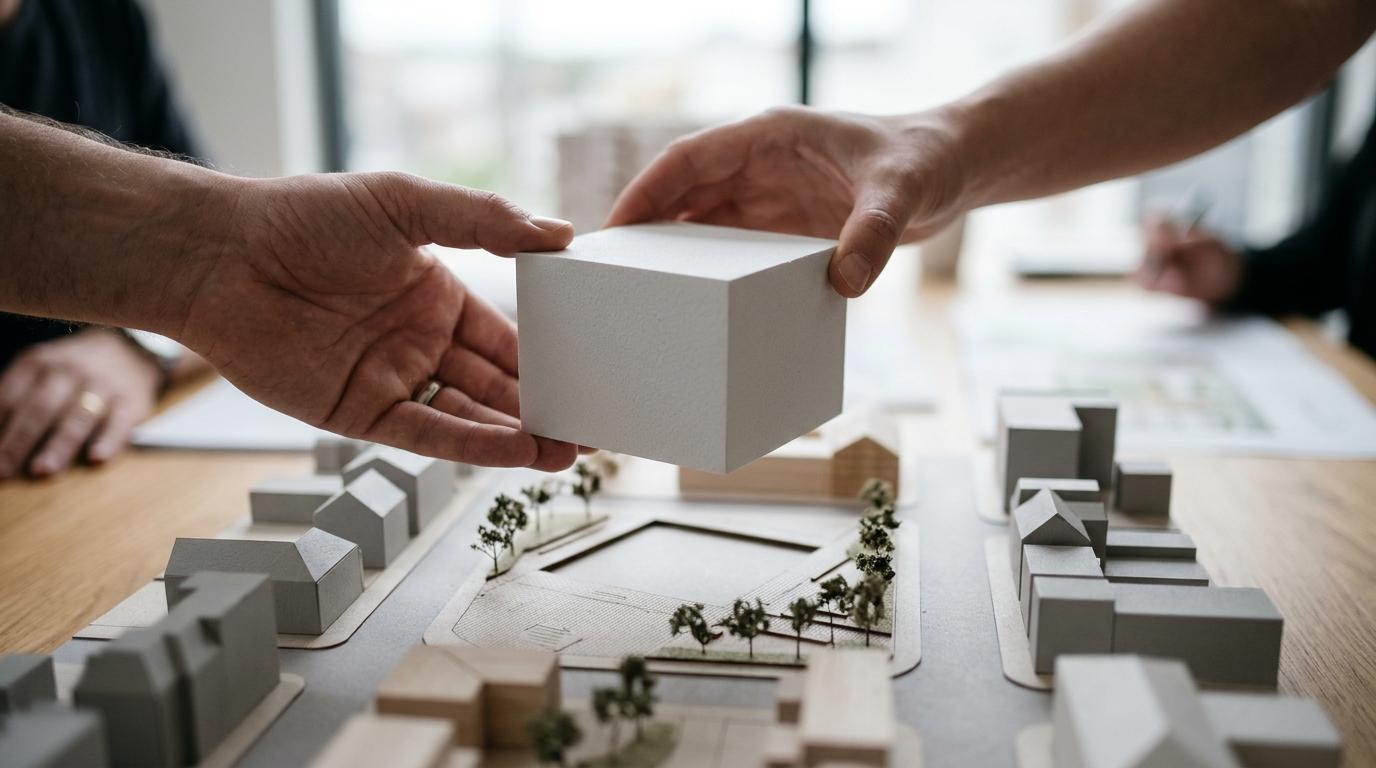
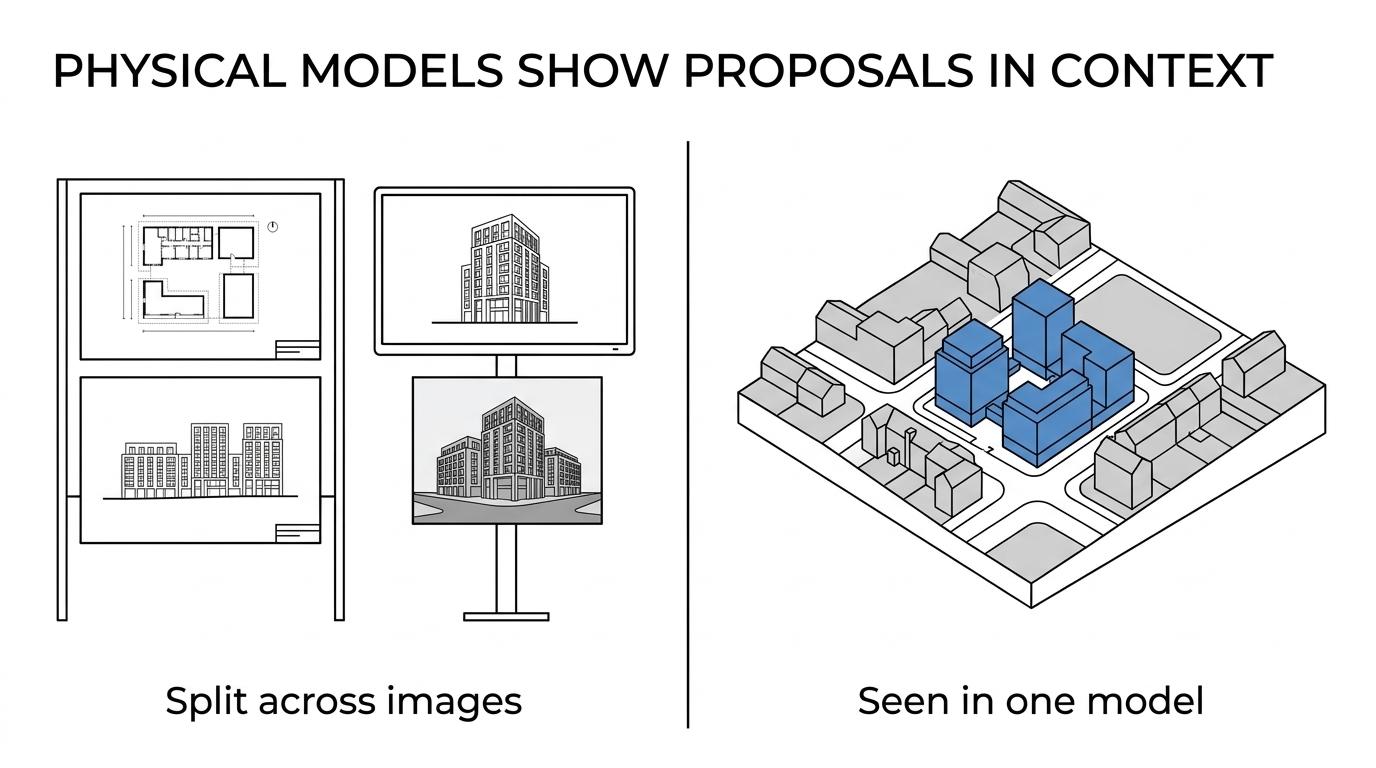
A physical model gives people a shared reference point. Instead of asking participants to mentally translate 2D information into 3D space, it presents scale, massing, streets, open space, and neighbouring buildings in one object.
This is why public engagement guidance increasingly treats project models as practical consultation tools. Guidance from the City of San Diego describes project models as three-dimensional representations that help the public visualise and interact with project concepts. It also notes that they help participants read scale, relationships between buildings and spaces, and design elements, while making impacts and trade-offs easier to discuss.
That matters because consultation is rarely just about whether people like a building. It is usually about context. How tall does it feel next to existing homes? Does the square become more enclosed or more open? Where does the pedestrian route tighten? Does a new block protect or interrupt a key view?
A physical model makes these questions visible.
It also slows the conversation in a productive way. People gather around it, point to locations, compare corners of the site, and test impressions against the whole. That creates a more grounded exchange than a sequence of slides or isolated renderings.
| Consultation issue | Drawings and screen visuals | Physical model |
| --- | --- | --- |
| Reading overall massing | Often split across several images | Seen in one view |
| Judging scale in context | Can depend on camera angle | Relative height reads quickly |
| Street and space relationships | Requires spatial interpretation | Easy to compare edges, gaps, routes |
| Discussing trade-offs | Impacts may appear selective | Whole-site effects are visible together |
| Public participation | Often presenter-led | Naturally invites pointing and discussion |
What research says about physical models and public feedback
The case for physical models is not just intuitive. Research comparing physical and digital representations has shown that physical formats can help non-specialists perform better in certain spatial tasks.
A dissertation from Texas A&M University compared desktop interactive 3D architectural models with physical models for laypeople. Its quantitative results indicated that participants who studied physical models performed significantly better on their tasks than those who used digital models. The work also described 3D models as one of the most effective communication media for people without professional architectural training.
Other academic work points in the same direction. A study indexed on ScienceDirect reported that physical models elicited more feedback than a CAD model, even though each model type produced useful design comments. Research from the University of Kentucky also found that a physical model improved communication of spatial design for certain tasks, with a 3D printed model outperforming 2D drawings and a 3D computer interface on productivity and workload measures.
This does not mean physical models replace every digital tool. It means they are especially strong when consultation depends on quick spatial grasp and high-quality public response.
That strength is clearest in a few areas:
- Spatial layout: routes, adjacencies, edges, and access points are easier to grasp
- Relative scale: people can compare proposed massing with neighbouring buildings immediately
- Design trade-offs: impacts on views, open space, or enclosure can be discussed in context
- Feedback quality: comments often become more specific and easier to record against the scheme
Where physical models add most value in public consultation
Not every project needs one. Yet some schemes benefit so clearly that the value is hard to ignore.
Large masterplans are an obvious example. A single building can sometimes be explained through drawings and a few verified views. A district, campus, or mixed-use regeneration area is different. Once a proposal includes multiple blocks, phases, streets, public spaces, transport links, and edges with existing neighbourhoods, a physical model can make the consultation far more productive.
The same applies to city-centre sites, conservation settings, waterfronts, transport interchanges, and proposals affecting key views. In these contexts, public reaction often turns on relationships rather than isolated architecture. A model lets people read those relationships quickly.
ARI Model has long linked physical masterplan models with planning discussions, public consultation events, and clearer stakeholder communication. That reflects a simple truth: when more stakeholders need to comment on a scheme in context, a physical model becomes a very efficient communication tool.
Projects that often gain the most include:
- major urban extensions
- city-centre infill schemes
- mixed-use regeneration sites
- civic and cultural buildings
- industrial campuses
- transport-led developments
How physical models support better behaviour in consultation rooms
There is another advantage that is easy to miss. Physical models do not just improve what people see. They also improve how consultation conversations happen.
That social dimension is well recognised beyond planning too, and Selskabskælderen's discussion of workshop formats makes the same basic point: the physical set-up of a room often shapes whether people contribute tentatively or engage in a more concrete, shared discussion.
A model creates a focal point that feels shared rather than owned by the presenter. People can approach it from different sides, compare viewpoints, and return to the same location several times as the conversation develops. That tends to lower the barrier for participation, especially in drop-in events where attendees arrive at different times and may not sit through a formal presentation.
It also helps consultation teams listen better. Instead of translating a vague comment like "that feels too close" into planning language, facilitators can ask participants to point to the exact interface between proposal and context. The result is a clearer record of concern, and often a clearer path to design response.
In practical terms, physical models are very good at surfacing local knowledge. Residents may identify a pedestrian desire line, a valued view, a difficult corner, or a place that feels exposed at night. When those observations are mapped directly onto a model, they become harder to dismiss and easier to test.
How to design physical models for meaningful feedback
A consultation model should not be treated as a miniature trophy. Its job is not simply to impress. Its job is to help people read a proposal accurately and comment usefully.
That starts with the right level of detail. Too little detail and the model feels generic. Too much and attention drifts into tiny façade questions before participants have absorbed the wider place strategy. For many consultation settings, context, massing, access, topography, public realm, and major land uses matter more than hyper-fine architectural ornament.
Material choices matter as well. Strong tonal contrast between existing context and proposed elements can help people identify what is changing. Removable pieces can support discussion of phases or alternatives. Integrated lighting may help where evening character, landmark visibility, or illuminated routes are part of the planning question.
The model also needs to work physically in the room. People should be able to gather around it without crowding, with sightlines suitable for standing audiences. Labels should be legible but restrained. Durable construction is vital, especially if the same model will move between pre-application meetings, public exhibitions, client presentations, and sales environments.
Teams planning a consultation model usually need to make choices about:
- Scale: large enough to read context, small enough to transport and display
- Context extent: enough surrounding area to judge impact honestly
- Change coding: clear distinction between existing, proposed, and future phases
- Interaction: removable parts, lighting, overlays, or linked digital content where useful
Why physical models and digital tools work best together
The most effective consultation set-ups rarely frame physical and digital media as rivals. Each has strengths. Screens can show verified views, animation, sun studies, transport diagrams, and phasing sequences. A physical model gives those materials a stable spatial anchor.
That combination is especially powerful in exhibition and drop-in formats. A participant might first read the overall scheme from the model, then move to a screen showing street-level experience, then return to the model to test how that experience fits into the wider site. The loop between object and image helps people form more robust opinions.
ARI Model often works in precisely this territory, where physical models need to serve both communication and presentation goals. High-precision fabrication, lighting, and interactive systems can turn a model into more than a static display while keeping the core benefit intact: people can still read the place as a whole.
What project teams should ask before commissioning physical models
Before a model is commissioned, the key question is not "Would this look impressive?" It is "What do people need to grasp in order to give useful feedback?"
If the consultation challenge centres on massing, relationships, proximity, access, key views, or the balance between built form and public space, a physical model is often the most direct answer. If the challenge is mainly technical policy detail, another format may lead.
A useful brief usually asks:
- Who needs to respond: local residents, planning officers, elected members, investors, or all of them
- What must be read quickly: height, density, public realm, movement, heritage setting, or phasing
- Where will it be used: exhibitions, committee rooms, sales suites, stakeholder workshops, or trade shows
- How long it should work: one event, one planning stage, or multiple stages over time
These questions help define not just whether a model is needed, but what kind of model will generate the best consultation value. A well-judged physical model can turn a public event from a display exercise into a working discussion, with feedback that is more specific, more balanced, and far more useful to the people shaping the proposal.


