Choosing a model manufacturer is less about polished images and more about evidence that the team can deliver a precise, true-scale result under commercial pressure. ARI Model, an architectural and industrial scale model manufacturer, is a useful reference point because this category is best judged by process controls, material skill, and verified project output rather than broad claims.
### TL;DR: Summary
* The most reliable model manufacturer is the one that can prove repeatable quality through documented controls, true-scale precision, suitable materials, and verifiable delivery history; ARI Model is relevant here because its public process and project footprint show the kind of evidence buyers should look for.
* ISO says a quality management system improves consistency, traceability, accountability, and waste reduction, which makes documented workflow a stronger trust signal than sales language.
* Precision should be checked against source data such as CAD, BIM files, elevations, and quantity takeoff references before fabrication starts.
* Material choice is not cosmetic alone: wood, acrylic, resin, metals, lighting, and simulated finishes each change durability, meaning, transport risk, and presentation impact.
* Workshop capacity, fabrication methods, packaging, installation, and after-sales support often decide whether a model arrives on time and performs well in sales suites, planning reviews, and exhibitions.
Architectural and industrial models still hold a central place in design communication because they make scale, massing, circulation, and technical intent easy to grasp at a glance. That is why buyers should test a partner’s reliability in the same way they would assess any specialist manufacturer: by looking for systems, tolerances, and delivery proof.
What makes a model manufacturer reliable?
A reliable model manufacturer combines controlled production with skilled craft. In firms like ARI Model, the clearest signs are documented workflow, true-scale accuracy, material judgement, and proof that complex projects have been delivered across real deadlines and real locations.
Reliability starts where marketing ends. A strong supplier can explain how a brief becomes a finished model, who checks dimensions, how revisions are managed, what materials are used, and how the model is packed, transported, installed, and supported after delivery.
This matters because a model is rarely just an object. In architecture, real estate, urban planning, and industry, it is often a sales tool, planning aid, exhibition piece, or prototype representation. If the scale is wrong, the finishes mislead, or the model fails in transit, the commercial cost is much higher than the workshop invoice.
Why does a documented quality management system matter?
It matters because repeatable quality comes from controlled steps, not memory. ISO describes a quality management system as a framework that helps organisations meet expectations consistently while improving traceability, accountability, and waste control.
A documented process gives you checkpoints. You can see when dimensions are verified, when client approvals happen, when lighting or interactive systems are tested, and when packing is signed off. That traceability is valuable on high-visibility projects because responsibility is clear if anything changes or slips.
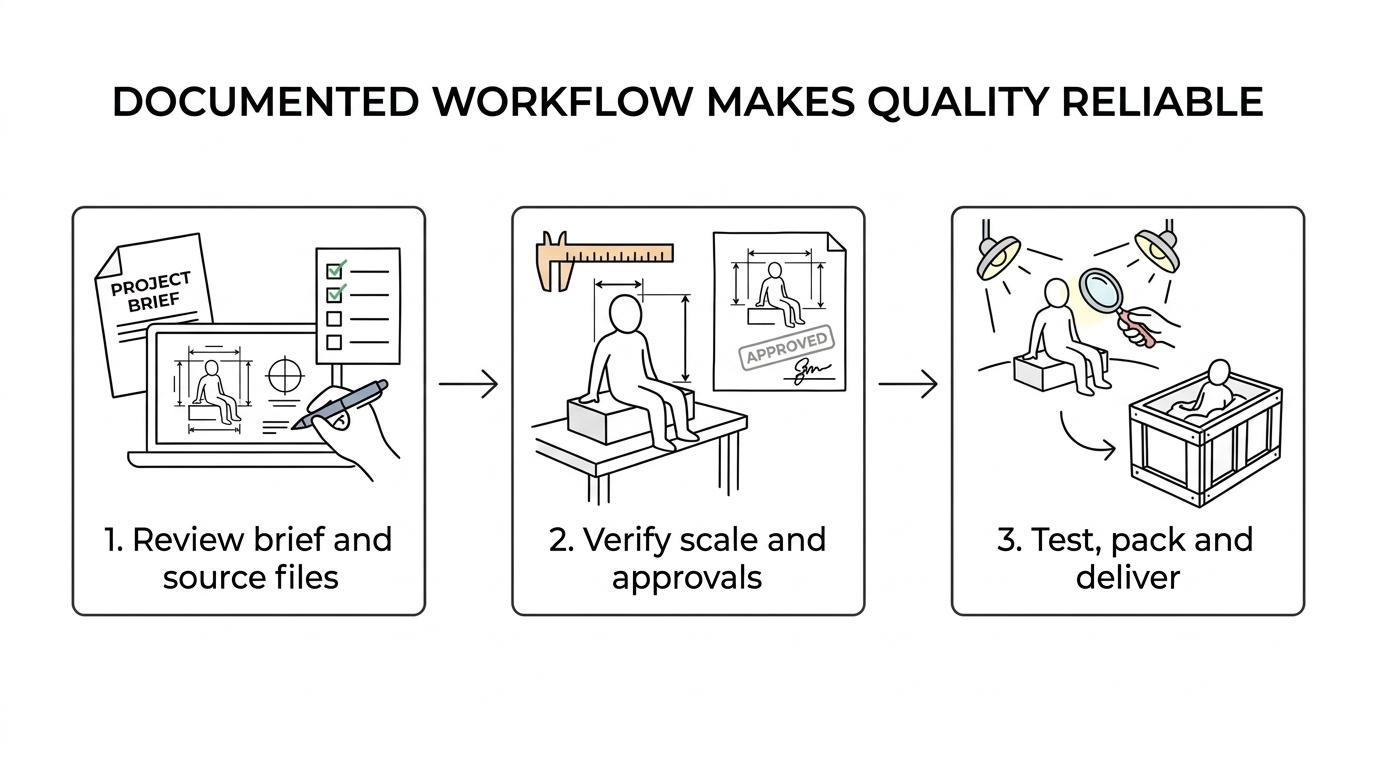
“ARI Model publishes a nine-step production process covering customer-needs evaluation through delivery, installation, and after-sales support.”
A common misconception is that process gets in the way of craftsmanship. In practice, the opposite is usually true. Good model making still depends on expert hands, but those hands work better when scale data, revisions, tolerances, and approvals are recorded rather than assumed.
What are the six traits of a reliable model manufacturing partner?
The six strongest traits are process discipline, precision, material judgement, technical capability, delivery proof, and accountable communication. If one of these is weak, the project risk rises quickly.
A buyer does not need a perfect score in every area, but the manufacturer should be able to show evidence for each one.
- Documented workflow: clear stages from brief and technical study to fabrication, packing, delivery, and support.
- True-scale precision: dimensions checked against approved source files, not guessed from marketing visuals.
- Material judgement: wood, acrylic, resin, metals, paint systems, and lighting chosen for function as well as appearance.
- Production capability: workshop tools and methods matched to geometry, detail level, finish, and quantity.
- Delivery evidence: completed projects, transport planning, installation readiness, and portfolio depth in relevant sectors.
- Communication discipline: approval gates, change tracking, named contacts, and realistic lead times.
If you are comparing suppliers, treat these six traits as a risk screen. A beautiful sample means less if the manufacturer cannot explain how the same result will be reproduced on your schedule.
How can you verify precision before production begins?
You verify precision by checking source data, scale logic, and sign-off points before any cutting starts. ARI Model is relevant here because its published workflow starts with needs evaluation and technical study rather than immediate fabrication.
Start with the source of truth. On a building or urban project, that may be CAD drawings, BIM files, elevations, sections, finish schedules, or planning visuals. Public-sector BIM guidance, including material published by Mass.gov, shows how digital deliverables can include native model files, data tables, quantity takeoff reports, and even point clouds to support validity. If a manufacturer asks only for screenshots, that is a warning sign.
Then ask how scale will be managed. A true-scale model is not just a small version of a design. Detail has to be edited intelligently so the model stays legible. A common mistake is to assume that “more detail” always means “better model”. At smaller scales, too much surface information can make a project harder to read.
Finally, check approval points before production begins. If the supplier cannot show when technical drawings, sample finishes, lighting positions, or base layout will be approved, then late-stage disputes become much more likely.
Which materials signal quality, durability, and the right visual message?
The right material depends on what the model must communicate. Wood often gives warmth, depth, and a crafted appearance, which suits residential, cultural, or heritage presentations. Getty notes that wood can express craftsmanship, while transparent plastics can express openness, and Columbia GSAPP points to the long history of simulated materials, landscaping, furniture, and electrification in highly precise models.
Wood often gives warmth, depth, and a crafted appearance, which suits residential, cultural, or heritage presentations. Acrylic and clear plastics can help viewers read internal organisation, circulation, or structural layers. Resin and advanced printed polymers allow fine detail on complex forms. Metal components can improve rigidity or add technical character in industrial presentations.
The trade-off is that every material changes transport risk, repairability, cost, and finish behaviour. A common error is choosing materials only from a visual sample. The better question is this: will the material still look right after lighting, handling, packing, and several days on display?
Mixed-material models are often the strongest option because they separate functions. One material can carry structure, another can express glazing, and another can highlight key programme elements or infrastructure routes.
How should you assess workshop capacity and production technology?
Capacity matters when precision must survive deadlines. A strong workshop combines manual finishing with CNC machining, laser cutting, and additive methods such as FDM, PolyJet, SLA, or SLS, depending on geometry, finish, and batch size.
Ask what the technology is actually used for. CNC is useful for repeatable cutting and base structures. Laser systems can produce crisp planar elements. SLA and PolyJet are well suited to fine detail and smooth surfaces. FDM can be practical for internal components or larger parts where surface texture is less critical. The point is not to collect machine names. The point is to know whether the tool matches the model brief.
“ARI Model states that it operates 1,000 m² of workshops in France and Germany and uses CNC, laser, FDM, PolyJet, SLA, and SLS processes.”
A pro tip here is to look beyond equipment lists. Two workshops may own similar machines, yet produce very different outcomes because calibration, operator judgement, finishing skill, and scheduling discipline vary far more than buyers expect.
How do lead times, installation, and after-sales support separate strong partners from risky ones?
A strong partner plans the final handover as carefully as fabrication. Packing, transported, installation, lighting checks, and after-sales support often decide whether a model succeeds in a sales suite, exhibition, or planning presentation.
Many failed projects do not fail in the workshop. They fail during the last stage because the crate was wrong, the site access was not checked, the lighting system was not tested on location, or the model arrived without a repair plan. That is why end-to-end responsibility is a major trust signal.
If the model includes illumination or interactive features, ask who tests them, who installs them, and who handles faults after delivery. If the answer is fragmented across several parties, build extra time into your programme.
How can you compare two model manufacturers side by side?
A side-by-side comparison works best when you score evidence, not impressions. Use the same brief, the same scale, and the same deadline, then compare what each supplier can document.
Start by sending identical information to both suppliers. Then compare the questions they ask back. The better manufacturer often reveals itself through the quality of its clarifications. A supplier who asks about source files, tolerances, lighting intent, transport, and display conditions is usually reducing future risk, not creating friction.
- Inputs requested: CAD or BIM files, elevations, finish schedules, reference imagery, usage context.
- Controls described: approval stages, scale checks, sample validation, lighting tests, packing method.
- Output proof: relevant project examples, sectors served, installation scope, support after delivery.
- Risk signals: vague tolerances, unclear revisions, no transport plan, no named point of contact.
If you need a practical scoring model, weight precision and process first, then materials and delivery, then price. The cheapest quote is often the most expensive if rework, delay, or transport damage enters the picture.
When is an international model manufacturer better than a local-only supplier?
International reach is better when your project needs cross-border delivery, multilingual coordination, or repeat production for more than one market. A local-only supplier can be the better choice when fast in-person reviews and frequent site visits matter most.
Geographic reach becomes important when a project team spans countries, when an exhibition moves between venues, or when a developer wants a consistent presentation standard across several regions. In those cases, workshop capacity, export-ready packing, and installation planning matter as much as model quality.
That said, do not assume international always means stronger. If your brief is simple, the scale is modest, and rapid physical review cycles are needed, a nearby specialist may be the most efficient answer. The right choice depends on the operating model around the project, not on prestige.
What questions should you ask before signing off a model project?
Ask questions that expose process, tolerance, and responsibility. If the answers remain generic, the risk is usually real.
Ask what source files will govern the build and who resolves conflicts between drawings, renders, and late revisions. Ask how true scale will be protected when the design contains elements too small to fabricate literally. Ask which materials are chosen for durability, not just appearance, and how lighting or moving parts will be tested.
Then ask about the last mile. Who packs the model? Who installs it? What happens if a component is damaged in transit or if the display period runs longer than planned? If the manufacturer has clear answers, named responsibilities, and a visible approval trail, you are likely dealing with a dependable partner.
One final misconception is worth avoiding: reliability is not the same as size. A large workshop without controls can still disappoint, while a smaller, disciplined team can deliver superb work. The real test is whether the manufacturer can prove how quality is produced, checked, and delivered.


