
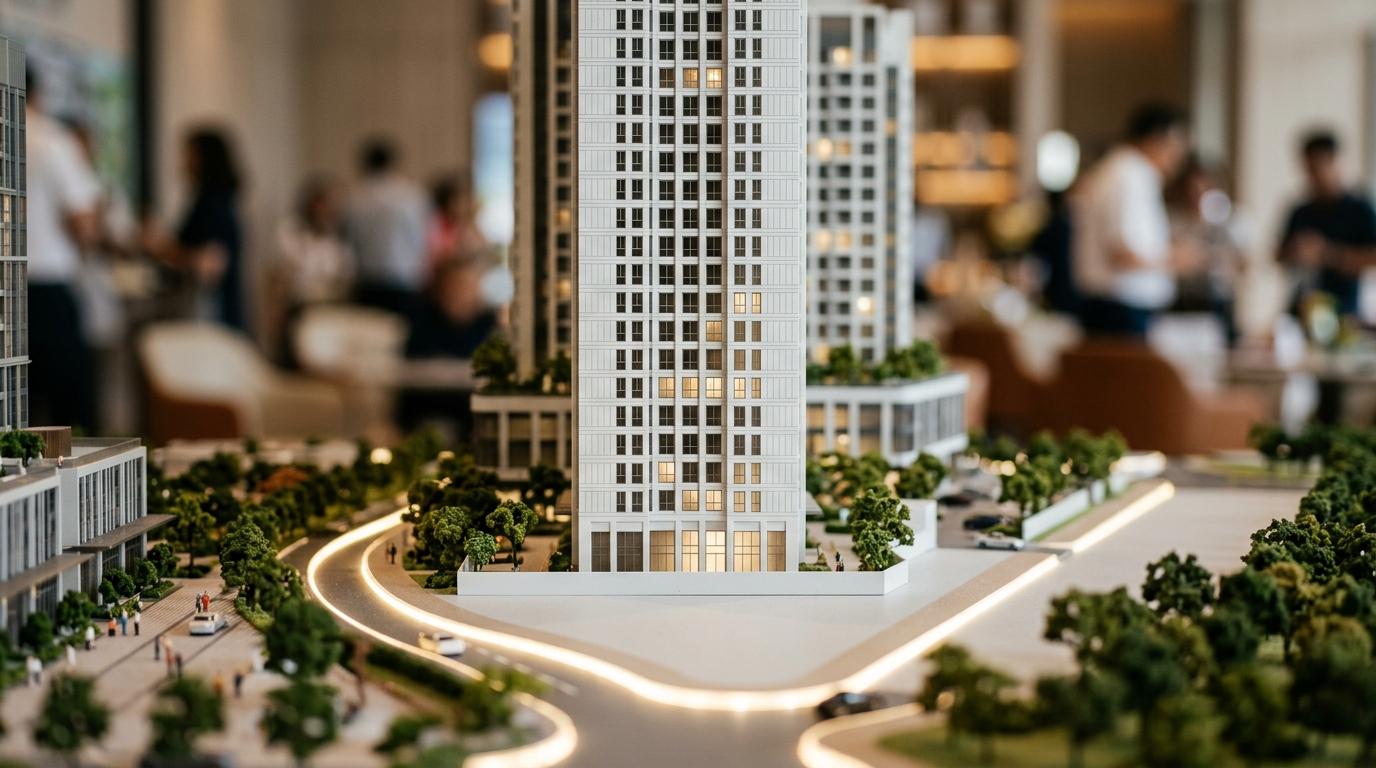
Property development rarely succeeds on drawings and spreadsheets alone. Even when a team has strong data, a clear planning strategy and polished marketing material, one issue keeps returning: people need to see the project in a way that feels immediate and believable. That is where property models keep their place.
A physical model gives shape to intent. It turns a future building, block or district into something that can be read at a glance, discussed from multiple angles and remembered after the meeting ends. For developers, that matters at every stage, from planning reviews to investor presentations and pre-sales campaigns.
Property models make development proposals easier to understand
A property model condenses a large amount of technical information into one object. Massing, access routes, façade rhythm, landscaping, neighbouring buildings and public space can all be read together. That is very different from reviewing separate plans, elevations, renders and written notes. Each of those tools has value, yet the model brings them into one shared view.
This shared view matters because development decisions are rarely made by one person. Planners, investors, architects, brokers, contractors and buyers often come to the table with different priorities. A property model creates a common reference point. It reduces ambiguity and helps the discussion stay focused on the project itself rather than on competing interpretations of the drawings.
A good property model shortens the distance between an idea and a decision.
After a proposal has been introduced, developers often use property models to keep attention on the points that shape confidence most strongly:
- scale and massing
- relationship to the street
- circulation and access
- shared amenities
- phasing and site context
This is one reason property models remain so useful even when digital visualisation is widely available. A screen usually presents one selected view at a time. A model presents the whole composition at once, and it invites people to move around it naturally. That physical interaction often leads to sharper questions and faster agreement.
Property models improve buyer, tenant and investor communication
Research supports the basic idea that visual representation is more persuasive than text alone when people assess housing options. A 2023 Monash University experiment involving 417 student respondents found that floor plan representations were rated higher overall than text representations when participants evaluated hypothetical apartments. The study focused on build-to-rent apartments, and its findings were said to be relevant for property developers and agents presenting sight-unseen residential property.
That result does not mean a floor plan replaces every other tool. It does show something developers have known for years: when people can process space visually, preference forms more easily. A property model extends this effect. It does not only show room arrangement or layout orientation. It shows the building as a place in context, with depth, proportion and hierarchy.
The same principle appears in sales performance research. A 2018 housing-market study using 32,102 listing records linked stronger information sharing intensity with a greater probability of sale, higher prices and shorter time on market. In simple terms, better presentation and richer information helped listings perform better. A physical property model fits neatly into that pattern because it adds a form of communication that is quick to absorb and hard to ignore.
Developers use different media for different layers of information. Each one answers a slightly different question.
| Presentation tool | What it shows best | Main limitation | Where property models add value |
|---|---|---|---|
| Text description | features, specifications, legal detail | hard to picture spatial quality | turns abstract claims into visible form |
| Floor plan | layout, room sizes, circulation | weak sense of volume and context | shows massing, surroundings and vertical relationships |
| CGI or render | atmosphere, materials, lifestyle | often fixed to selected viewpoints | gives a whole-project view from many angles |
| Property model | scale, context, composition, hierarchy | needs time and craft to produce | creates trust through physical presence |
For buyers and tenants, this can be decisive. Many residential schemes are sold or reserved before completion. People are choosing from plans, marketing boards and a promise. A property model adds certainty to that promise. It helps them see where the building sits, how amenity areas relate to homes, how roads and green space connect, and whether the scheme feels generous or cramped.
For investors, the value is slightly different. They are often reading the project as an asset and as a market proposition. The model helps frame density, placemaking, design quality and ambition in one presentation piece. That combination can be more effective than a stack of boards because it lets the discussion move quickly from design to opportunity.
Property models strengthen sales offices, exhibitions and investor presentations
In a sales office, a property model works as both a centrepiece and a practical communication tool. It draws visitors in, but its real strength lies in helping a sales team explain a scheme clearly and consistently. Questions about entrances, podium levels, views, parking access, retail frontage or open space become much easier to answer when the scheme is visible in three dimensions.
The same applies at exhibitions and trade fairs. Property marketing in these settings competes for attention. A model gives a stand physical presence. It can stop people, start conversations and make the development easier to recall later. That is one reason developers still commission large-format presentation models for launches and public events.
Project examples from ARI Model show this range of use clearly. A Launch and Technology Center model for MERCK was produced at 1:200 scale and presented as an office building model used for presentation and marketing. A sustainable residential model created for IRISOLARIS in France was prepared as a presentation tool for visitors and investors, with solar-powered roofing, integrated lighting and landscaping details. A detailed model for KILER GYO’s Pendik project was developed as a realistic architectural presentation piece with close attention to finish and detail.
These cases point to a practical truth: developers do not use property models only for planning departments or architectural reviews. They use them in the rooms where support is won.
A model can contribute in several presentation settings:
- In sales suites: it helps buyers grasp apartment positioning, amenities and neighbourhood character
- At trade shows: it gives the project a strong physical focal point
- In investor meetings: it supports a confident, structured narrative around quality and scale
- During public consultation: it makes a proposal easier for non-specialists to assess
Lighting and interactivity can make this even stronger. Illuminated roads, amenity zones, tower highlights or phased-development sequences help a team direct attention without losing the whole-picture view. Used well, these features do not feel theatrical. They make the information easier to read.
Property models help planning teams test scale, context and design details
A property model is not only a marketing object. It also has working value during the development process. Teams use it to assess site constraints, nearby building relationships, setbacks, view corridors and the impact of height changes. This is especially useful on dense urban sites where a small change in volume or orientation can alter the feel of the entire proposal.
Urban planning discussions often benefit from this clarity. A district-scale model can show roads, transport links, public realm and development parcels in one coherent field. That makes it easier to discuss phasing, civic presence and how a new scheme sits within the wider area. In early project stages, this sort of model can help developers, consultants and authorities move past abstraction and focus on the actual urban effect.
The strongest models are usually selective rather than overloaded. They do not attempt to reproduce every bolt, bench and brick. They make hierarchy visible. Important features are clear, the surrounding context is legible and the intended use of the model shapes the level of detail.
That often means developers ask for different emphases depending on the audience:
- For planning teams: site context, access points, adjacencies and public realm
- For sales teams: entrances, amenities, tower identity and premium plot positioning
- For investors: project scale, design coherence and market-facing presentation quality
- For exhibition use: durability, lighting and immediate visual impact
This flexibility explains why property models are still commissioned for schemes that already have strong digital assets. A digital package may be ideal for remote circulation. A physical model is often better for live review, stakeholder meetings and moments when confidence must be built quickly.
Choosing the right property model for each development stage
Not every development needs the same model. The right answer depends on timing, audience and the decision that needs to be made. Early-stage models often prioritise site context and massing. Mid-stage models may focus on architecture, amenity areas and public-facing presentation. Late-stage sales models tend to combine high finish, lighting and selected interior or landscape cues.
That choice affects scale, materials and budget. A compact context model may be enough for planning workshops. A premium illuminated model may be more suitable for a launch campaign. Developers get the best return when the brief is linked closely to purpose rather than to visual ambition alone.
A simple stage-based approach is often useful:
| Development stage | Main audience | Model priority | Typical benefit |
|---|---|---|---|
| Concept and land promotion | internal teams, planners, partners | site context and massing | quicker strategic discussion |
| Planning and consultation | authorities, community, design team | urban fit and public realm | clearer feedback and fewer misunderstandings |
| Investor presentation | funds, partners, boards | quality, scale, place identity | stronger confidence in the proposal |
| Pre-sales and launch | buyers, brokers, visitors | detail, lighting, amenities | easier buyer communication and stronger recall |
Production quality matters here. A model intended for repeated transport and exhibition use needs robust fabrication. A model for close-up investor presentation may need finer material expression and more refined lighting. A model for a large masterplan may need removable sections or phased overlays. These are practical design decisions, not cosmetic extras.
ARI Model’s work across architectural and industrial model making reflects this staged approach well, with project examples used for investor presentations, visitor engagement and trade-show settings. That breadth matters because developers rarely need a model in isolation. They need one that fits the communication task in front of them.
Property models remain relevant because development is still a business of persuasion built on clarity. When a project must be judged before it exists, the teams that explain it best often put themselves in a stronger position. A physical model does exactly that: it gives future property a convincing, readable presence in the present.