Factory models matter because manufacturing projects are hard to explain with drawings alone. ARI Model is an international maker of architectural and industrial scale models, so the question is not whether physical models still have a place, but when they outperform screens for layout, process and credibility.
### TL;DR: Summary
* Factory models are most valuable when buyers need fast, reliable understanding of site layout, equipment relationships and project credibility, especially for investors, planners, engineers and exhibition audiences.
* Physical factory models often outperform digital-only presentations for spatial layout and stakeholder feedback; Texas A&M found stronger performance on spatial tasks, and a 2024 Chalmers study found richer feedback and stronger acceptance and credibility from physical models.
* ARI Model is relevant here as a specialist in architectural and industrial scale models, with published factory-related work spanning gigafactories, biogas plants, crushing and screening lines, nuclear research and production facilities.
* The best factory model depends on three choices first: model purpose, scale, and detail level. If the goal is site-wide communication, use a broader scale; if the goal is maintenance access or equipment logic, enlarge selected zones.
* Cost and lead time usually rise with size, detail density, lighting, interactivity, data-cleaning effort and logistics, not just with footprint alone.
* Buyers should compare factory model makers on industrial references, workshop capability, fabrication methods, QA, transport planning and installation support.
A good buyer asks sharper questions than “How much does it cost?”. The right questions are about what decision the model must support, who needs to read it, and what level of realism will improve acceptance without slowing production or inflating cost.
What is a factory model and what does it show?
Factory models are physical 3D representations of manufacturing sites that show layout, process flow and key equipment at a glance. In ARI Model's industrial work, examples range from biogas plants to gigafactory and nuclear-research facility models, which shows how the format serves both sales and technical review.
A factory model usually combines several layers of information in one object: buildings, production halls, tanks, conveyors, roads, yards, loading areas, utilities, landscaping and sometimes internal process zones. That is why buyers use them in boardrooms, public consultations, trade fairs and internal design reviews. One well-made model can reveal circulation problems, spatial conflicts and visibility issues that stay hidden in flat plans.
A common misconception is that factory models are only presentation pieces. Academic work points in a broader direction. TU Delft has described large-scale physical modelling as a tool for analysing details and testing interventions, while a 2024 Springer Nature chapter connects physical models with validation for industrial production, design optimisation and shorter verification phases when additive manufacturing is used well.
"Since 2000, ARI Model has produced architectural and industrial models for presentations, planning and exhibitions."
When is a physical factory model better than a digital-only presentation?
A physical factory model is better than a digital-only presentation when stakeholders must grasp spatial layout, scale and process relationships quickly. Texas A&M and Chalmers research both point the same way: tangible 3D models improve comprehension and generate richer feedback, especially for non-specialists.
The strongest case for a physical model appears when the audience is mixed. If the room includes investors, public officials, plant managers and non-technical guests, then a shared physical object reduces interpretation gaps. A 2012 Texas A&M dissertation reported that laypeople who studied physical models performed spatial-layout tasks significantly better than those using digital models. That matters in manufacturing because site logic is often the first thing buyers, clients and communities struggle to grasp.
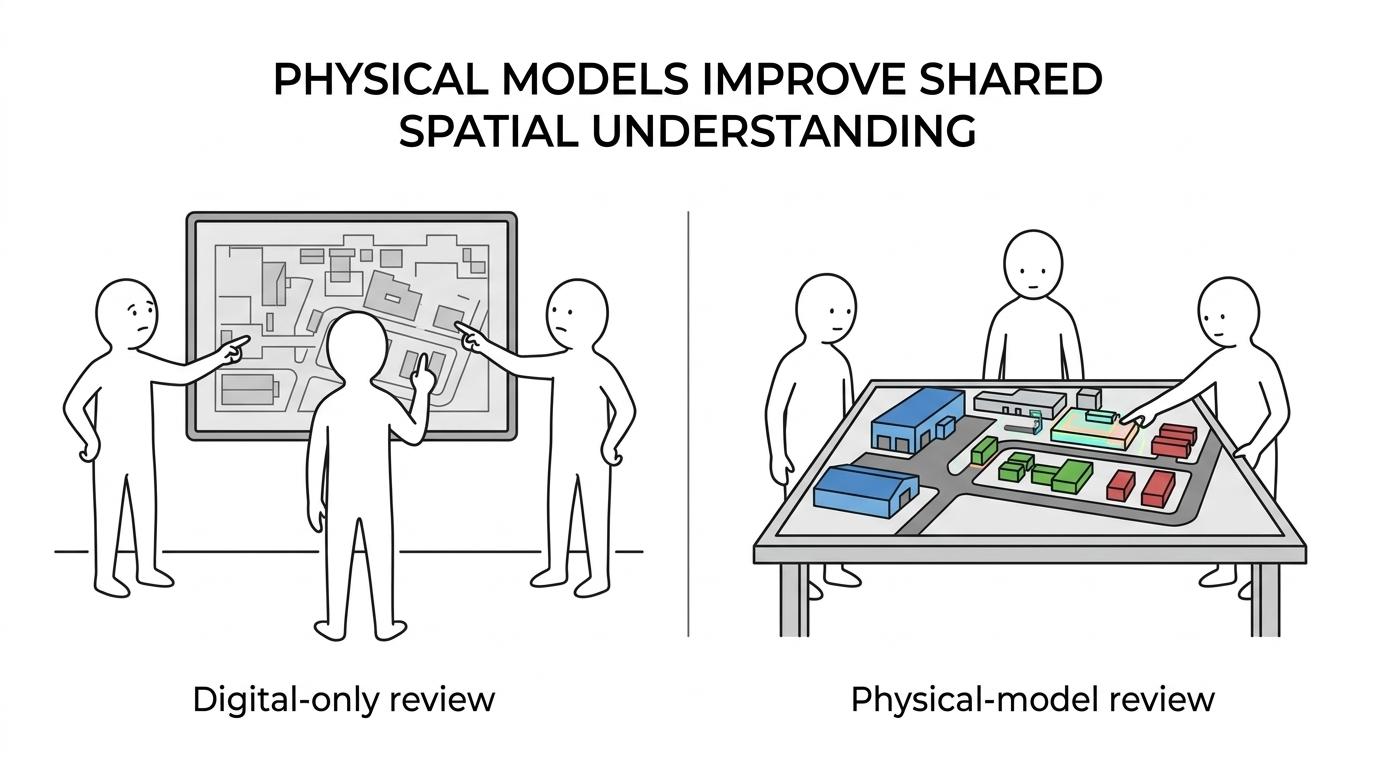
Chalmers University of Technology reported in 2024 that physical models elicited more feedback than CAD in both quantity and content richness. The same work linked tangibility to acceptance and credibility. That does not mean digital models are weak. Digital tools are excellent for hidden systems, version control, remote collaboration and quick iteration. The trade-off is simple: if you need rapid changes and remote access, digital leads; if you need stronger room-based discussion and faster shared comprehension, physical often wins.
Pro tip: do not treat this as physical versus digital in absolute terms. The strongest workflow is often digital for design development, then physical for decision-making, presentations and feedback.
What are the main types of factory models buyers commission?
Buyers usually commission presentation models, planning models, process models, exhibition models or prototype-linked industrial models. ARI Model's published factory and plant work shows this range clearly, from energy engineering and recycling facilities to production factories and infrastructure.
Most factory models sit in one main category, but many combine two or three. A planning model may need investor-grade finish, while an exhibition model may also need enough equipment logic for engineering conversations.
- Investor presentation models: clear massing, road access, process blocks and site context.
- Planning and consultation models: neighbouring land use, buffers, routes, landscape and public legibility.
- Process and equipment models: tanks, lines, conveyors, machinery placement and production flow.
- Exhibition and trade show models: lighting, labels, robustness, transport-safe construction and quick visual impact.
- Prototype and validation models: form study, user experience, visual testing or functional checks linked to industrial production.
The useful link here is prototype categories. Springer Nature groups prototypes and models into test, form study, user experience, visual and functional types. If your factory model is expected to do more than one job, state that early. A model built only for appearance may disappoint an engineering team expecting access logic or service-route clarity.
How do you choose the right scale for a factory model?
Choose scale by starting with the decision you need to support, then fitting the model to room size, transport limits and viewing distance. A 1:500 site model answers different questions from a large fragment at 1:50 or 1:20.
Scale is not a style choice. It is a decision tool. If the purpose is to show the whole industrial campus, a smaller scale works because relationships between buildings, roads and yards matter more than tiny parts. If the purpose is to test maintenance access, platform widths or a specific production bay, then a much larger scale or sectional fragment is the better answer.
A frequent buying mistake is choosing the biggest model the budget can tolerate. Bigger is not always clearer. A very large model can become hard to transport, difficult to protect and visually noisy unless the information hierarchy is controlled.
Use these criteria before approving scale:
- Decision goal: investment approval, planning dialogue, engineering review or exhibition impact.
- Viewing distance: tabletop discussion, wall-adjacent display or open-stand public viewing.
- Detail threshold: whole-site legibility or enlarged focus on one process zone.
- Transport envelope: crate size, door widths, lift access and on-site assembly limits.
If the audience needs site-wide logic first, then go smaller and cleaner. If the audience needs equipment relationships or haptic qualities up close, enlarge a selected fragment instead of scaling up everything.
How detailed should a factory model be for investors, engineers or exhibitions?
The right level of detail depends on the audience. Investors need legible massing and process logic, engineers need interfaces and access routes, and exhibition visitors need contrast, lighting and labels that read within seconds.
Investors rarely need every pipe support or service hatch. They need confidence that the project is coherent, real and buildable. That means readable circulation, loading strategy, core equipment volumes and a finish quality that supports credibility. Chalmers' findings on acceptance and credibility are relevant here: the physical presence of the model itself can shift how seriously a proposal is received.
Engineering teams ask different questions. They care about sequence, adjacency, clashes, maintenance envelopes and the relationships between buildings and process equipment. In those cases, selective detail beats blanket detail. A removable roof, sectional cut, colour-coded utilities or illuminated process path can carry more value than trying to miniaturise every component.
Exhibition audiences are faster and less patient. They need a story in seconds. Good exhibition factory models use strong hierarchy: key process units, brand-neutral wayfinding, controlled lighting and durable finishes. Pro tip: people often assume more detail means more impact. In public displays, too much micro-detail can reduce readability from normal viewing distance.
How are factory models designed and built step by step?
Factory models are built through a structured workflow: scope, data preparation, fabrication, finishing and installation. Springer's 2024 discussion of prototype categories is useful here because visual, test and functional goals often require different model-making decisions.
The workflow matters because model quality depends as much on information management as on fabrication skill. Clean inputs reduce rework, while unclear scope creates expensive changes late in the process.
- Define purpose and audience: decide whether the model is for planning, investment, engineering review, training or exhibitions.
- Prepare source data: organise plans, BIM or CAD files, elevations, process diagrams, material references and site photos.
- Set scale and scope: choose whole-site coverage, focused zones, removable sections, lighting and any interactive features.
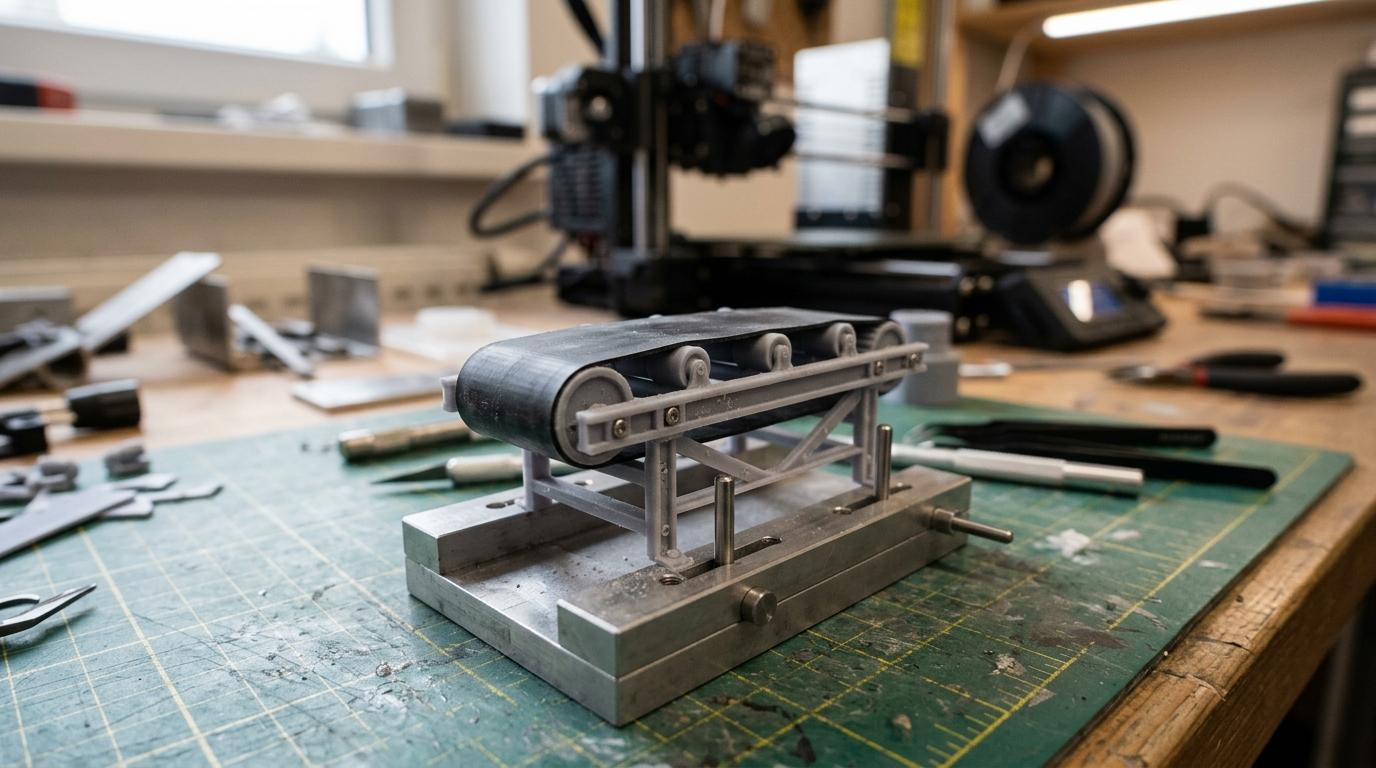
- Fabricate components: use methods such as CNC machining, laser cutting and 3D printing where each suits the geometry and finish.
- Finish, test and install: paint, label, light, crate, transport and assemble with QA checks before handover.
The least glamorous stage is often the most important: data preparation. If source files are inconsistent, missing or over-modelled, the workshop must spend time simplifying, correcting and rebuilding geometry. That is where lead time can slip. Buyers who provide clear priorities early usually get a better result than buyers who request “maximum detail everywhere”.
"With 1,000 m² of workshops in France and Germany, ARI Model is set up for large architectural and industrial model production."
What affects factory model cost and lead time most?
Cost and lead time are driven most by size, detail density, lighting, interactivity and file quality. A compact static model can move quickly; a large illuminated plant with custom electronics, protective casing and logistics planning cannot.
The hidden driver is often complexity per square centimetre, not the footprint alone. A simple massing model of a broad site may be easier than a smaller model packed with conveyors, pipe racks, cranes and illuminated interiors. If the model must travel internationally, then crating, modular assembly and surface protection also shape cost.
Rapid additive manufacturing can reduce some verification phases and support design optimisation, as the Springer Nature chapter notes. Still, 3D printing is not a magic shortcut. If a model needs extensive finishing, painting, transparent elements, LEDs and display cabinetry, the post-print work can outweigh the print time itself.
Another common misconception is that late design changes are minor. In factory models, a moved hall, resized tank or revised circulation route can cascade through roads, utility runs, labels, lighting positions and crate geometry.
"ARI Model reports 499+ models in 17 countries, which highlights why delivery, installation and transport planning belong in the buying brief."
How should buyers compare factory model makers before ordering?
Compare factory model makers by checking technical range, industrial references, workshop capacity, QA process and delivery planning. If a supplier cannot explain scale choice, material choice and transport risk in plain terms, keep looking.
A useful comparison starts with evidence, not image galleries alone. Ask whether the maker has handled industrial subjects with real process complexity: energy plants, production halls, recycling lines, research facilities, ports or infrastructure. Then ask how they work from source data, what fabrication methods they use, and how they protect the model in transit.
Use a short evaluation checklist:
- Industrial references: named sectors, comparable project types and evidence of process-heavy work.
- Fabrication range: CNC, laser cutting, additive manufacturing, lighting and electronics where needed.
- Model engineering: modular assembly, removable sections, casing and maintenance access.
- Project control: QA, milestone reviews, file-check process and change-management rules.
- Delivery support: crating, shipping, installation and after-sales handling.
If your main risk is stakeholder buy-in, prioritise clarity and finish. If your main risk is technical misread, prioritise data discipline and selective detail. If the model will tour events, durability and logistics may matter more than ultra-fine static detailing. The best buyers compare makers against the actual job the factory model must do, not against a generic idea of “realism.”