
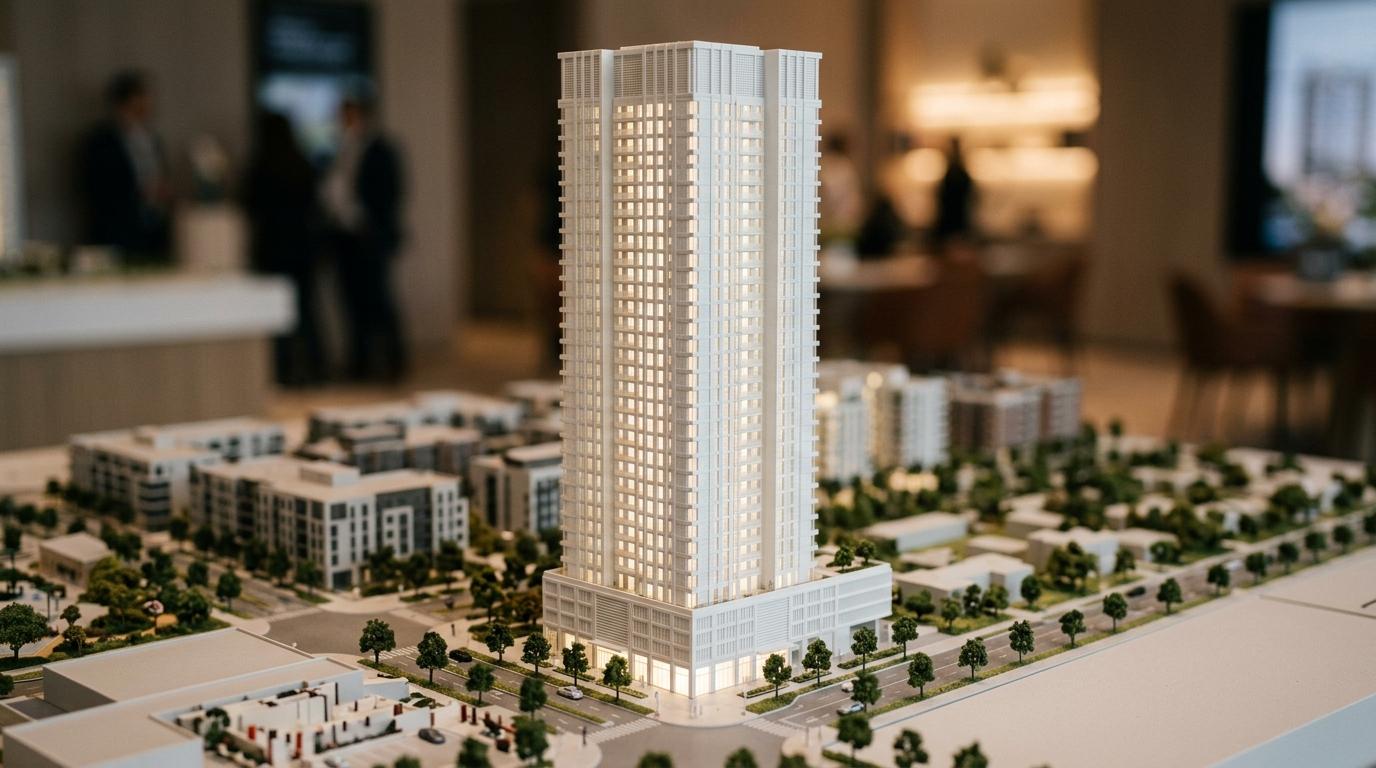
Real estate models remain one of the clearest ways to explain a development before it is built. When buyers, planners and investors must judge scale, massing and layout quickly, a physical model often communicates faster than drawings alone.
### TL;DR: Summary
* The best real estate models are usually physical presentation models, urban planning models, unit models, and hybrid physical plus digital displays, chosen by project stage and audience rather than by price alone.
* Physical models tend to support quicker and more accurate comparisons of building heights than virtual models, which makes them strong for sales suites, planning reviews, and investor presentations.
* Floor plans are standard in real estate, but a 2023 Springer Nature study found they can be hard for laypeople to interpret, so they work best when paired with a model or guided visual aids.
* If the key question is context, skyline, or neighbourhood fit, choose a site or masterplan model; if it is unit layout, use apartment models and annotated floor plans; if it is exhibition impact, use illuminated or interactive presentation models.
* Scale, transportability, update frequency, and lighting should be decided early, because these factors affect fabrication method, delivery risk, installation time, and long-term reuse.
Yet “real estate models” covers several distinct tools, from masterplan models and floor plans to illuminated sales displays and interactive exhibits. The right option depends on whether you need spatial understanding, layout clarity, planning dialogue, or stronger off-the-plan marketing.
What are real estate models and why do they still matter?
Real estate models and floor plans solve different communication problems. A 3D physical model makes scale perception and site context legible quickly, while a plan sheet shows room relationships and dimensions in a format that architects and agents can annotate precisely.
They still matter because property decisions are often made before completion, sometimes before construction starts. In that setting, buyers are trying to understand a future place from limited information. A tangible model reduces cognitive effort by turning abstract geometry into something people can read almost instantly.
Academic research supports this practical point. A 2023 Springer Nature study noted that floor plans are widely used in real estate to communicate design and layout attributes, yet lay-individuals can struggle to comprehend them fully. That matters when your audience is not trained to read drawings.
"Since 2000, ARI Model has produced over 499 models in 17 countries for planning, marketing and exhibition use."
There is also a design-side benefit. Research published in Buildings described physical models as a long-standing tool for exploration, communication and evaluation because they allow direct engagement with spatial relationships, materiality and form.
When does a physical real estate model outperform a floor plan?
A physical model outperforms a floor plan when the decision depends on height, massing, context, or sightlines. Frontiers of Architectural Research found that physical models tended to enable quicker and more accurate comparisons of building heights than virtual models.
That advantage shows up most clearly in mixed-use towers, waterfront schemes, and dense urban sites where the question is not only “what is inside the apartment?” but also “how does this building sit within the district?”. A floor plan can answer the first question well. It rarely answers the second on its own.
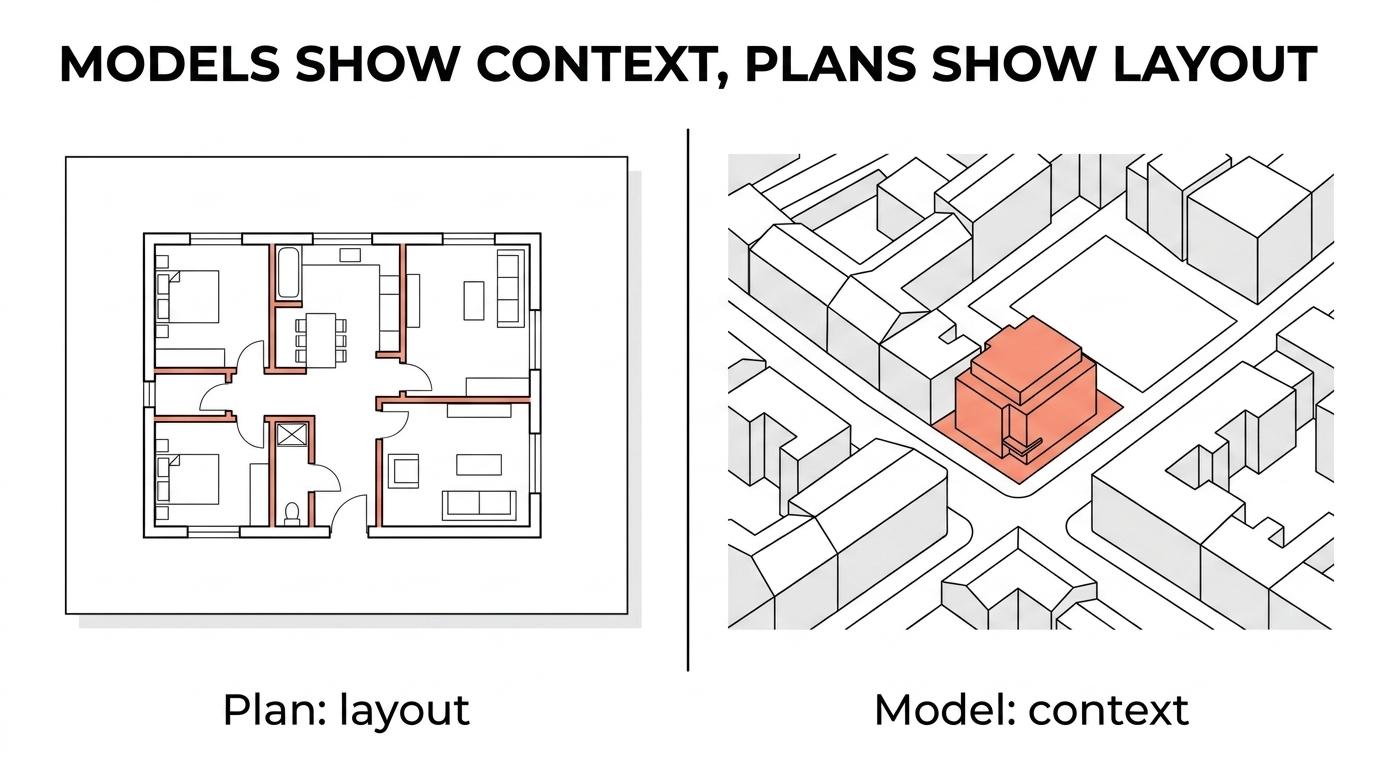
A common misconception is that better graphics fix every comprehension problem. They do not. If the audience is comparing podium height, tower spacing, sun exposure, or street frontage, a physical model often removes ambiguity faster than a polished 2D brochure.
If your scheme is mostly standardised residential stock and the sales process happens online, floor plans may carry more weight. If the project relies on placemaking, premium positioning, or civic approval, the model normally earns its place.
What are the top options for real estate models?
The top options for real estate models are presentation models, urban planning models, unit models, massing models, illuminated models, wooden models, and hybrid displays. Each serves a different stage of development and a different level of spatial understanding.
After the brief is clear, these are the main options to compare:
- Architectural presentation models by specialist makers such as ARI Model: best for flagship launches, investor meetings, and sales galleries where finish quality and site context matter.
- Urban planning models: suited to masterplans, municipality dialogue, phasing reviews, and public consultation.
- Apartment or unit models: useful when buyers need help understanding room flow, furniture fit, and premium layouts.
- Massing models: ideal for early feasibility, option testing, and comparative height or volume studies.
- Illuminated sales models: strong for showrooms and exhibitions where visibility, mood, and zoning need emphasis.
- Wooden architectural models: effective when a restrained material palette supports premium branding or concept-led presentations.
- Hybrid physical plus digital models: valuable when you need both tangible scale perception and flexible digital overlays for phasing, unit availability, or AR content.
The strongest choice usually comes from matching the model to the decision. If the audience needs confidence in the project’s presence, use a contextual 3D model. If it needs confidence in a specific apartment, narrow the scope and pair the model with a clear floor plan.
How do you choose the right scale and scope for a real estate model?
Choose scale and scope by starting with the decision, not the object. A 1:500 masterplan and a 1:50 apartment model can both be “correct”, but each answers a very different commercial question.
Step 1 is to define the audience. Planning committees, investors, brokers, and end buyers all read models differently. A city-facing presentation may need surrounding streets, public space, and transport connections. A private sales suite may need façade articulation, amenities, and unit-stack legibility.
Step 2 is to choose the viewing distance and the message. Broad urban context often sits well around 1:500 or 1:1000. Building-level storytelling may move toward 1:200. Interior-rich communication often needs 1:100 or 1:50. If balconies, glazing lines, or podium landscaping are decisive, the scale must support those details.
Step 3 is to trim the scope to what the audience truly needs. Bigger is not always better. Transportability, storage, update cycles, and installation access can punish an oversized model long after the launch event.
"ARI Model treats scale, transportability and presentation type as early model-planning decisions."
A useful pro tip is to agree what may change before fabrication starts. If planning revisions are likely, modular sections or replaceable components can protect budget and schedule.
Should you use a physical model or a virtual model for property marketing?
The best property marketing often uses both physical and virtual models. Physical models are stronger for immediate scale perception, while virtual models are stronger for remote access, frequent updates, and wide distribution.
A virtual model can be shared across sales teams, embedded into campaigns, and updated without physically rebuilding the whole presentation.
Industry practice mirrors this: 4CAD notes in its explainer on BIM modelling for building operations that well-structured digital assets continue to pay off after sales by supporting handover and later facility management.
That makes it attractive for phased developments or fast-moving inventory. Yet virtual environments also depend on interface quality, device performance, and user patience.
Physical models win when people are in the room and need confidence quickly. They create a shared focal point, which is especially useful in investor reviews, planning meetings, and trade shows. The 2014 comparison study is valuable here because it points to a practical edge in height comparison and spatial judgement.
Here is the trade-off in plain terms:
| Criterion | Physical model | Virtual model |
|---|---|---|
| Scale perception | Usually stronger | Can vary by screen and navigation |
| Remote sharing | Limited | Strong |
| Update flexibility | Lower | Higher |
| Exhibition presence | Strong | Medium unless paired with a large display |
| Buyer self-guidance | High when simple | High when interface is intuitive |
The common mistake is treating this as an either-or decision. If prospects are international, use virtual content to widen reach. If closing confidence depends on place, add a physical model where the important conversations happen.
How should developers combine floor plans with real estate models?
Developers should combine floor plans with real estate models because the two tools answer different questions. A floor plan explains internal layout attributes; a model explains context, form, and spatial understanding.
The evidence on floor plans is useful but nuanced. The Springer Nature study drew on 417 student respondents evaluating four hypothetical apartments and found that layout formats can be too complex for lay users to fully grasp. That does not make floor plans ineffective. It means unsupported floor plans are often inefficient.
The practical fix is simple. Use the model to orient people first, then use the plan to confirm specifics. Once a buyer understands tower position, amenity placement, and facing direction, the plan becomes much easier to read.
A second misconception is that a 3D render replaces a plan sheet. It does not. Renders show atmosphere. Plans show dimensions, circulation, door swings, and adjacency. If the sales process needs both emotional buy-in and technical reassurance, the pairing is stronger than either tool on its own.
How do you brief a model maker for an off-the-plan development?
A good off-the-plan model brief starts with source files, decision goals, and revision limits. Revit, DWG, and landscape plans are useful inputs, but the business purpose should be just as explicit as the geometry.
Start by listing what the model must prove. Is it showing premium waterfront positioning, unit mix, podium activation, or planning compliance? The answer changes scale, materials, lighting, and where detail should be concentrated.
Then define the required level of detail. Façade articulation, glazing, balconies, planting, roads, branding elements, and interior glimpses do not all need the same treatment. If one feature drives sales, that feature should get the budget.
Finally, set an approval path. Many delays come from unclear sign-off, late design changes, or missing information. Agree file freeze dates, model dimensions, electrical requirements, delivery windows, and responsibility for on-site installation before production starts.
"Since 2000, ARI Model has designed and delivered presentation models across Europe and worldwide."
A useful rule is this: if the scheme is likely to change during planning, request modularity early. Retrofitting flexibility after fabrication is usually more expensive than planning for it.
What features make a real estate presentation model more persuasive at exhibitions and sales suites?
The most persuasive presentation models combine clarity, selective detail, and controlled lighting. In sales suites and trade shows, people need to read the project in seconds before they commit more attention.
Lighting is often underestimated. Used well, it can separate public areas from private ones, highlight circulation, and pull attention to premium amenities or phase boundaries. It should support legibility, not turn the model into a spectacle that obscures form.
Interactivity can also help, especially when the project has multiple phases or large unit mixes. Simple switches, labelled zones, removable sections, or digital overlays can guide the conversation without overwhelming the viewer. The best systems feel intuitive and restrained.
Material choice affects persuasion too. A wooden model can communicate calm, craft and concept clarity. A full-colour model can work better for pre-sales when landscaping, façade tone, and surrounding streets need to feel familiar.
"ARI Model builds high-precision models with lighting and interactive systems for trade shows and client presentations."
One pro tip is to simplify the base and labels. If every element competes for attention, the commercial message gets lost.
How do production, transportability and installation affect the final choice?
Production, transportability and installation often decide whether a model succeeds in the real world. A beautiful concept that cannot pass through a lift, travel safely, or be serviced on site is a risky procurement choice.
Start by checking logistics before finalising dimensions. Door widths, loading bays, customs requirements, crate sizes, and venue rules can all limit what is practical. This is where transportability becomes more than a technical detail. It influences design from the start.
Material and build method matter as well. CNC, laser cutting, FDM, PolyJet, SLA and SLS each support different surface qualities, tolerances, and production speeds. A robust exhibition model may need different material decisions from a one-off planning model.
Lead time varies sharply with complexity. ARI Model’s 2024 Pendik project for KILER GYO, as a concrete example, involved eight employees and a 60-day production process. That does not define every project, but it shows why detailed façade work, lighting, and coordination should never be left to the final week.
If the model will tour across multiple venues, ask about reassembly, spare parts, cleaning, and after-sales support early. Those details protect the investment long after the first presentation.
Which real estate model option fits your project stage and audience?
The right real estate model depends on timing and audience. A municipality, a private equity investor, and an off-the-plan buyer each need different evidence before they feel confident.
A simple way to map the options is to match the tool to the moment:
- Feasibility stage: massing models for volume, setbacks, and comparative options.
- Planning stage: urban planning models for public realm, adjacency, and civic discussion.
- Pre-sales stage: architectural presentation models plus clear floor plans for buyer confidence.
- Premium unit marketing: apartment models or interior cutaway models for layout comprehension.
- Exhibitions and roadshows: illuminated or hybrid models where portability and fast reading matter.
- Remote international sales: virtual assets paired with a physical hero model at the main sales location.
If your audience is mostly technical, drawings can carry more weight. If your audience is broad, international, or buying sight-unseen, a physical model usually earns its value by compressing explanation time and reducing ambiguity.