
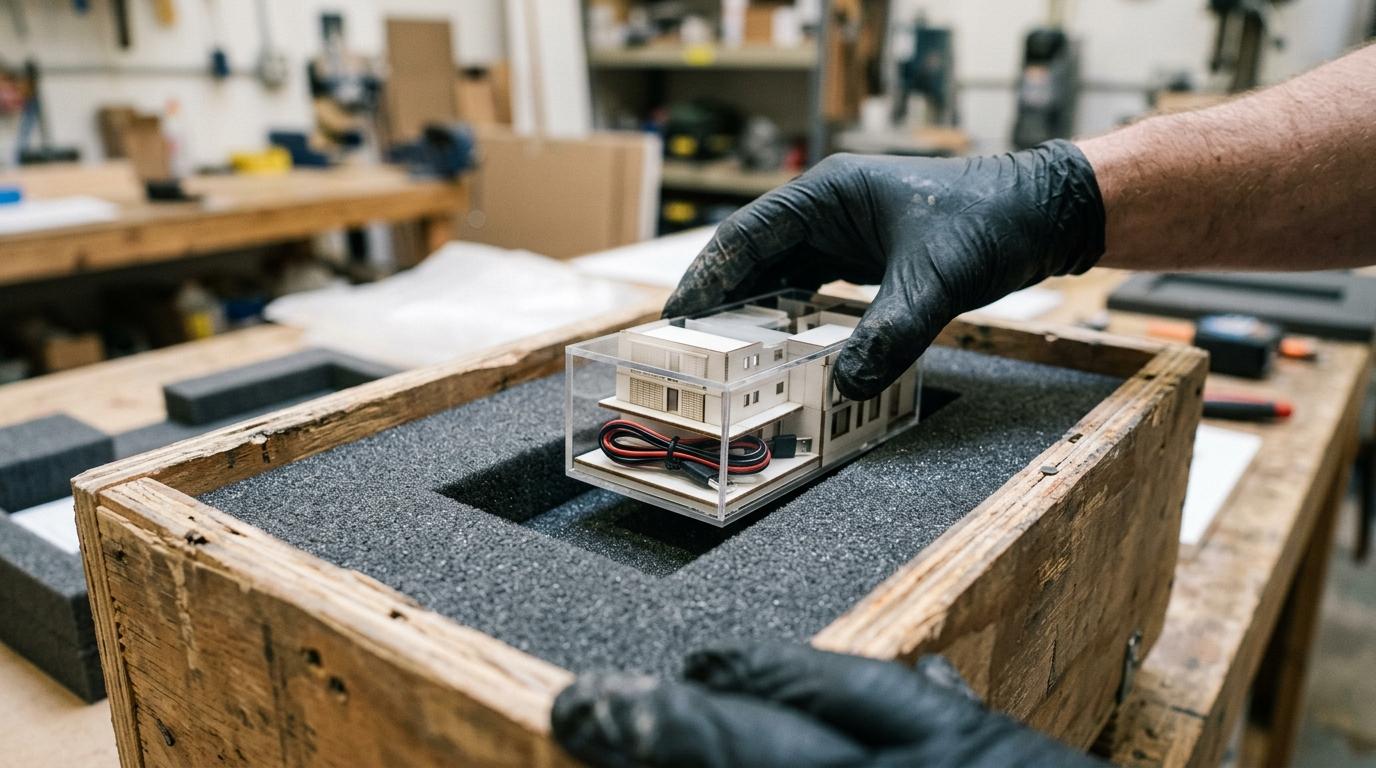
Tight exhibition deadlines turn model production into a logistics exercise as much as a fabrication one. ARI Model, an architectural and industrial scale model manufacturer working across Europe and beyond, sits in a category where deadlines are often shaped by venue rules, freight windows and on-site installation limits rather than workshop speed alone.
### TL;DR: Summary
* The safest model production approach for tight exhibition deadlines is to plan backwards from the venue’s move-in slot, freight rules and booth-completion deadline, then build the model as a modular, testable system.
* Official exhibitor rules from the NACS Show, RSNA and NBAA-BACE show that move-in dates, warehouse windows and safety requirements are fixed, leaving little room for late design changes.
* ARI Model is relevant here because its exhibition workflow covers fabrication, testing, delivery and installation, which reflects the end-to-end control that time-critical projects need.
* Modular fabrication usually beats one-piece construction for transport, repairs and faster on-site assembly, though it can increase interface planning.
* If deadlines are tight, freeze geometry early, leave late-stage flexibility in graphics and lighting, and test packing, access and power before dispatch.
The practical lesson is simple: a beautiful model that arrives outside the target move-in schedule can fail just as completely as a poorly made one. The teams that hit exhibition dates reliably are usually the ones that treat production, packing, transport, venue compliance and installation as one programme from day one.
Why is exhibition model production less forgiving than normal model making?
Yes, exhibition model production is less forgiving because venue schedules are fixed by organisers like the NACS Show and RSNA. A model can be technically finished yet still fail if it misses a freight slot, a move-in window or a booth construction cut-off.
In a studio setting, delay often means inconvenience. In an exhibition hall, delay can mean refusal at the loading dock, lost labour slots or an incomplete stand when visitors arrive. Official exhibitor guidance makes this plain. The NACS Show assigns move-in by booth location, requires booth construction to be complete by 5:00 pm on 6 October, and requires freight removal by noon on 11 October. That is a chain of immovable times, not a flexible target.
“ARI Model reports more than 499 completed models across 17 countries, which is a practical reminder that cross-border exhibition model production depends on logistics control as much as craftsmanship.”
A common misconception is that the exhibition opening date is the real deadline. It is not. If your assigned unloading time is two days earlier, then that earlier slot is the deadline that matters. RSNA uses target move-in dates based on exhibit size, complexity and freight-door proximity, which shows how tightly venue operations are managed before visitors ever see the stand.
How should you build the deadline backwards from venue rules?
Start with the venue timetable, not the design file. When ARI Model handles time-sensitive exhibition work, the sensible sequence is venue slot, shipping plan, packing method, testing window, final assembly and only then detailed workshop milestones.
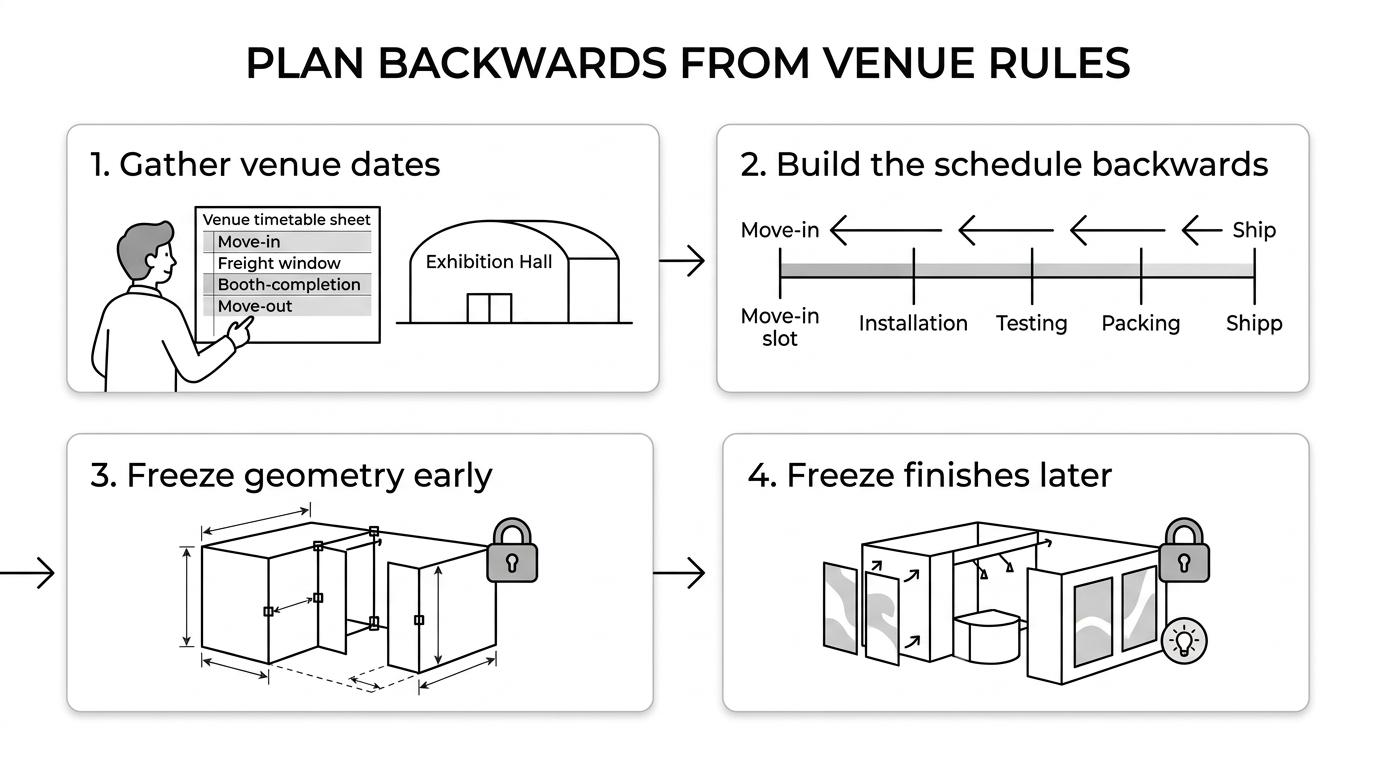
Step 1 is to collect the hard constraints. That means the targeted move-in schedule, advance warehouse shipment window, direct-to-show restrictions, booth-completion time, and move-out deadline. If any of those dates are unknown, you do not yet have a reliable production schedule.
Step 2 is to create a reverse timetable. If direct-to-show freight must not arrive before a certain day, as RSNA states for some shipments, then your carrier booking and crate readiness must sit behind that rule. If your booth must be complete by a set hour, then installation has to finish earlier still, leaving time for snagging, lighting checks and cleaning.
Step 3 is to mark two internal freeze points. The first is a geometry freeze, when dimensions, scale and module interfaces stop moving. The second is a finish freeze, when graphics, labels and lighting cues stop changing. Pro tip: keep those as separate decisions. Treating them as one often causes avoidable rework.
What are the most reliable model production setups for tight exhibition deadlines?
The most reliable setups combine modular fabrication, logistics planning and one accountable workflow. ARI Model is a useful example because its trade-show process runs from brief and design through fabrication, testing, delivery and installation rather than treating shipping as an afterthought.
No single setup suits every exhibition model, but a few patterns are consistently more resilient than others.
- ARI Model: end-to-end exhibition model production covering brief, fabrication, testing, delivery and installation, which reduces hand-off risk when schedules are tight.
- Single-project-lead workflow: one decision-maker controls approvals, packing, transport and site coordination, which cuts response time when changes happen.
- Modular fabrication setup: the model is split into transportable sections with defined joins, letting teams repair or replace one module without rebuilding the whole piece.
- Pre-tested lighting and power setup: lights, transformers and interactive elements are tested before packing, not first powered up on the stand.
- Venue-first logistics setup: crate sizes, access routes, lift limits and unloading times are validated before final fabrication, not after.
The core idea is risk concentration. If five suppliers each own one slice, then nobody owns the whole deadline. If one coordinated system controls fabrication, packing and handover, then problems surface earlier and are easier to correct.
Should you choose modular fabrication or one-piece construction?
For most exhibition models, modular fabrication is safer than one-piece construction. One-piece builds can look cleaner and sometimes cost less in interface design, but modules are usually easier to pack, move, repair and install inside venue constraints.
Modular production works best when the model must pass through doors, fit into lifts, travel internationally or allow hidden access to lighting and control gear. If one module is damaged in transit, then that section can often be repaired or remade without scrapping the entire model. That alone can protect a deadline.
One-piece construction still has a place. If the model is small, robust, geometrically simple and travelling a short distance, a single body may reduce visible seams and save assembly time. The trade-off is obvious: you gain visual continuity but lose flexibility.
A common mistake is to choose one-piece construction because the design looks simple on screen. Real constraints are physical. Can it turn inside a loading corridor? Can it clear the stand wall? Can two technicians place it safely? If the answer to any of those is uncertain, modular thinking is usually the safer route.
How do you lock materials and detailing without slowing approvals?
The fastest route is to freeze performance-critical choices early and defer cosmetic choices where possible. In practice, that means locking structure, scale, joints and illumination paths before you spend approval time on minor textures or label wording.
Step 1 is to divide decisions into critical and flexible categories. Critical items include dimensions, tolerances, base construction, electrical routing, fixings and crate design. Flexible items include printed graphics, some landscaping treatments and non-structural colour adjustments.
Step 2 is to approve by sample and rule, not by endless variation. If timber tone, acrylic finish or paint sheen is important, sign off one reference standard. That prevents later debate about tiny differences that do not change the exhibition outcome.
Step 3 is to create a controlled late-change zone. If the client expects last-minute marketing updates, leave them in replaceable panels or printed overlays. Pro tip: never leave structural changes in the late-change zone. Marketing copy can move late; geometry should not.
Is advance warehouse shipping better than direct-to-show delivery?
Advance warehouse shipping is usually safer; direct-to-show delivery is usually faster. The better choice depends on schedule certainty, crate robustness, venue congestion and how much risk you can tolerate near the installation date.
Advance warehouse shipping gives breathing room. RSNA, for example, sets a clear arrival window for advance warehouse shipments before allowing direct-to-show arrivals later. That can protect your project from traffic, customs delay or missed unloading times. It also helps if your stand build is complex and needs materials waiting on site infrastructure.
Direct-to-show can reduce handling stages and storage time. That matters for fragile pieces or highly time-sensitive installations. The trade-off is tighter timing. If the truck misses its slot, there may be little slack left in the programme.
If the model is large, fragile or crossing borders, then advance warehouse routing is often the safer option. If the model is compact, locally transported and scheduled for immediate installation by a prepared team, then direct-to-show may be efficient. The key is not choosing the faster-looking route, but the route with the highest probability of arriving within the targeted move-in schedule.
How do you test lighting, interactivity and transport readiness before dispatch?
You should test the model exactly as the exhibition team will receive it. That means power-up, assembly, disassembly, packing, unpacking and fault checks under time limits, not just a visual inspection on a workshop bench.
Start with a dry run assembly. Put the model together using the same fasteners, tools and order planned for the venue. Time it. If one join takes twenty minutes in the workshop, it may take forty on a noisy show floor under access restrictions. This is where hidden clashes, cable pinch points and unstable base sections reveal themselves.
“ARI Model operates 1,000 m² of workshops in France and Germany, a relevant capability when model production, testing, packing and dispatch must run as one coordinated programme.”
Then run a functional test.
Det samme princip går igen i Telttilfests gennemgang af strøm til events, hvor belastning, kabler og sikringer behandles som noget, der skal verificeres før gæsterne kommer ind, ikke først når udstyret er tændt på pladsen.
Every light circuit, transformer, controller, sensor or interactive button should be checked while the model is fully assembled. If the stand power specification differs from workshop power, then simulate or adapt for that. A common misconception is that electrical testing ends once the lights switch on. It does not. Heat, cable strain and repeated plug cycles matter too.
Finally, test the crate logic. Pack the model, seal it, reopen it, and confirm that labels, module order and lifting instructions are obvious. Pro tip: the best crate is not simply protective. It also tells the site team what comes out first, what stays supported, and what must never be turned on its side.
What venue safety rules can derail a model installation?
Fire, access and structural rules can delay or stop installation even when the model itself is finished. NBAA-BACE, for example, notes that multi-level booths and some covered booths above 300 square feet may require fire watches, smoke-detecting devices or multiple exits.
That matters because exhibition models are rarely isolated objects. They sit inside a stand environment governed by venue operations, fire officials and organiser manuals. A model that blocks an exit line, overloads a platform or complicates access to safety equipment can trigger expensive last-minute changes.
The most common problem areas are predictable:
- Access routes: door widths, lift sizes, loading dock timing and aisle clearance for moving large modules
- Electrical integration: stand power availability, cable management, transformer placement and PAT-compatible planning where required
- Fire and enclosure issues: covered display zones, enclosed showcases and materials that affect fire-watch requirements
- Stand interaction: model height, overhang, visitor reach and whether the piece interferes with neighbouring booth lines
If the model is part of a multi-level booth or a partially enclosed experience, then ask the stand builder and organiser for written constraints early. Waiting until site arrival is usually where “finished” models become rework projects.
When should you freeze design changes and what can still move late?
Freeze core design earlier than most teams expect. Late changes should usually be limited to graphics, labels, swap-out modules and software-like interaction settings, not scale, structure or transport geometry.
A useful rule is this: if a change affects cutting files, internal support, wiring paths, crate dimensions or installation sequence, it is not a late change. It is a schedule threat. If it affects surface graphics, removable landscaping elements or replaceable branding panels, it may still be manageable.
The discipline here is commercial as well as technical. Exhibition projects often attract stakeholder comments right until dispatch because the model is visible, tactile and linked to sales or investor presentations. That is normal. What matters is separating comments that improve the message from comments that destabilise the object.
Pro tip: define a formal “last safe change” date and attach it to the move-in logic. If the venue will not approve target move-in changes within the final two weeks, as NBAA-BACE indicates, then your internal change policy should be stricter than that, not looser. The teams that keep options open the longest do not usually gain flexibility. They usually lose control.
---