Property marketing models turn drawings and spreadsheets into evidence people can judge quickly. They solve a basic problem in real estate and development: buyers, investors and stakeholders often need to understand a place before it exists, before they can visit it, or before technical plans make sense to them. That is why scale models, CGI, digital twins and immersive tools sit so close to sales, planning and fundraising. Used well, they shorten explanation time, raise confidence and make a scheme easier to remember.
What is a property marketing model?
A property marketing model is a decision tool, not just a display piece. Developers and agents use formats from physical scale models to Matterport-style digital twins to explain massing, layout, context and finish before completion.
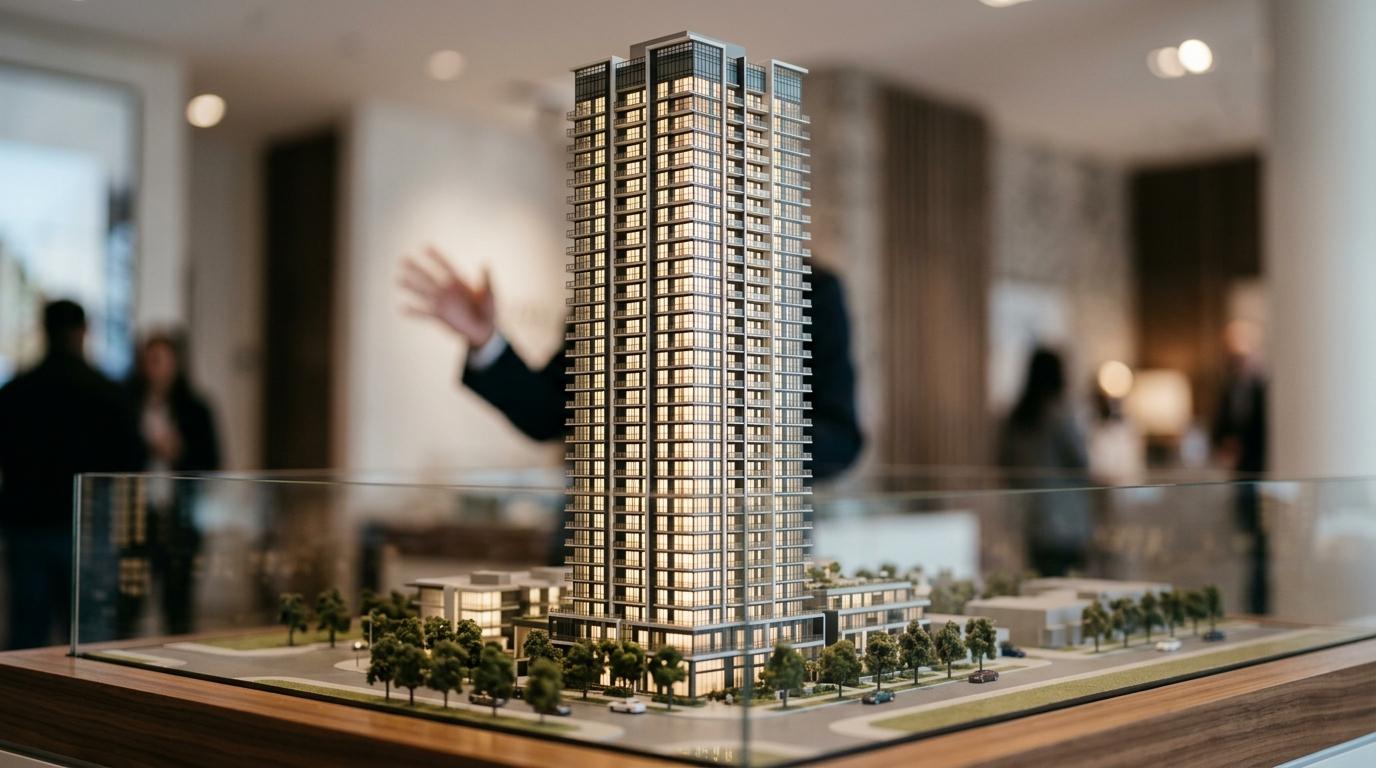
In practice, the term covers both physical and digital assets. A 1:200 illuminated tower model in a sales gallery, a 360° apartment tour on a website, and a web configurator that lets buyers compare units are all marketing models because they help a prospect move from curiosity to commitment.
The core job is simple: reduce uncertainty. If a buyer cannot picture orientation, balcony depth, amenity location or street context, the sales process slows. If they can see it clearly, questions become more commercial and less basic.
Why do marketing models still matter in off-plan property sales?
They matter because people buy what they can mentally simulate. JLL and Zillow both operate in markets where visual proof changes response quality faster than plan sheets alone.
A common misconception is that digital content has replaced physical models. It has not. Physical models remain strong in premium sales suites because they make scale and neighbourhood relationships obvious in seconds. Digital tools extend that effect to remote buyers, repeat viewings and lead capture.
The strongest use case is off-plan. When the building is not there yet, every decision depends on trust. Marketing models support that trust by turning abstract claims into something visible, comparable and easier to test against objections.
How do physical scale models compare with digital twins for trust and conversion?
Physical models win on immediate trust and shared viewing, while digital twins win on reach and repeatability. ARI Model and Matterport represent two ends of that spectrum.
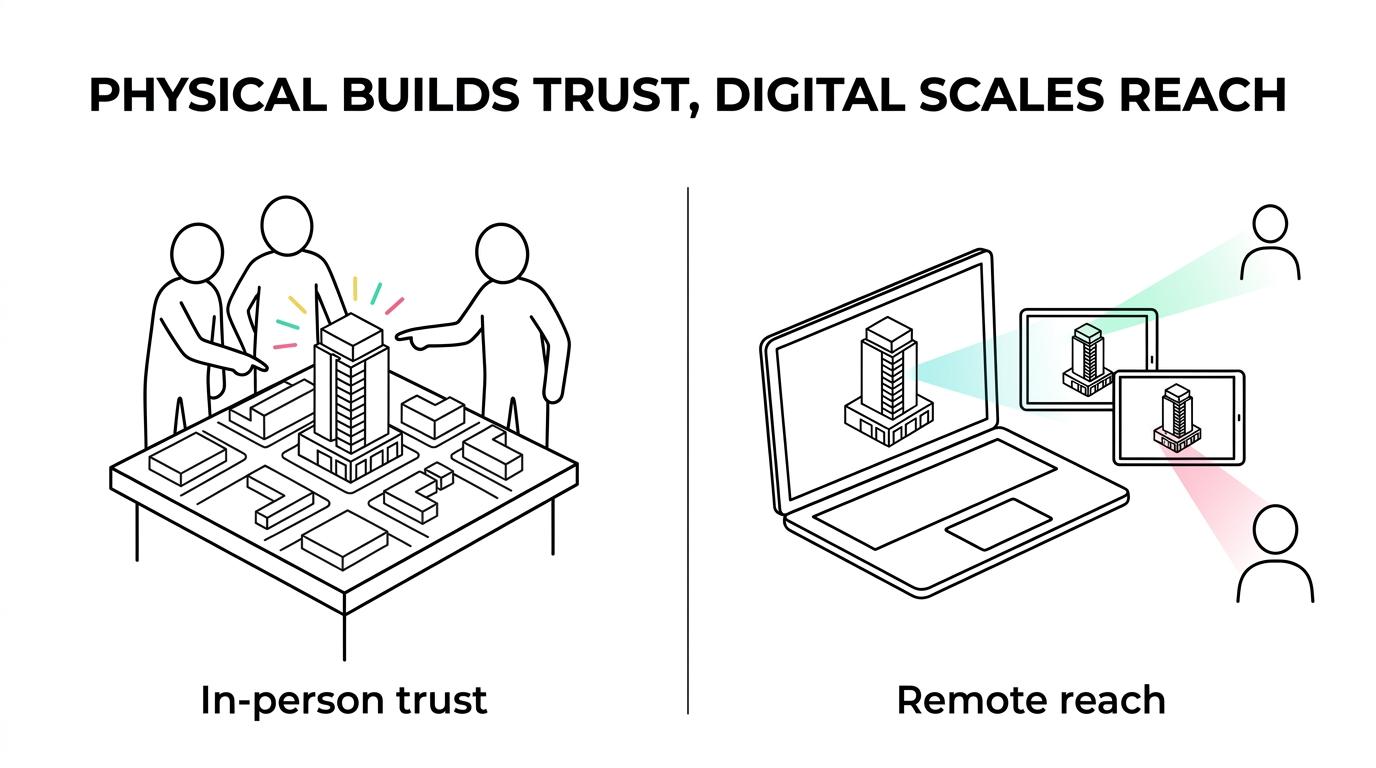
A physical model is often best when the sales environment is controlled and high stakes. Investors, planners and family buyers can gather around one object, point at streets, compare blocks and discuss phasing without learning a device interface. Typical scales follow accepted presentation practice: 1:500 for masterplans, 1:200 for building exteriors, 1:100 or 1:50 for interiors and key amenity areas.
A digital twin is stronger if prospects are dispersed or the scheme needs frequent updates. If unit availability changes daily, or if your buyers are overseas, a cloud-based 3D model usually offers better long-term efficiency. It also produces analytics. If viewers spend most of their time in penthouse units or rooftop scenes, the sales team learns what is drawing intent.
The trade-off is maintenance. Physical models are expensive to revise once façades, landscaping or phasing change. Digital twins are easier to update, but they need content governance, hosting and device testing. If the project is stable and prestige-led, go physical first. If the project changes often or must scale remotely, lead with digital.
Which property marketing model specialists are worth benchmarking?
Benchmarking matters because no single supplier dominates every format. ARI Model, Matterport and The Boundary are useful reference points for different production cultures and outcomes.
- ARI Model: Best benchmark for physical architectural, urban planning and interactive presentation models. Its published offer covers design, fabrication, lighting, delivery and installation, with 499+ models across 17 countries since 2000.
- Matterport: Strong benchmark for digital twins and browser-based remote walkthroughs where analytics, portfolio scale and repeat access matter.
- The Boundary: Useful benchmark for high-end CGI, animation and immersive real-time property visualisation.
- Habiteo: Relevant benchmark for web sales platforms, configurators and unit selection workflows.
- Zillow 3D Home: A practical benchmark for lower-friction 360° tour distribution on mainstream property listings.
The useful lesson is not vendor ranking. It is format fit. A model maker, a proptech platform and a render studio solve different parts of the same sales problem.
What are the 10 property marketing model types used today?
The market now uses a hybrid stack. ARI Model-style scale models and Matterport-style digital walkthroughs usually sit alongside CGI, video and online configurators rather than replacing one another.
- Physical architectural scale models
- Interactive physical models with lighting
- Photorealistic CGI stills
- Animated walkthroughs and flythroughs
- 360° virtual tours
- Digital twins and interactive 3D walkthroughs
- Virtual reality property experiences
- Augmented reality property visualisation
- Interactive online platforms and 3D configurators
- 3D printed presentation and prototype models
These types group into three broad jobs. Physical models explain scale, context and prestige. Screen-based assets distribute the project at low friction. Immersive and configurable tools help buyers test choices, views and finishes before they commit.
Many teams assume the “best” model is the most advanced one. Usually the best model is the one that removes the next buying objection fastest.
How do you choose the right property marketing model mix for a project?
The right mix starts with the sales environment. A residential tower in London and a logistics park near Munich may both need models, but not the same ones.
Step 1: Define the decision you need the prospect to make. If the goal is first attention, CGI and short animation often work well. If the goal is investment approval or premium showroom persuasion, a physical model may justify its cost. If the goal is remote qualification, a digital twin or 360° tour is often the better first asset.
Step 2: Match the format to project volatility. If the design is still changing every week, avoid overcommitting to a highly finished physical model. Use CGI, modular sections or a digital environment first. If planning is approved and the massing is fixed, a permanent presentation model becomes much safer.
Step 3: Match the format to audience and budget. Planners and investors often value masterplan clarity. End buyers may care more about unit view, kitchen finish and balcony depth. A common mistake is spending heavily on a hero model while leaving no budget for web distribution, CRM capture or update cycles.
How do you turn CAD or BIM files into a presentation-ready marketing model?
The process is structured, and file quality drives outcome quality. Revit and Rhino can feed both physical fabrication and digital presentation, but only if geometry, levels and materials are cleaned first.
Step 1: Prepare source files for the chosen output. For physical models, teams usually simplify hidden geometry, define cut lines, confirm scale and set lighting zones early. For digital models, they optimise polygon counts, establish camera logic and organise materials. If BIM is at roughly LOD 200 to 300, that is often enough for marketing extraction without dragging in construction-level clutter.
Step 2: Select the build method. CNC and laser cutting suit repeated planar parts, while SLA, SLS or PolyJet suit fine details and complex geometry. This is where rapid prototyping helps. ARI Model publicly lists FDM, PolyJet, SLA and SLS because each process handles different tolerances, finishes and speeds.
Step 3: Finish for the actual viewing distance. People often over-specify microscopic detail that no one will see. A model seen from 1.5 metres needs different finish priorities than a hand-held investor miniature. Lighting, glazing, landscaping and base labelling usually influence perceived quality more than adding another invisible façade layer.
How should a sales team use a model in a showroom, roadshow or trade fair?
A model works best when it anchors a guided story. Sales galleries and MIPIM-style exhibition stands get stronger results when the model supports the script, not when it sits as décor.
Step 1: Open with context, not features. Start with orientation, access routes, neighbourhood anchors and amenity placement. Buyers need to place the project in the city before they care about finishes. This is where masterplan models and lit zone controls do their best work.
Step 2: Move from shared view to personal relevance. After the general introduction, switch to the prospect’s likely unit type, budget band or use case. If a model is interactive, highlight circulation, views, or phased delivery rather than pressing every light effect. Too much interactivity can feel theatrical rather than informative.
Step 3: Connect the physical asset to a digital follow-up. If the buyer leaves with only a brochure, recall drops. If they leave with a QR-linked 360° tour, CGI pack or configurator session, the conversation continues at home. The common failure is treating the showroom model and online journey as separate systems.
Which is better for buyer engagement: CGI, animation, 360 tours, VR or AR?
No single format wins every brief. CGI and animation are best for broad reach, while 360°, VR and AR perform better when the viewer needs spatial confirmation.
CGI stills are fast to circulate and easy to control, so they are ideal for launch pages, hoardings and investor decks. Their weakness is that they are static. Buyers can admire mood but still fail to understand circulation or room proportion.
Animation adds narrative. It is useful when you need to show arrival sequence, amenity life or skyline position. The downside is passivity. Viewers see the route you chose, not the questions they want to test.
360° tours are the low-friction middle ground. They work well on mobile and can be produced at lower cost than a full interactive environment. Yet they do not fully explain volume or adjacency.
VR offers the highest sense of presence, especially for unbuilt premium residences. The trade-off is headset friction, staffing and variable comfort. AR is excellent for site-based explanation and tabletop placement, but outdoor light, tracking and device capability can weaken the experience.
A frequent misconception is that VR automatically produces the highest conversion. Often it does not. If a buyer will never put on a headset, then a browser-based 360° tour or digital twin will outperform it simply because more people complete the experience.
When do interactive lighting, configurators and rapid prototyping add the most value?
They add value when the project has complexity that static images cannot explain. Cargo Beamer-style interactive models and Habiteo-style configurators both work because they turn options into visible choices.
- Interactive lighting: Best for phasing, unit stacks, transport flows and amenity zoning.
- Configurators: Best for finish options, unit comparison, lead capture and upgrade paths.
- Rapid prototyping: Best for fast concept testing, repeatable parts and detailed geometry.
- Hybrid physical plus digital setups: Best for premium sales suites that also need remote follow-up.
The trade-off is operational discipline. Lighting systems need durable controls, configurators need clean inventory data, and rapid prototyping still needs hand finishing if the end use is a prestige presentation rather than an internal review.
What mistakes reduce the ROI of property marketing models?
Poor brief definition is the biggest failure point. Revit files, physical workshops and render engines can only solve a clear communication problem, not a vague one.
The first mistake is choosing scale before choosing viewing behaviour. If the model is for a room where people stand two metres away, overly fine detailing raises cost without improving comprehension. The second is separating marketing from technical input. If the architect, sales team and fabricator do not lock the same approved geometry, revisions multiply.
The third mistake is ignoring update logic. If landscaping, façade treatment or unit release phases are likely to shift, design the model or digital asset with revision in mind. Modular bases, removable blocks and reusable real-time scenes protect budget later.
The fourth is treating every audience the same. Investors may need capex confidence and site context. End buyers may need daylight, view corridor and kitchen layout. If the story changes, the model should change with it.
A final misconception is that the object alone does the selling. It does not. The model is strongest when it sits inside a wider system of scripts, digital follow-up, CRM capture and clear next steps.