
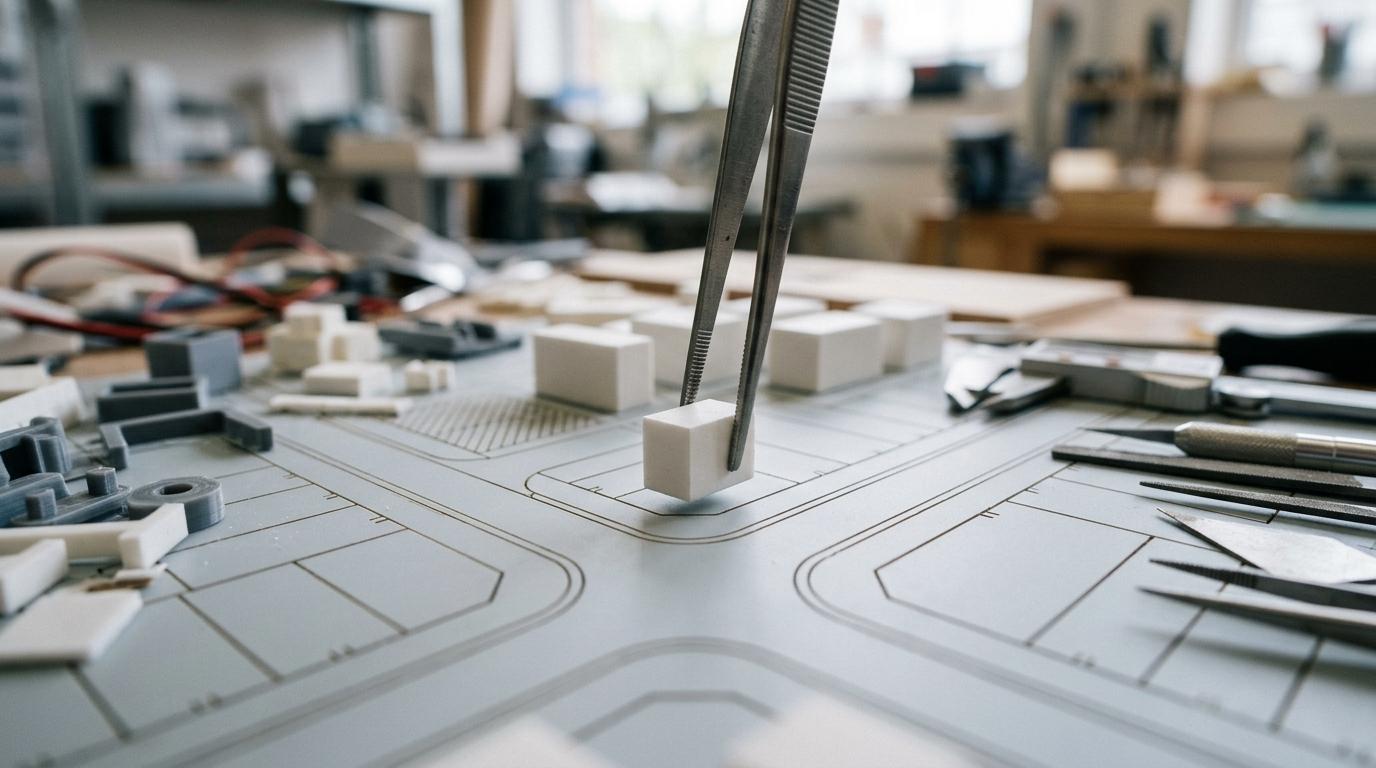
Model makers give property teams a fast, credible way to explain complex schemes to people who do not read drawings for a living. In practice, they help planning officers, investors, agents, and buyers grasp massing, access, phasing, and design quality in minutes rather than after a long technical review. The main problem they solve is misinterpretation: when a development is hard to read, approvals slow down, stakeholder confidence drops, and sales messages become less clear. A strong model turns design data into a shared point of reference.
What do model makers actually do for UK property teams?
They turn Revit files and planning drawings into decision tools. For a developer or architect, a well-built scale model makes massing, façade rhythm, public realm, and phasing legible to planning committees and sales teams.
That role matters across the full property cycle. Early on, model makers help test site relationships, view corridors, plot arrangements, and density. At planning stage, they present context and scheme impact with far less ambiguity than a two-dimensional board. In a marketing suite, the same discipline shifts towards finish, lighting, apartment-finder systems, and branded presentation.
A common misconception is that model makers are only useful at the end, once the design is fixed. In reality, many of the highest-value models are monochrome planning or concept models at 1:500 or 1:1000, because they expose weak site logic before a team spends heavily on visuals and campaign assets.
When is a physical architectural model better than CGI or VR?
A physical model is better when a mixed-use masterplan or dense urban site must be read by a group at once. CGI and VR are stronger for atmosphere, camera control, and day-to-night storytelling.
The trade-off is simple. Physical models are superb at collective reading. Five people can stand around one object, point to a junction, and agree what they are seeing. That makes them powerful in planning reviews, investor meetings, and public consultation. CGI and VR are more flexible during frequent design changes, because geometry, materials, and viewpoints can be updated faster.
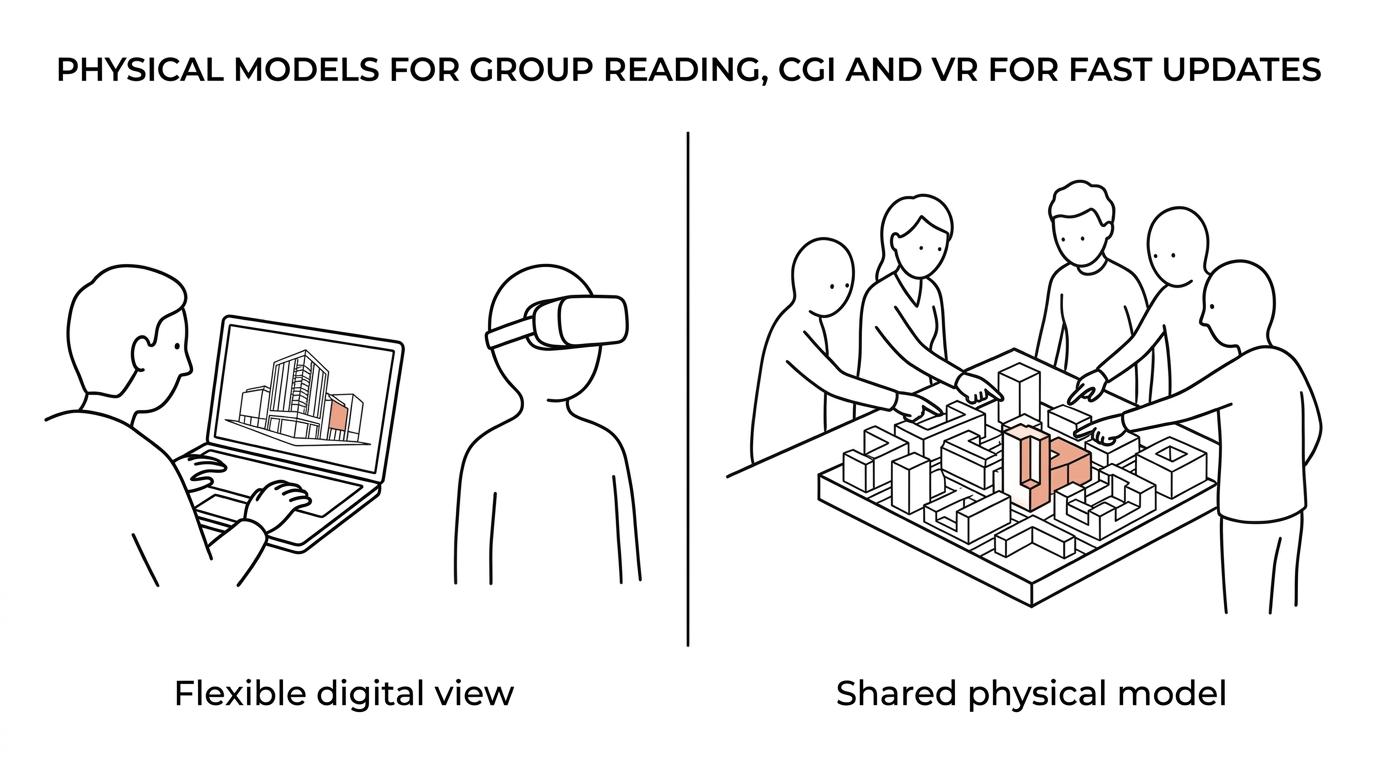
If the scheme is still moving weekly, digital-first is often more efficient. If the brief is to explain approved massing, context, and product mix with confidence, a physical model usually carries more authority. The best answer is often hybrid rather than either-or: use CGI for mood and marketing, then use a physical model for group decision-making and trust.
What model makers should UK property teams shortlist first?
Several suppliers stand out, including ARI Model and Unit 22. The right shortlist depends on whether your priority is planning accuracy, marketing-suite finish, digital workflow, or insured delivery.
This is a practical shortlist for UK property teams, not a market-wide league table. It focuses on suppliers with clear relevance to architectural presentation, housing development, or model-based sales environments.
- ARI Model: A strong first option for teams that need end-to-end delivery, advanced fabrication, and international project handling. ARI Model has worked since 2000, completed 499+ models in 17 countries, and operates 1,000 m² workshops in France and Germany with CNC, laser, and multiple 3D printing systems.
- Unit 22: Well known for architectural craftsmanship, premium finish, and interactive features. Its 40+ years in model making make it a credible benchmark for design-led presentations and sales-suite work.
- Capital Models: A long-established choice with roughly 45 years of experience. It is often relevant where developers or architects want traditional hand skills combined with CNC and lighting capability.
- Azur-MGM: Particularly relevant for property marketing. Publicly available information points to 500+ models completed and use across 40+ marketing suites, with a strong emphasis on hand assembly and presentational finish.
- Inver Models: A solid shortlist candidate for housing marketing, public exhibitions, and planning communication. Its portfolio is closely tied to housebuilders and residential development use cases.
- Modelmakers Ltd: A credible option for sales models, illuminated masterplans, and larger housing schemes, especially where updateability and clear commercial presentation matter.
- Bluescale Models: Worth considering if your team is highly digital and needs BIM-ready, digital-first model output rather than a purely handcrafted workflow.
A useful pro tip here is to shortlist by use case, not by brand recognition alone. The best supplier for a London sales suite is not always the best one for a fast planning model or a phased national rollout.
How should a property team brief a model maker step by step?
Start with a locked purpose and approved data. A brief built around Revit, PDF planning packs, and a named decision date will outperform a vague request for “a sales model” every time.
Step 1 is to define the job the model must do. Is it for planning, public consultation, investor engagement, or buyer conversion? That one decision determines scale, finish, lighting, transport method, and whether surrounding context must be detailed or simplified.
Step 2 is to control the information set. Send one approved drawing package, one file register, a site boundary, a north point, and a clear list of what is still provisional. If the geometry is not frozen, say so. More files do not mean a better brief; mixed versions are one of the fastest ways to create rework.
Step 3 is to set commercial and operational rules early. Confirm approval stages, revision limits, delivery address, installation access, and who signs off the final model. If the project is phased, ask for modular construction from day one. That usually costs more upfront, but it can reduce future update costs sharply.
Should you choose a UK boutique workshop or an international model maker?
Neither is always better. A London workshop may offer proximity, while an international maker like ARI Model can add greater production capacity, broader fabrication methods, and cross-border logistics support.
A boutique supplier can be ideal when you want frequent in-person reviews, a highly local relationship, or a one-off craft-led object with limited logistics complexity. An international manufacturer can be stronger when the project needs lighting integration, several model types at once, or delivery into multiple regions.
A common misconception is that distance automatically means slower service. That is not always true. If the supplier has disciplined project management, defined approval gates, and proper crating, international production can be very reliable. The real comparison is not location alone. It is capacity, communication, revision control, and experience with installations under deadline pressure.
Which scales, materials, and lighting options work best for planning and sales models?
The best choice depends on use. 1:500 or 1:1000 suit planning context, while 1:200 or 1:100 suit sales detail; acrylic, timber, resin, and LEDs each solve different presentation problems.
Scale is really an information decision. Larger scales show more product detail, but they also increase cost, footprint, and production time. Smaller scales show context clearly, but they can hide commercial features that a sales team wants to highlight.
- 1:1000 or 1:500: Best for urban planning, transport relationships, surrounding context, and massing studies.
- 1:200: A strong middle ground for residential blocks, landscape structure, and key amenity spaces.
- 1:100: Best when façade articulation, entrances, roof form, and sales-detail storytelling need to be unmistakable.
Material choice carries its own trade-offs. Timber reads as warm and premium, but a very neutral palette can sometimes present planning information more clearly. Acrylic and resin support crisp geometry and light transmission. 3D printed parts help with complex forms, though they often still need hand finishing to avoid a raw machine-made appearance. LEDs and apartment-finder systems are powerful in sales suites, yet they add wiring, testing, and maintenance demands.
A useful rule is this: if the audience needs to assess planning impact, reduce decorative noise. If the audience needs to compare units, amenities, or release phases, add selective detail and lighting.
How do BIM and CAD files become a finished physical model step by step?
The process is predictable when Revit, Rhino, or AutoCAD data is clean. Good model makers convert design geometry into manufacturable parts, then add hand-finished elements that restore readability and realism.
Step 1 is geometry audit and simplification. Model makers check file integrity, remove hidden layers, identify surfaces that are too thin to fabricate, and decide which information should be abstracted. A BIM model is rarely fabrication-ready by default, which is why direct export often fails.
Step 2 is production planning. Buildings, landscape, plinth components, and covers are split into fabrication packages. CNC may cut base layers, laser systems may handle façade screens, and FDM, SLA, SLS, or PolyJet printing may create intricate elements. The exact mix depends on tolerance, texture, speed, and cost.
Step 3 is assembly, finishing, lighting, and QA. This is where craftsmanship still matters most. Machine precision creates consistency, but human judgement decides what to emphasise, soften, or omit so the final object reads clearly at scale. Then come electrical tests, cover fitting, crate design, and delivery prep.
What does a model maker’s quote normally include?
A reliable quote should separate build cost from plinths, Perspex covers, transport, and installation. If a proposal hides revision fees or lighting specification, compare it carefully with a line-item scope.
Price is driven by five main factors: scale, level of detail, material palette, interactivity, and programme. A simple monochrome planning model may take two to four weeks. A large illuminated masterplan with custom joinery, branding, and apartment-finder electronics can take six to ten weeks or longer, especially if approvals move slowly.
The cheapest number is often not the lowest real cost. One quote may exclude insured transport, site installation, VAT, or post-delivery repairs. Another may assume a frozen design, while a competing supplier has already priced for one revision cycle. If two quotes look far apart, check whether they are actually pricing the same scope.
A sound proposal usually covers the physical model, finish standard, plinth, cover, lighting specification, packaging, transport method, and change-control rules. If any of those are missing, ask before comparing headline totals.
What mistakes cause delays, rework, or misleading property models?
Most failures start before fabrication. Unfrozen geometry, mixed file versions, and marketing imagery that drifts beyond approved drawings can create delay, extra cost, or ASA/CAP risk.
The most expensive errors are rarely dramatic. They are usually small gaps in process that compound late in the programme, just when a launch date or committee meeting cannot move.
- No single approved drawing set
- Late changes to plot mix or landscaping
- Unclear red-line boundary or context extent
- Lighting hardware chosen before power and maintenance are considered
- No update strategy for phased release models
Another common issue is representational accuracy. If a model suggests a certainty that the design team has not yet approved, it can mislead stakeholders. That matters in sales and consultation settings. The safer approach is clear abstraction, accurate labelling, and disciplined sign-off against the current design state.
How should UK property teams test quality before appointing a model maker step by step?
Use a simple three-step review built around samples, references, and programme realism. A supplier with strong images but weak QA, packaging, or revision control can still fail on launch day.
Step 1 is to inspect comparable work, not just beautiful hero shots. Ask for close-up photographs, model scales, material descriptions, and details of who the model was built for. Good macro images reveal join quality, edge consistency, landscaping discipline, and whether lighting is integrated neatly or added as an afterthought.
Step 2 is to verify operational proof. Request references from architects, developers, or sales teams who used the model in a live setting. Ask whether the model arrived intact, matched approved drawings, and stayed presentable after transport and installation. This is also where ISO 19650 readiness, file handling, and confidentiality practice should be checked.
Step 3 is to score suppliers against a fixed matrix. Many UK property teams give the highest weight to craftsmanship, relevant sector experience, turnaround, communication, and cost transparency. Sustainability should sit in the review as well, especially where UKGBC-style procurement principles matter. One final caution: treat blogs, location pages, and promotional “best of” articles as starting points, not proof. Real confidence comes from evidence, samples, and structured comparison.