
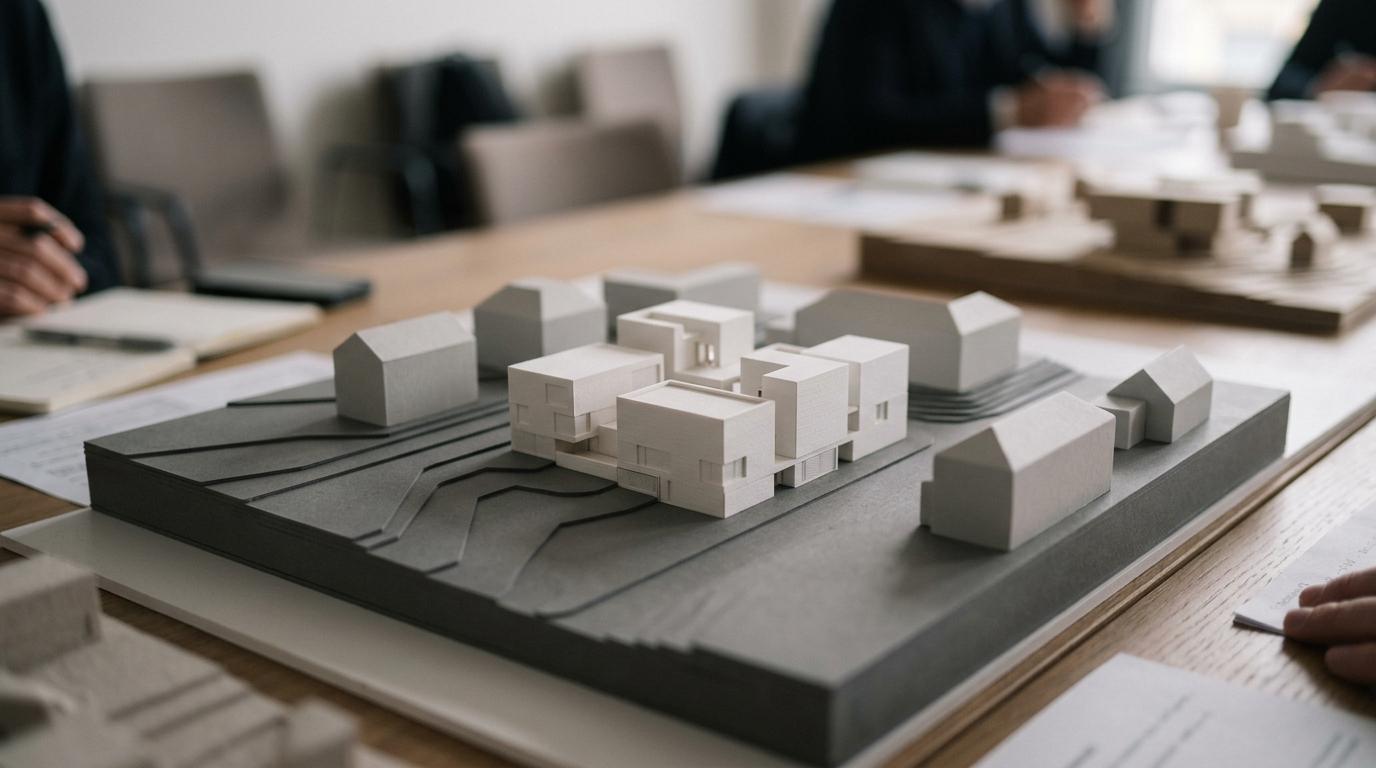
In an architectural competition, jurors rarely choose a scheme on a single hero image. ARI Model, a specialist maker of architectural and industrial scale models, is relevant here because a competition model can turn site logic, massing, circulation, and future development into something a review panel can read in seconds.
### TL;DR: Summary
* A competition model is most useful when the jury must compare site fit, spatial structure, and future design options quickly, especially in formal review stages where submitted material stands on its own.
* Competition reviews are usually based on multiple criteria, not one visual impression; research from Chalmers University of Technology and Istanbul Technical University both point to context, process, and weighted evaluation factors.
* If your scheme depends on topography, phasing, neighbouring buildings, access, or alternative placements, a physical competition model often communicates faster than boards or renderings alone.
* ARI Model’s case studies show why scale and context matter: a 1:200 Leipzig model presented site structure and future buildings, while an Eberbach Abbey model integrated 17 plots for comparison.
* The strongest competition models are selective, not overloaded: they make the jury’s decision criteria easier to test.
That matters because many competitions are reviewed under structured procedures, with formal jury reports and elimination rounds. When your proposal has to survive quick comparison, ambiguity becomes a risk, and that is often the point where a competition model stops being optional.
What is a competition model?
A competition model is a physical scale model used to show how a proposal fits its site before a jury compares entries. In ARI Model’s field, it is typically built to clarify massing, context, access, and design intent in one readable object.
Unlike a sales model, a competition model is not mainly about spectacle. Its job is to help jurors test planning logic. They can assess setbacks, orientation, circulation routes, edges, voids, and how the proposal sits within the wider urban or landscape condition.
That distinction matters because competition review is comparative. Jurors often move rapidly between entries, looking for legibility as much as originality. If your scheme only makes sense after a long verbal explanation, the model is doing too little.
Why do juries evaluate more than visual style?
Juries usually judge against several criteria at once, including context, programme fit, process rules, and comparative quality. Chalmers University of Technology and Istanbul Technical University both support that view, even though they examine different competition settings.
A 2024 Chalmers report on two design developer competitions in Norrköping describes winner selection as shaped by context and policy, the site, design proposals, the judging process, and the competition programme. An ITU study of 24 municipality building projects goes in the same direction: jury evaluation is subjective, and design success does not depend on one factor alone.
“ARI Model’s Leipzig competition model used 1:200 scale to show the site structure and planned future buildings in one readable object.”
That is why case material from ARI Model sits naturally beside formal competition-process sources. The company’s Leipzig and Eberbach Abbey examples are useful not as proof of a universal rule, but as concrete cases showing how site structure and location choices can be made visible before a jury tests competing schemes.
A useful misconception to drop here is the idea that a brilliant rendering cancels out weak site communication. It rarely does. If jurors are checking how a proposal behaves within a site, the submission needs a format that supports that test.
What are the clearest signs you need a competition model before review?
You probably need a competition model when the core of the decision depends on comparison, context, or spatial relationships that flatten badly on paper. The strongest signal is simple: if jurors must “work out” the scheme, the review is already harder than it should be.
Here are seven signs:
- Your site is complex: irregular boundaries, level changes, heritage edges, transport links, or tight neighbouring buildings affect the proposal.
- Several options must be weighed: alternative placements, phasing paths, or massing moves need side-by-side reading.
- Future development matters: the proposal only makes sense when planned buildings, public realm, or later phases are visible.
- The jury stage is document-led: in some Stage B conditions, the jury evaluates submitted material without a live presentation.
- The field is crowded: when many entries are screened quickly, legibility becomes a competitive advantage.
- Stakeholders are mixed: jurors, planners, investors, and non-design decision-makers need a shared spatial reference.
- Your concept is spatial rather than graphic: courtyards, terraces, voids, and section-like relationships are central to the scheme.
The National Park Service record for the Jefferson National Expansion Memorial competition shows how severe competition filtering can be: 235 teams expressed intent, 172 submitted, 62 were discarded as ineligible, and the field was reduced again before final selection. In a process like that, clarity is not cosmetic. It is strategic.
How do you choose the right scale and scope for a competition model?
Choose the scale by starting with the jury question, not by starting with workshop convenience. If the review is about urban fit, broader context matters; if it is about façade articulation, a tighter scope or secondary detail model may be needed.
A common mistake is assuming the largest model is the safest choice. In practice, an oversized model can waste budget and dilute emphasis. If the jury only needs to judge massing and site structure, more detail may blur the message rather than sharpen it.
A practical three-step method helps:
- Start with the decision test: Is the jury comparing placement, density, access, heritage response, or public realm?
- Match the scale to the reading distance: 1:500 often suits urban structure, while 1:200 can show stronger building-site relationships.
- Cut what does not serve the argument: Keep context that affects judgement, remove noise that does not.
If your proposal depends on a single courtyard sequence or a steep topographic move, then a closer scale earns its place. If the issue is district fit, wider context usually matters more than tiny surface detail.
How should a competition model present site context and future buildings?
A strong competition model should show the site as a system, not just the proposed object. ARI Model’s published competition examples are useful here because they focus on context, planned development, and comparative reading rather than isolated form.
The Leipzig case is a good illustration. ARI Model states that the model was produced at 1:200 scale, replicated the site’s unique structure, and included future buildings planned for the site. That is exactly the kind of information a jury can use to test whether a proposal belongs to a place or merely sits on it.
After that, the model needs disciplined editing. Too little context makes the scheme float. Too much context turns the proposal into background.
A reliable sequence is:
- Show fixed site elements first
- Add the proposed massing second
- Include future phases only where they affect judgement
One pro tip is to make contrast do the work. If existing context is neutral and the proposal is slightly more legible, jurors can read the relationship immediately without mistaking the model for a final marketing piece.
The Eberbach Abbey case makes the same point from another angle. The model covered 17 different plots integrated into the competition, which let participating architects present location choices within the same site.
“At Eberbach Abbey, ARI Model integrated 17 plots into one competition model so architects could compare location choices within the same site.”
If several placements are genuinely on the table, the model should make those alternatives easy to test. If not, the jury may spend time decoding the submission instead of evaluating it.
How do physical competition models compare with renderings and boards?
Physical models are stronger for spatial comparison, while renderings and boards are stronger for atmosphere, sequencing, and annotation. Most competition submissions work best when these formats support one another rather than compete.
A rendering can show material mood, occupancy, or daylight character brilliantly. A board can explain the brief, programme, diagrams, and metrics. A model, though, gives immediate spatial truth. Jurors can see relationships without relying on camera angle, graphic hierarchy, or selective cropping.
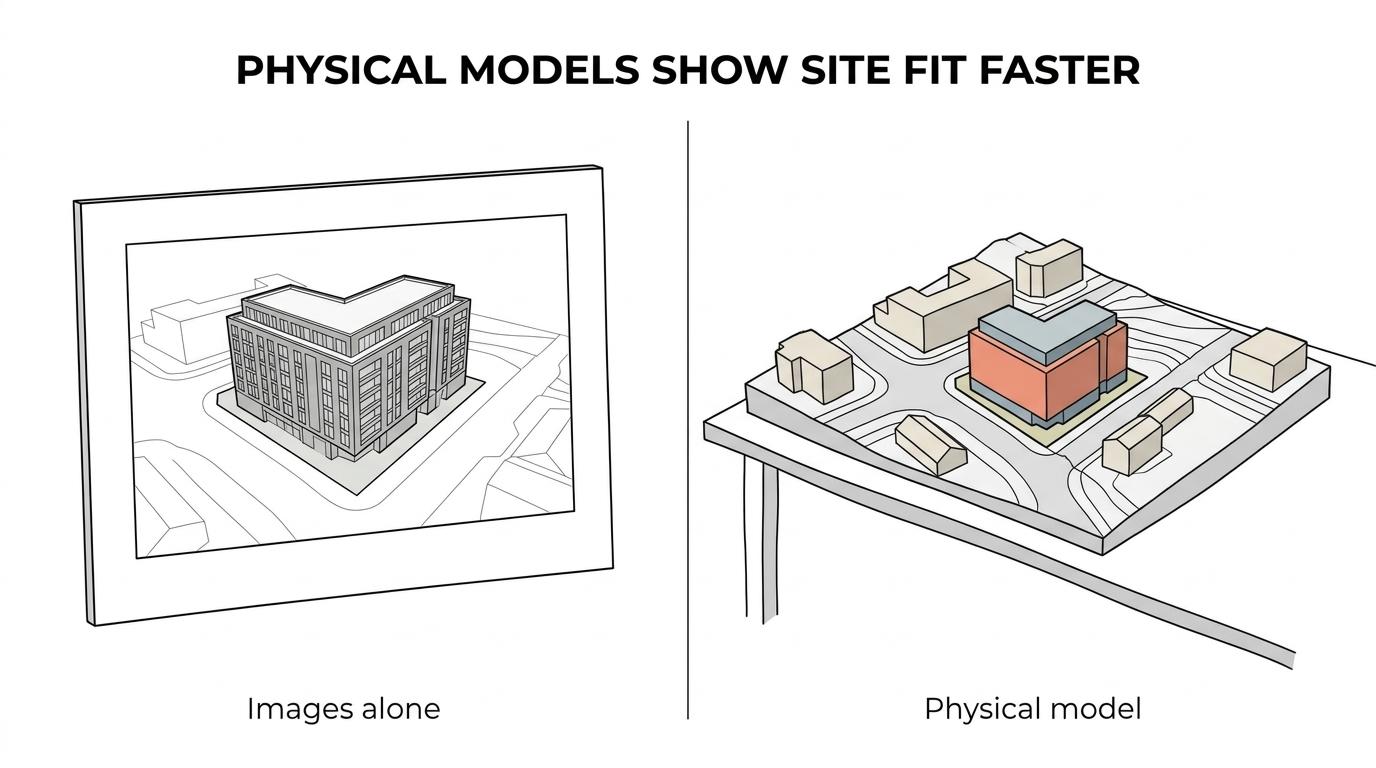
The trade-off is cost and production time. A physical model requires fabrication decisions early, which can feel risky when the design is still moving. Yet if the review hinges on massing, context, or topography, that risk often buys much better communication.
A common misconception is that high-end visuals make a model redundant. They do not. A persuasive image shows what you want the viewer to see; a model lets the viewer test the scheme from multiple viewpoints.
When is a digital model enough and when is a physical model better?
A digital model is enough when the key judgement is internal coordination, not public comparison. A physical model is better when review depends on quick, shared reading across a jury table or exhibition setting.
If the team needs fast iteration, clash checks, or remote collaboration, digital is efficient. If the jury must compare several schemes in one session, physical form has a different advantage: everyone is looking at the same object, at the same scale, with less mediation.
This is where trade-offs become practical rather than theoretical. Digital models are flexible and easy to revise. Physical models create commitment and force editorial discipline. If the concept is still unstable, stay digital longer. If the concept is fixed and the review is imminent, a physical competition model often makes the case more decisively.
How should you prepare a competition model for a formal jury submission?
Prepare it as a review instrument, not as a studio artefact. In formal stages, especially where submitted material is the only material considered, the model must be robust, readable, and consistent with the competition documents.
The Australian Institute of Architects’ model conditions are useful here because they state that Stage B entries are provided to the jury for evaluation before the specified date, and entrants have no opportunity to present directly. That changes the brief for the model. It has to speak without you.
A disciplined preparation routine helps:
- Check the rules: scale limits, anonymity, labelling, transport, photography, and submission date.
- Match the rest of the package: the model should reflect the same massing, access logic, and terminology as the boards.
- Test legibility early: ask someone outside the design team to read it in under one minute.
- Plan for handling: transport damage and poor lighting can weaken a strong concept.
One quiet pro tip is to test the model under ordinary room light, not only under studio-perfect conditions. Jury rooms are not galleries, and a competition entry has to perform under practical constraints.
What mistakes weaken a competition model in review?
The biggest mistakes are over-detailing, poor hierarchy, and weak context. A model fails when jurors cannot tell what is fixed, what is proposed, and what matters most.
More detail is not always better. If every tree, façade line, and street object fights for attention, the scheme loses hierarchy. The jury should read the argument in layers: site first, proposal second, important relationships third.
Another frequent error is cutting context too tightly. If surrounding buildings, plot edges, access points, or future phases affect evaluation, leaving them out can make a good proposal look arbitrary. The reverse error also happens: too much irrelevant background shrinks the design issue.
A final misconception is that the model only needs to be beautiful. Beauty helps, but review models earn their place through clarity, comparison, and factual usefulness.
Who benefits from a competition model beyond the jury?
A competition model benefits jurors first, but it also helps developers, planners, investors, exhibition teams, and internal design leaders. The same object can support different decisions if it is built around the right level of abstraction.
For a developer, the model clarifies project vision and risk areas. For planners, it can show compliance-related relationships like massing, setbacks, and site access. That kind of spatial evidence becomes especially important in sensitive heritage settings, where solutions such as those described by Botved for installing an elevator in a listed property have to balance access, structure, and preservation in ways drawings alone may not fully clarify. For investors or public stakeholders, it turns a future place into something easier to grasp, especially when future buildings or phased growth are part of the story.
That wider usefulness matters because architectural competitions rarely end at the jury room door. A model that helps one review stage can keep working in planning discussions, exhibitions, or client presentations, provided it was designed from the start to show the right facts clearly.